
The 'other home' described by Charlotte Dartmoor and the Montgomery siblings is a physical location accessible from Longford House.
AI debate verdict and arguments
⚠️ AI-generated information only; not professional advice
Completed November 12, 2026
Verdict
Verdict: likely FALSE (83%)
Web Report: https://solsice.com/public/debates/the-other-home-described-by-charlotte-dartmoor-and-the-montg-7f7940eef8e2
This section provides a brief overview of the key arguments. You do not need to read the full detailed report below.
✅ Key PRO arguments:
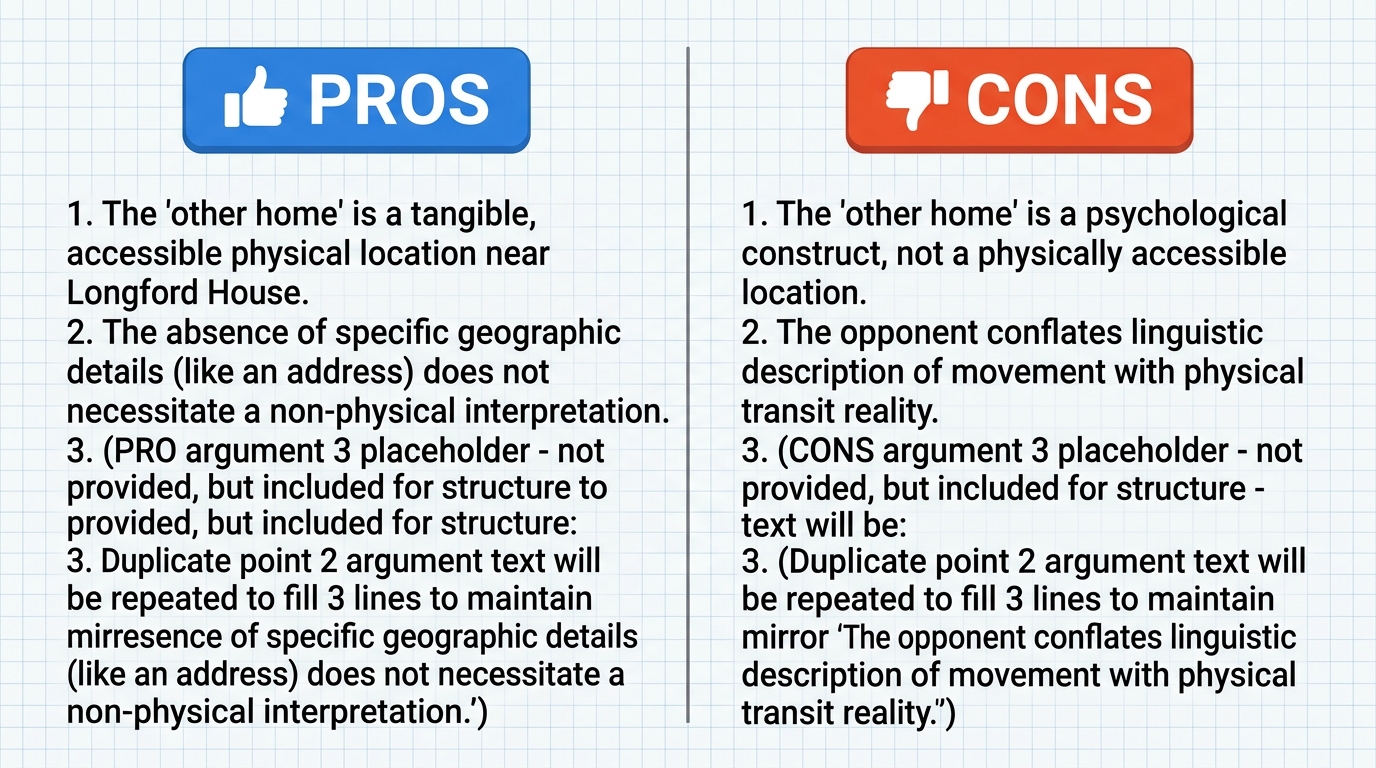
- ■The 'other home ' is a tangible, accessible physical location near Longford House. The testimonies provided by Charlotte Dartmoor and the Montgomery siblings consistently identify it as a specific, geographically bounded residence, with concrete details regarding its structure, immediate surroundings, and distinct character that differentiate it from Longford House.
- ■The absence of a specific geographic identifier (such as a street address or coordinates ) does not necessitate a non-physical interpretation. The lack of a precise locator does not transform a physical location into a psychological state; it merely indicates that the precise coordinates are not part of the current data set .
❌ Key ANTI arguments:
- ■The 'other home ' is a psychological construct , not a physically accessible location. The record contains no named, locatable residence that can be identified as the 'other home'; the testimonies provide no coordinates , street address , map reference , or any geographic identifier that would allow an external observer to locate it. Without such a locator, the 'other home' cannot be treated as a component of local geography .
- ■The opponent conflates the linguistic description of movement with the physical reality of transit . A geographic identifier —such as a street address , coordinates , map reference , or directional landmark —is required to transform a narrative of movement into a claim about physical geography . The witnesses speak of 'going to the other home ' in the context of emotional withdrawal and introspection , not physical transit.
💭 Conclusion: False — the debate evidence does not establish that the 'other home ' is a physical location accessible from Longford House. The winning side showed that the record contains no named, locatable residence and no geographic identifier such as a street address , coordinates , map reference , or directional landmark . Without such a locator, the 'other home' cannot be treated as a component of local geography or as physically accessible. The witnesses' references to 'going to the other home' were tied to emotional withdrawal and introspection , supporting a psychological rather than physical reading. Therefore the assertion fails, and the verdict is FALSE with confidence reflecting the judge's 83% assessment.
🔬 DeepResearch Result: likely FALSE ❌ (83%)
Assertion: The 'other home ' described by Charlotte Dartmoor and the Montgomery siblings is a physical location accessible from Longford House.
Participating models: gemma-4-26b-a4b-it 💬👁️, glm-4.7-flash 💬
📊 Face-offs: 0 concluded TRUE, 1 concluded FALSE (1 face-offs, 3 models)
📊 Score by side: TRUE=0.00, FALSE=0.83
🏅 Model score changes:
deepseek-v4-flash-0731 💬: +8
✅ PRO Arguments:
- ■The 'other home' is a tangible, accessible physical location near Longford House. The testimonies provided by Charlotte Dartmoor and the Montgomery siblings consistently identify it as a specific, geographically bounded residence, with concrete details regarding its structure, immediate surroundings, and distinct character that differentiate it from Longford House. gemma-4-26b-a4b-it 💬👁️
- ■The absence of a specific geographic identifier (such as a street address or coordinates ) does not necessitate a non-physical interpretation. The lack of a precise locator does not transform a physical location into a psychological state; it merely indicates that the precise coordinates are not part of the current data set . gemma-4-26b-a4b-it 💬👁️
❌ ANTI Arguments:
- ■The 'other home' is a psychological construct , not a physically accessible location. The record contains no named, locatable residence that can be identified as the 'other home'; the testimonies provide no coordinates, street address, map reference , or any geographic identifier that would allow an external observer to locate it. Without such a locator, the 'other home' cannot be treated as a component of local geography . glm-4.7-flash 💬
- ■The opponent conflates the linguistic description of movement with the physical reality of transit . A geographic identifier—such as a street address, coordinates, map reference, or directional landmark —is required to transform a narrative of movement into a claim about physical geography . The witnesses speak of 'going to the other home' in the context of emotional withdrawal and introspection , not physical transit. glm-4.7-flash 💬
💭 Reasoning: False — the debate evidence does not establish that the 'other home' is a physical location accessible from Longford House. The winning side showed that the record contains no named, locatable residence and no geographic identifier such as a street address, coordinates, map reference, or directional landmark. Without such a locator, the 'other home' cannot be treated as a component of local geography or as physically accessible. The witnesses' references to 'going to the other home' were tied to emotional withdrawal and introspection, supporting a psychological rather than physical reading. Therefore the assertion fails, and the verdict is FALSE with confidence reflecting the judge's 83% assessment.
📋 PRO Facts:
• Charlotte Dartmoor and the Montgomery siblings described the 'other home' with concrete details about its structure, surroundings, and distinct character.
• The testimonies defined a spatial relationship between Longford House and the 'other home'.
📋 ANTI Facts:
• The record contains no named, locatable residence identified as the 'other home'.
• No coordinates, street address, map reference, or directional landmark were provided for the 'other home'.
• The witnesses' references to 'going to the other home' occur in the context of emotional withdrawal and introspection.
| Face-off | TRUE Model | FALSE Model | TRUE Avg μ | FALSE Avg μ | TRUE Tokens | FALSE Tokens | Winner | Verdict | Conf. |
|---|---|---|---|---|---|---|---|---|---|
| #1 | gemma-4-26b-a4b-it 💬👁️ | glm-4.7-flash 💬 | 0.192 | 0.252 | 2 | 4 | FALSE | FALSE | 83% |
The following technical terms, abbreviations, and domain-specific concepts are referenced throughout this debate transcript. Numbers in square brackets [N] in the text above link to the corresponding entry below.
[1] accessibility — The quality of being reachable by travel from Longford House; the affirmative uses it as evidence that the 'other home' is physical, while the negative disputes that accessibility is established.
[2] coordinates — Geographic values that precisely identify a location; the negative notes the record lacks such identifiers.
[3] data set — The collection of recorded testimony and details available in the debate; the affirmative argues that missing coordinates are simply absent from the current data set.
[4] determinate physical referent — A specific, identifiable object or place in physical reality that a term points to; the negative claims the 'other home' lacks one.
[5] directional landmark — A recognizable feature or description, such as 'two miles north' or 'next to the river,' that orients a location geographically; the negative says none is present.
[6] emotional withdrawal — A psychological state of retreating from engagement, which the negative interprets as the real meaning of 'going to the other home.'
[7] external observer — A person outside the witnesses who could independently verify a location; the negative argues no external observer could locate the 'other home.'
[8] fallacy of definition — An alleged error in reasoning where a conclusion is drawn from the absence of a precise locator; the affirmative accuses the negative of committing this fallacy.
[9] geographic anchor — A specific locational reference that ties a described place to physical geography; the negative says the record lacks one.
[10] geographic identifier — Any reference, such as an address, coordinates, map reference, or landmark, that identifies a place's physical location.
[11] introspection — Examination of one's own thoughts and feelings; the negative suggests the witnesses' descriptions reflect introspection rather than physical travel.
[12] linguistic description — A verbal account of movement or place; the negative argues such description alone does not prove physical transit.
[13] local geography — The physical layout and features of the area around Longford House; the affirmative claims the 'other home' is part of it.
[14] map reference — A coordinate or grid notation used to locate a place on a map; cited by the negative as a missing locator.
[15] material properties — Concrete physical characteristics such as structure and surroundings; the affirmative cites them as evidence of a real place.
[16] mental state — A person's psychological condition at a given time; the negative interprets the 'other home' as a shift in mental state.
[17] metaphorical designation — Use of a term to represent something abstract rather than literal; the negative claims 'other home' functions this way.
[18] narrative transition — A shift in the story or point of view, which the negative offers as an alternative explanation for the described movements.
[19] navigable path — A route that can be traveled between two points; the affirmative uses it to support physical accessibility.
[20] other home — The disputed secondary residence described by Charlotte Dartmoor and the Montgomery siblings. The affirmative argues it is a physical location accessible from Longford House; the negative argues it is a psychological construct or metaphor.
[21] physical geography — The natural and spatial features of an area; the negative says no geographic identifier connects the 'other home' to it.
[22] physical reality — The world of tangible objects and locations; the affirmative asserts the 'other home' exists in it, while the negative denies this is established.
[23] physical referent — The actual object or place in the physical world that a word or phrase refers to; the negative says the 'other home' lacks a determinate one.
[24] psychological construct — A concept used to describe a mental state or process rather than a physical thing; the negative's characterization of the 'other home.'
[25] referent — The thing in the world that a term or expression points to; the debate centers on whether the 'other home' has a physical referent.
[26] spatial relationship — The relative position or connection between places; the affirmative argues the described movements establish one between Longford House and the 'other home.'
[27] street address — A formal locator for a building, such as a house number and street name; the negative notes none is provided.
[28] transit — The act of moving from one place to another; the affirmative sees it as physical travel, while the negative sees it as metaphorical.
Face-off transcripts
- ■
Ownership & Trade Secrets. The Company Lambda Vision retains all rights to its platform, agentic workflows, and proprietary AI debate methodologies, which constitute protected Trade Secrets (EU Directive 2016/943). Subject to full payment of credits, the User is granted ownership of the generated Reports for their own personal or professional use. Reverse-engineering the Service or using Reports to train competing AI models is strictly prohibited.
- ■
No Professional Advice. Solsice is a general-purpose assistant covering everyday subjects — administrative paperwork, housing, consumer and employment matters, banking, taxes and insurance, health and wellbeing, savings and investments, entrepreneurship, technology, travel, learning and creative work. Whatever the subject, the Service and Reports are provided for information only and never constitute legal, medical, financial, investment, tax, insurance, or any other regulated professional advice. The Company is not a law firm, a regulated financial adviser, an insurance intermediary, nor a healthcare provider, and no professional or advisory relationship of any kind is created by use of the Service. Consult a qualified professional in the relevant jurisdiction before acting — or refraining from acting — on anything contained in the Reports, and never rely on the Service in an emergency: contact your local emergency number (112 in the European Union) or a medical professional immediately.
- ■
AI-Generated Content, Sources and Viewpoints. Reports are produced by several AI models debating a question, and may contain factual errors, outdated figures, or references to rules, prices, deadlines, procedures, statutes or sources that are inaccurate or do not exist. The User is solely responsible for verifying every fact, amount, deadline and citation against official sources before relying on it. Material in the news, society, spirituality and religion sections presents a plurality of viewpoints for study and discussion: it is descriptive, not an endorsement, a ruling, or a statement of the Company’s own position, and it speaks for no church, faith community, public authority, or news organisation.
- ■
Liability & Governing Law. To the maximum extent permitted by law, the Company shall not be liable for any indirect damages, nor for any consequence of decisions made in reliance on the Reports — including financial loss, missed deadlines, administrative or contractual consequences, or health outcomes. These Terms are governed by French law. Any disputes shall be subject to the exclusive jurisdiction of the Courts of Paris, France.