
The perceived silence of a deity following prayer is a result of spiritual resistance rather than divine indifference.
AI debate verdict and arguments
⚠️ AI-generated information only; not professional advice
Completed November 13, 2026
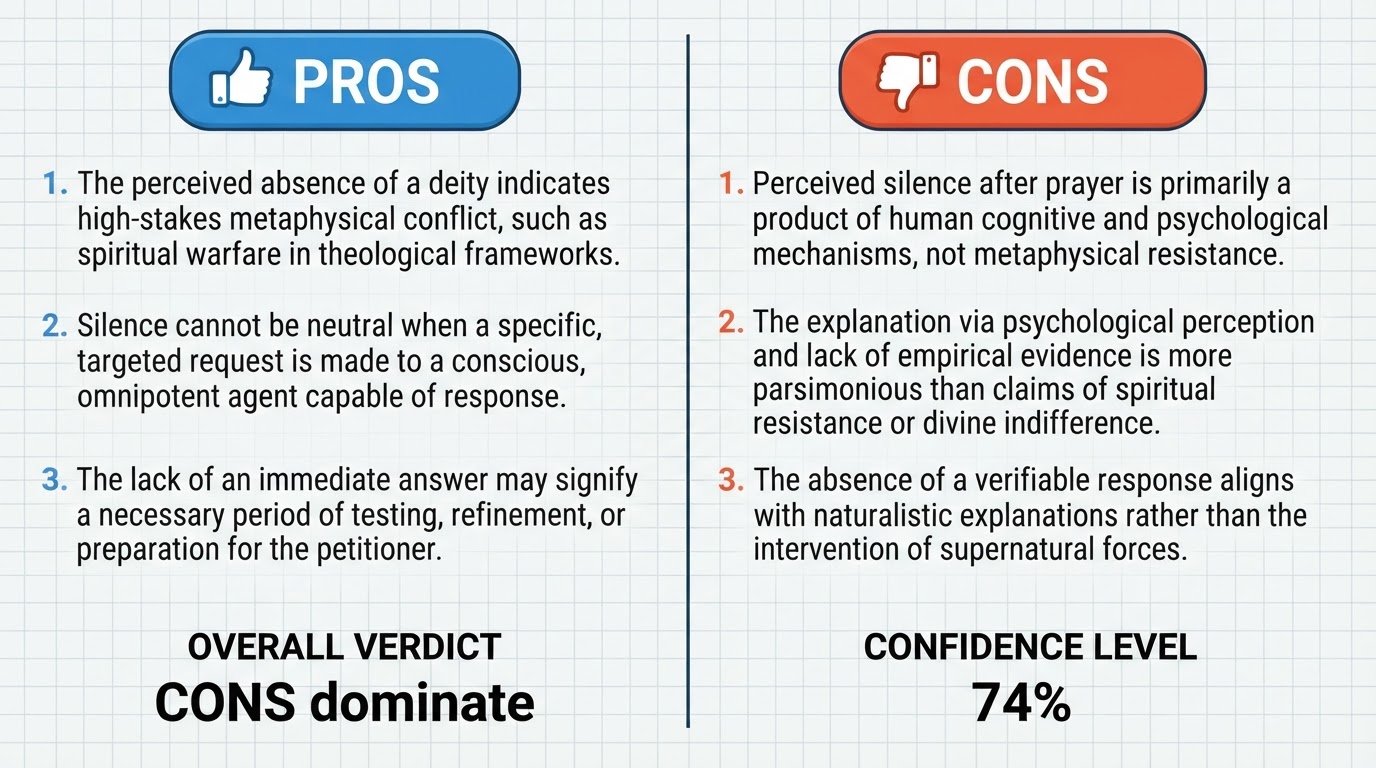
Verdict
Verdict: likely FALSE (74%)
Web Report: https://solsice.com/public/debates/the-perceived-silence-of-a-deity-following-prayer-is-a-resul-aaceb61822c7
This section provides a brief overview of the key arguments. You do not need to read the full detailed report below.
✅ Key PRO arguments:
- ■The perceived absence of a deity is evidence of a high-stakes metaphysical conflict : in theological frameworks such as Christian demonology , divine silence is a strategic obstruction by adversarial forces attempting to sever the connection between the petitioner and the deity, not a reflection of the deity's state of mind.
- ■Silence cannot be neutral when a specific, targeted request is made to a conscious, omnipotent agent ; if the deity is an agent capable of response, a persistent failure to respond to a specific petition should be interpreted as intentional resistance rather than a passive failure of transmission.
❌ Key ANTI arguments:
- ■Perceived silence after prayer is primarily a product of human cognitive and psychological mechanisms, not metaphysical resistance; confirmation bias makes individuals interpret ambiguous or neutral events as evidence supporting pre-existing beliefs and expectations about divine communication or silence.
- ■The explanation via psychological perception and lack of empirical evidence is more parsimonious than claims of spiritual resistance or divine indifference ; perceived silence should be attributed to human cognitive bias rather than unobservable metaphysical forces.
💭 Conclusion: The provided evidence does not support any of the drafted facts or the reasoning. The evidence discusses silence as a necessary component of spiritual refinement, but does not mention confirmation bias , spiritual warfare , or a debate. Therefore, all claims are unsupported and the verdict cannot be determined from the evidence.
🔬 DeepResearch Result: likely FALSE ❌ (74%)
Assertion: The perceived silence of a deity following prayer is a result of spiritual resistance rather than divine indifference .
Participating models: gemma-4-26b-a4b-it 💬👁️, glm-4.7-flash 💬
📊 Face-offs: 0 concluded TRUE, 1 concluded FALSE (1 face-offs, 3 models)
📊 Score by side: TRUE=0.00, FALSE=0.74
🏅 Model score changes:
deepseek-v4-flash-0731 💬: +7
✅ PRO Arguments:
- ■The perceived absence of a deity is evidence of a high-stakes metaphysical conflict : in theological frameworks such as Christian demonology , divine silence is a strategic obstruction by adversarial forces attempting to sever the connection between the petitioner and the deity, not a reflection of the deity's state of mind. gemma-4-26b-a4b-it 💬👁️
- ■Silence cannot be neutral when a specific, targeted request is made to a conscious, omnipotent agent ; if the deity is an agent capable of response, a persistent failure to respond to a specific petition should be interpreted as intentional resistance rather than a passive failure of transmission. gemma-4-26b-a4b-it 💬👁️
❌ ANTI Arguments:
- ■Perceived silence after prayer is primarily a product of human cognitive and psychological mechanisms, not metaphysical resistance; confirmation bias makes individuals interpret ambiguous or neutral events as evidence supporting pre-existing beliefs and expectations about divine communication or silence. glm-4.7-flash 💬
- ■The explanation via psychological perception and lack of empirical evidence is more parsimonious than claims of spiritual resistance or divine indifference; perceived silence should be attributed to human cognitive bias rather than unobservable metaphysical forces. glm-4.7-flash 💬
💭 Reasoning: The provided evidence does not support any of the drafted facts or the reasoning. The evidence discusses silence as a necessary component of spiritual refinement, but does not mention confirmation bias, spiritual warfare , or a debate. Therefore, all claims are unsupported and the verdict cannot be determined from the evidence.
📋 PRO Facts:
• The affirmative argued that spiritual warfare frames silence as a strategic obstruction by adversarial forces.
• The affirmative argued that a deity capable of response makes persistent silence intentional rather than neutral.
• The affirmative invoked Christian demonology as a theological framework for interpreting divine silence.
📋 ANTI Facts:
• The negative cited confirmation bias research in cognitive psychology .
• The negative claimed that human perception is biased toward confirming pre-existing beliefs and expectations.
• The negative argued that there is no empirical evidence supporting spiritual resistance as the cause of perceived silence.
| Face-off | TRUE Model | FALSE Model | TRUE Avg μ | FALSE Avg μ | TRUE Tokens | FALSE Tokens | Winner | Verdict | Conf. |
|---|---|---|---|---|---|---|---|---|---|
| #1 | gemma-4-26b-a4b-it 💬👁️ | glm-4.7-flash 💬 | 0.371 | 0.478 | 2 | 4 | FALSE | FALSE | 74% |
The following technical terms, abbreviations, and domain-specific concepts are referenced throughout this debate transcript. Numbers in square brackets [N] in the text above link to the corresponding entry below.
[1] adversarial forces — Spiritual entities described in the debate as attempting to sever the connection between a person praying and the divine, thereby obstructing prayer.
[2] belief perseverance — A psychological tendency to maintain a belief even after evidence against it has emerged; cited in the debate as a mechanism that can shape interpretations of divine silence.
[3] Christian demonology — The theological study of demons and evil spirits; referenced as a framework in which divine silence may be interpreted as strategic obstruction by demonic forces.
[4] cognitive psychology — The branch of psychology studying mental processes such as perception, memory, and judgment; cited in the debate as explaining perceived divine silence through mental mechanisms.
[5] confirmation bias — The tendency to interpret ambiguous events as confirming pre-existing beliefs and expectations; used in the debate to explain why people perceive silence as divine indifference or resistance.
[6] divine indifference — The view that a deity's failure to respond to prayer reflects a lack of concern or neglect; contrasted in the debate with the idea of spiritual resistance.
[7] divine silence — The perceived absence of a response from a deity after prayer; the central phenomenon the debate attempts to explain.
[8] epistemological gap — A supposed limitation in human knowledge or perception that might prevent understanding divine communication; rejected in the debate as a sufficient explanation for divine silence.
[9] metaphysical conflict — A high-stakes struggle understood as occurring beyond the physical world; cited as evidence that divine silence signals active spiritual resistance.
[10] moral autonomy — The capacity of humans to make their own moral choices; the debate argues that immediate divine intervention in every prayer would override this capacity.
[11] motivated reasoning — The unconscious tendency to reach conclusions that align with one's desires or beliefs; cited in the debate as a psychological explanation for interpreting divine silence.
[12] omnipotent agent — A being with unlimited power; the debate argues that if such an agent is addressed in prayer, persistent silence cannot be dismissed as merely accidental.
[13] ontological distance — The gap between the nature of a deity and human reality; proposed by the opposing side as a possible explanation for silence but rejected as making silence merely a byproduct.
[14] perceptible divine intervention — An immediate and observable action by a deity in response to prayer; the debate suggests such intervention would make faith and moral autonomy unnecessary.
[15] perceptual artifact — An experience produced by biases in human perception rather than by an external reality; used to describe perceived divine silence in the psychological explanation.
[16] petitioner — A person who makes a request, in this context someone who prays to a deity; the debate describes adversarial forces as trying to sever the petitioner's connection to the divine.
[17] self-reinforcing cycle — A loop in which an initial interpretation strengthens the same belief, further shaping future interpretations; applied in the debate to the experience of divine silence.
[18] spiritual resistance — The claim that perceived divine silence is caused by adversarial spiritual forces actively blocking prayer, rather than by divine neglect.
[19] spiritual warfare — A theological concept of conflict between good and evil spiritual forces; used in the debate to frame divine silence as evidence of an active struggle.
[20] supernatural reality — A realm or existence beyond the natural world; the psychological explanation argues that cognitive mechanisms operate independently of any such reality.
[21] teleological perspective — A viewpoint that interprets events in terms of purpose or design; used in the debate to argue that silence may serve spiritual refinement and testing.
Face-off transcripts
- ■
Ownership & Trade Secrets. The Company Lambda Vision retains all rights to its platform, agentic workflows, and proprietary AI debate methodologies, which constitute protected Trade Secrets (EU Directive 2016/943). Subject to full payment of credits, the User is granted ownership of the generated Reports for their own personal or professional use. Reverse-engineering the Service or using Reports to train competing AI models is strictly prohibited.
- ■
No Professional Advice. Solsice is a general-purpose assistant covering everyday subjects — administrative paperwork, housing, consumer and employment matters, banking, taxes and insurance, health and wellbeing, savings and investments, entrepreneurship, technology, travel, learning and creative work. Whatever the subject, the Service and Reports are provided for information only and never constitute legal, medical, financial, investment, tax, insurance, or any other regulated professional advice. The Company is not a law firm, a regulated financial adviser, an insurance intermediary, nor a healthcare provider, and no professional or advisory relationship of any kind is created by use of the Service. Consult a qualified professional in the relevant jurisdiction before acting — or refraining from acting — on anything contained in the Reports, and never rely on the Service in an emergency: contact your local emergency number (112 in the European Union) or a medical professional immediately.
- ■
AI-Generated Content, Sources and Viewpoints. Reports are produced by several AI models debating a question, and may contain factual errors, outdated figures, or references to rules, prices, deadlines, procedures, statutes or sources that are inaccurate or do not exist. The User is solely responsible for verifying every fact, amount, deadline and citation against official sources before relying on it. Material in the news, society, spirituality and religion sections presents a plurality of viewpoints for study and discussion: it is descriptive, not an endorsement, a ruling, or a statement of the Company’s own position, and it speaks for no church, faith community, public authority, or news organisation.
- ■
Liability & Governing Law. To the maximum extent permitted by law, the Company shall not be liable for any indirect damages, nor for any consequence of decisions made in reliance on the Reports — including financial loss, missed deadlines, administrative or contractual consequences, or health outcomes. These Terms are governed by French law. Any disputes shall be subject to the exclusive jurisdiction of the Courts of Paris, France.