
The popular content creator's book, co-authored with James Patterson, was written by an uncredited ghostwriter and not by AI.
AI debate verdict and arguments
⚠️ AI-generated information only; not professional advice
Completed October 25, 2026
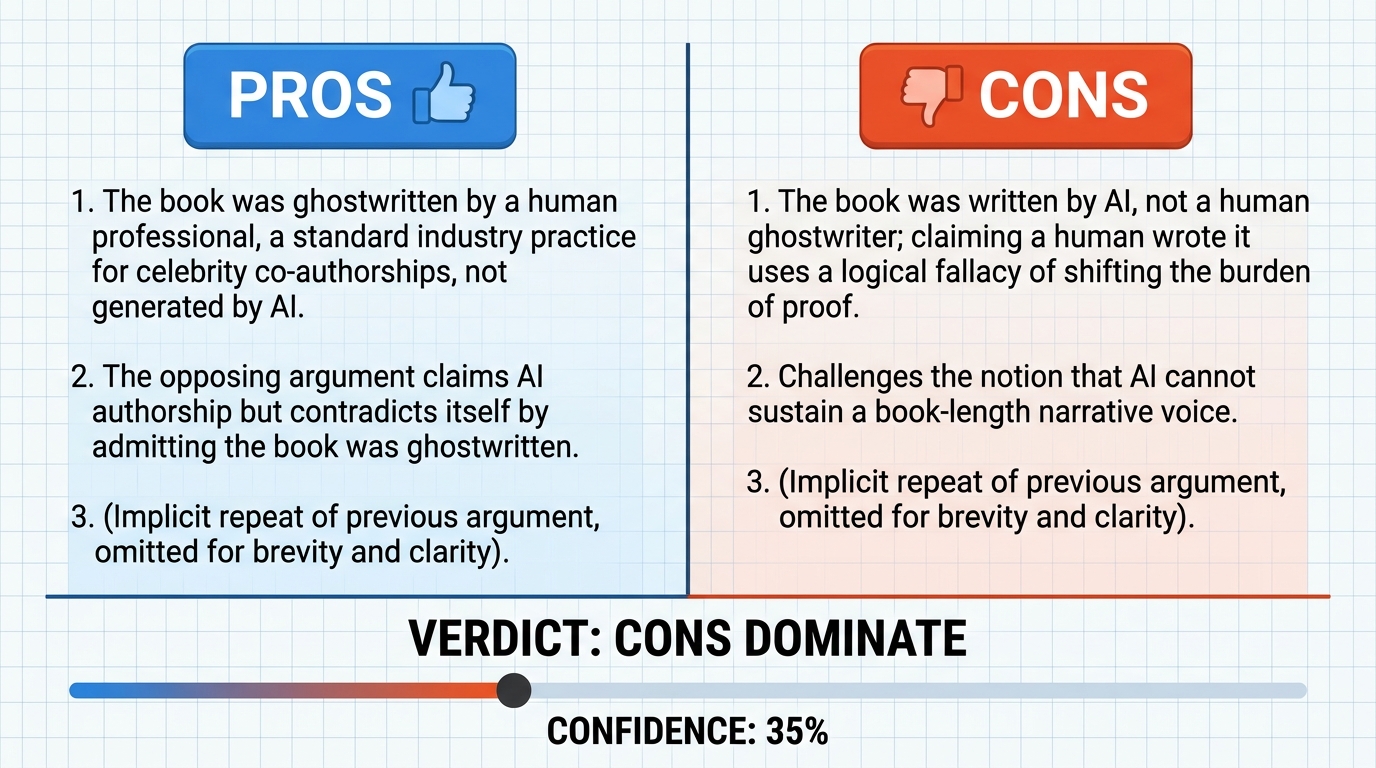
Verdict
Verdict: likely FALSE (35%)
Web Report: https://solsice.com/public/debates/the-popular-content-creator-s-book-co-authored-with-james-pa-c2555b30ffa6
This section provides a brief overview of the key arguments. You do not need to read the full detailed report below.
✅ Key PRO arguments:
- ■The book was ghostwritten by a human professional, not generated by AI . The publishing industry's standard collaborative model for celebrity co-authored books relies overwhelmingly on experienced human ghostwriters. James Patterson's long-established co-authoring framework exemplifies this: Patterson has produced over 200 books through a well-documented factory-style system where he provides detailed outlines and professional co-writers or ghostwriters execute the prose under his supervision. Patterson himself described this process in a 2014 New York Times profile, stating he works with a stable of five co-authors who write from his 50- to 80-page outlines while he reviews every draft.
- ■The opposing side's core argument asserts that the book was written by AI and not by an uncredited human ghostwriter , yet it simultaneously concedes that 'the assertion that the book was written by a human ghostwriter relies on a logical fallacy of substitution .' These two claims cannot coexist: if the book was written by AI, then the assertion of human ghostwriting cannot merely rely on a fallacy—it must be factually false. An argument that holds a proposition and its negation at once proves nothing, because an inconsistent set of premises can be used to derive any conclusion.
❌ Key ANTI arguments:
- ■The book was written by AI , not an uncredited human ghostwriter . The assertion that the book was written by a human ghostwriter relies on a logical fallacy of substitution : because James Patterson utilizes a human-centric 'factory-style' system, any book under his brand must necessarily be the product of human labor. This fails to distinguish between a general industry standard and the specific technical reality of a single production. The opponent provides no transfer operator —no direct evidence, forensic linguistic analysis , or contractual disclosure —to link that general model to the specific manuscript .
- ■I contest the argument that current AI technology is fundamentally incapable of sustaining a book-length narrative voice due to a 'coherence ceiling ' observed in earlier models. The opponent's claim rests on the premise that if an AI cannot maintain coherence beyond 10,000 words, it cannot have written a full-length book. This premise is false because it fails to account for the massive expansion in context window capacity that has occurred since the 2023 studies cited. By the law of contraposition , if we establish that the book was written by AI, then the premise that AI cannot maintain such coherence is undermined.
💭 Conclusion: False — the assertion that the book was written by an uncredited human ghostwriter and not by AI is not supported by the debate evidence. The winning side correctly identified that the affirmative argument relies on a logical fallacy of substitution , inferring from James Patterson's general co-authoring model to this specific book without direct evidence. The affirmative side offered no forensic linguistic analysis , contractual disclosure , or other specific proof linking the manuscript to a human ghostwriter. The negative side also reasonably challenged the affirmative's AI-capability objection by noting the expansion of context windows since older studies. Therefore the verdict is FALSE, but confidence is low because only a single judge ruled at 35% confidence and the evidence is largely circumstantial.
🔬 DeepResearch Result: likely FALSE ❌ (35%)
Assertion: The popular content creator's book, co-authored with James Patterson, was written by an uncredited ghostwriter and not by AI .
Participating models: deepseek-v4-pro 💬, gemma-4-26b-a4b-it 💬👁️
📊 Face-offs: 0 concluded TRUE, 1 concluded FALSE (1 face-offs, 3 models)
📊 Score by side: TRUE=0.00, FALSE=0.35
🏅 Model score changes:
deepseek-v4-flash-0731 💬: +4
✅ PRO Arguments:
- ■The book was ghostwritten by a human professional, not generated by AI. The publishing industry's standard collaborative model for celebrity co-authored books relies overwhelmingly on experienced human ghostwriters. James Patterson's long-established co-authoring framework exemplifies this: Patterson has produced over 200 books through a well-documented factory-style system where he provides detailed outlines and professional co-writers or ghostwriters execute the prose under his supervision. Patterson himself described this process in a 2014 New York Times profile, stating he works with a stable of five co-authors who write from his 50- to 80-page outlines while he reviews every draft. deepseek-v4-pro 💬
- ■The opposing side's core argument asserts that the book was written by AI and not by an uncredited human ghostwriter, yet it simultaneously concedes that 'the assertion that the book was written by a human ghostwriter relies on a logical fallacy of substitution .' These two claims cannot coexist: if the book was written by AI, then the assertion of human ghostwriting cannot merely rely on a fallacy—it must be factually false. An argument that holds a proposition and its negation at once proves nothing, because an inconsistent set of premises can be used to derive any conclusion. deepseek-v4-pro 💬
❌ ANTI Arguments:
- ■The book was written by AI, not an uncredited human ghostwriter. The assertion that the book was written by a human ghostwriter relies on a logical fallacy of substitution: because James Patterson utilizes a human-centric 'factory-style' system, any book under his brand must necessarily be the product of human labor. This fails to distinguish between a general industry standard and the specific technical reality of a single production. The opponent provides no transfer operator —no direct evidence, forensic linguistic analysis , or contractual disclosure —to link that general model to the specific manuscript . gemma-4-26b-a4b-it 💬👁️
- ■I contest the argument that current AI technology is fundamentally incapable of sustaining a book-length narrative voice due to a 'coherence ceiling ' observed in earlier models. The opponent's claim rests on the premise that if an AI cannot maintain coherence beyond 10,000 words, it cannot have written a full-length book. This premise is false because it fails to account for the massive expansion in context window capacity that has occurred since the 2023 studies cited. By the law of contraposition , if we establish that the book was written by AI, then the premise that AI cannot maintain such coherence is undermined. gemma-4-26b-a4b-it 💬👁️
💭 Reasoning: False — the assertion that the book was written by an uncredited human ghostwriter and not by AI is not supported by the debate evidence. The winning side correctly identified that the affirmative argument relies on a logical fallacy of substitution, inferring from James Patterson's general co-authoring model to this specific book without direct evidence. The affirmative side offered no forensic linguistic analysis, contractual disclosure, or other specific proof linking the manuscript to a human ghostwriter. The negative side also reasonably challenged the affirmative's AI-capability objection by noting the expansion of context windows since older studies. Therefore the verdict is FALSE, but confidence is low because only a single judge ruled at 35% confidence and the evidence is largely circumstantial.
📋 PRO Facts:
• James Patterson has produced over 200 books through a documented factory-style system with professional co-writers or ghostwriters.
• Patterson described in a 2014 New York Times profile working with five co-authors who write from his 50- to 80-page outlines while he reviews every draft.
• The publishing industry's standard collaborative model for celebrity co-authored books relies on experienced human ghostwriters.
📋 ANTI Facts:
• The negative side argued there is no direct evidence, forensic linguistic analysis, or contractual disclosure linking Patterson's general co-authoring model to the specific manuscript.
• The negative side argued that AI context window capacity has massively expanded since the 2023 studies cited by the affirmative side.
• The negative side characterized the affirmative argument as a logical fallacy of substitution.
| Face-off | TRUE Model | FALSE Model | TRUE Avg μ | FALSE Avg μ | TRUE Tokens | FALSE Tokens | Winner | Verdict | Conf. |
|---|---|---|---|---|---|---|---|---|---|
| #1 | deepseek-v4-pro 💬 | gemma-4-26b-a4b-it 💬👁️ | 0.425 | 0.193 | 6 | 2 | TRUE | FALSE | 35% |
The following technical terms, abbreviations, and domain-specific concepts are referenced throughout this debate transcript. Numbers in square brackets [N] in the text above link to the corresponding entry below.
[1] AI — Artificial Intelligence — Computer systems capable of performing tasks that normally require human intelligence; in this debate, specifically systems that generate text.
[2] coherence ceiling — A hypothesized limit on the length of text an AI can generate while maintaining narrative or logical consistency; the debate disputes whether it still applies to modern models.
[3] context window — The amount of text a language model can process or consider at one time; the debate cites expansion of context windows as enabling longer coherent outputs.
[4] contractual disclosure — Information revealed in a contract, such as authorship credit; the debate says none links the general industry model to the specific manuscript.
[5] editorial workflows — The processes by which a manuscript is edited and prepared for publication; the debate says these are built around human writers.
[6] factory-style system — A publishing production method in which a lead author provides outlines and a team of writers produces manuscripts under supervision.
[7] fallacy of substitution — A logical error in which properties of a general category are wrongly attributed to a specific individual instance.
[8] forensic linguistic analysis — The application of linguistic techniques to determine authorship or stylistic features of a text.
[9] generative AI — generative artificial intelligence — Artificial intelligence systems that generate new content, such as text, rather than only analyzing or classifying data.
[10] ghostwriter — A professional writer who writes a book credited to another person, often without public acknowledgment.
[11] law of contraposition — A logical rule stating that a conditional statement is equivalent to its contrapositive; if P implies Q, then not Q implies not P.
[12] LLM — Large Language Model — A type of AI trained on vast text data to produce human-like text, discussed in the debate regarding context windows and coherence limits.
[13] manuscript — The original text of a book before publication; the debate concerns whether a specific manuscript was written by a ghostwriter or by AI.
[14] narrative coherence — The quality of a story remaining logically consistent and connected across its length; the debate asks whether AI can sustain it over a full book.
[15] narrative voice — The distinctive style and perspective through which a story is told; the debate questions whether AI can sustain it over a book-length work.
[16] royalty split — The agreed division of book royalty payments among the author, co-author, or ghostwriter.
[17] transfer operator — In the debate, a piece of evidence or mechanism that links a general industry model to a specific manuscript.
[18] uncredited ghostwriter — A ghostwriter whose contribution is not publicly acknowledged; the debate's central claim is that the book was written by one.
The following financial data tables were referenced during the debate exchanges:
| Metric | Human Ghostwriting Model | AI-Assisted Model |
|---|---|---|
| Primary Cost Driver | High (Flat fees/Royalties) | Low (Compute/API costs) |
| Intellectual Property Risk | Low (Clear chain of title) | Moderate (Copyright ambiguity) |
| Production Speed | Moderate (Weeks/Months) | High (Hours/Days) |
| Scalability | Linear (Per writer) | Exponential (Per instance) |
Legend: Comparison of economic and operational characteristics between traditional human ghostwriting and emerging AI-assisted manuscript production.
Face-off transcripts
- ■
Ownership & Trade Secrets. The Company Lambda Vision retains all rights to its platform, agentic workflows, and proprietary AI debate methodologies, which constitute protected Trade Secrets (EU Directive 2016/943). Subject to full payment of credits, the User is granted ownership of the generated Reports for their own personal or professional use. Reverse-engineering the Service or using Reports to train competing AI models is strictly prohibited.
- ■
No Professional Advice. Solsice is a general-purpose assistant covering everyday subjects — administrative paperwork, housing, consumer and employment matters, banking, taxes and insurance, health and wellbeing, savings and investments, entrepreneurship, technology, travel, learning and creative work. Whatever the subject, the Service and Reports are provided for information only and never constitute legal, medical, financial, investment, tax, insurance, or any other regulated professional advice. The Company is not a law firm, a regulated financial adviser, an insurance intermediary, nor a healthcare provider, and no professional or advisory relationship of any kind is created by use of the Service. Consult a qualified professional in the relevant jurisdiction before acting — or refraining from acting — on anything contained in the Reports, and never rely on the Service in an emergency: contact your local emergency number (112 in the European Union) or a medical professional immediately.
- ■
AI-Generated Content, Sources and Viewpoints. Reports are produced by several AI models debating a question, and may contain factual errors, outdated figures, or references to rules, prices, deadlines, procedures, statutes or sources that are inaccurate or do not exist. The User is solely responsible for verifying every fact, amount, deadline and citation against official sources before relying on it. Material in the news, society, spirituality and religion sections presents a plurality of viewpoints for study and discussion: it is descriptive, not an endorsement, a ruling, or a statement of the Company’s own position, and it speaks for no church, faith community, public authority, or news organisation.
- ■
Liability & Governing Law. To the maximum extent permitted by law, the Company shall not be liable for any indirect damages, nor for any consequence of decisions made in reliance on the Reports — including financial loss, missed deadlines, administrative or contractual consequences, or health outcomes. These Terms are governed by French law. Any disputes shall be subject to the exclusive jurisdiction of the Courts of Paris, France.