
The primary cause of Connecticut's extreme economic inequality is the concentration of hedge funds and the finance industry in Fairfield County, which disproportionately benefits a small, wealthy population.
AI debate verdict and arguments
⚠️ AI-generated information only; not professional advice
Completed October 24, 2026
Verdict
Verdict: likely FALSE (82%)
Web Report: https://solsice.com/public/debates/the-primary-cause-of-connecticut-s-extreme-economic-inequali-db31f8c835c3
This section provides a brief overview of the key arguments. You do not need to read the full detailed report below.
✅ Key PRO arguments:
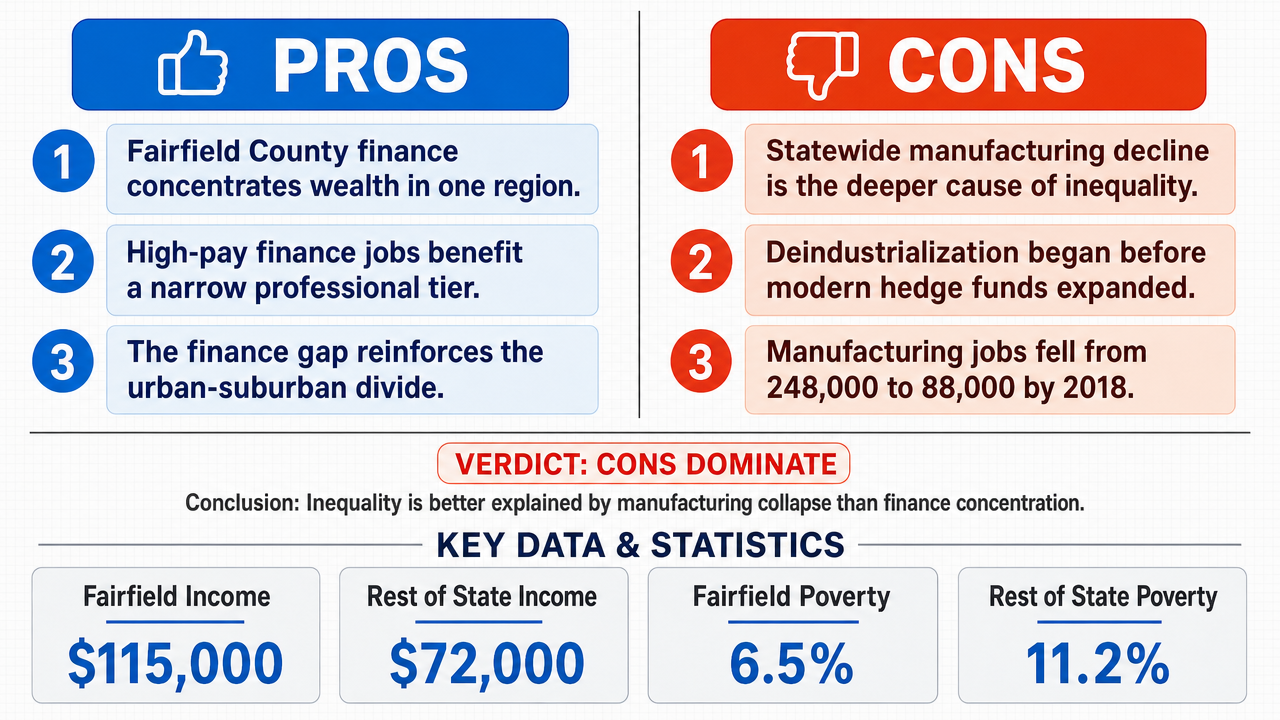
- ■The geographic concentration of high-finance capital in Fairfield County creates a bifurcated economic structure that prevents broad-based prosperity , with wealth highly concentrated and lacking significant trickle-down effects into the broader labor market .
- ■The hedge fund and private equity sectors create a localized 'wealth island ' where high wages are restricted to a narrow tier of specialized professionals, while the rest of the state experiences stagnant wage growth and rising costs of living .
- ■The urban-suburban divide is not an independent phenomenon but is fundamentally driven by the finance-vs-rest dynamic, with extreme wealth in Fairfield County's financial sector creating the suburban side of the divide.
❌ Key ANTI arguments:
- ■Connecticut's extreme economic inequality stems primarily from the statewide collapse of manufacturing and chronic underinvestment in urban centers, not from local finance concentration in Fairfield County.
- ■Structural deindustrialization occurred decades before the modern hedge fund industry emerged in Fairfield County, establishing a temporal sequence that undermines the claim that finance is the primary cause.
- ■Connecticut manufacturing employment plummeted from approximately 248,000 jobs in 1980 to just over 88,000 by 2018—a loss of more than 65% of the manufacturing workforce—destroying the bedrock of the state's middle class .
💭 Conclusion: False. The judge determined that the assertion is not supported because the primary cause of Connecticut's extreme economic inequality is more accurately attributed to the statewide collapse of manufacturing rather than the concentration of hedge funds in Fairfield County. The temporal sequence is critical: manufacturing employment fell by more than 65% between 1980 and 2018, a structural deindustrialization that predated the modern hedge fund industry's emergence. The affirmative's argument that finance concentration drives inequality was undermined by the negative's demonstration that the urban-suburban divide is itself a consequence of manufacturing collapse, not an independent phenomenon caused by finance. Furthermore, the affirmative's framing of the urban-suburban divide as the mechanism of inequality was shown to be circular, as the divide itself reflects the deeper structural economic shifts that preceded finance's rise.
🔬 DeepResearch Result: likely FALSE ❌ (82%)
Assertion: The primary cause of Connecticut's extreme economic inequality is the concentration of hedge funds and the finance industry in Fairfield County, which disproportionately benefits a small, wealthy population.
Participating models: gemma-4-26b-a4b-it 💬👁️, glm-4.7-flash 💬
📊 Face-offs: 0 concluded TRUE, 1 concluded FALSE (1 face-offs, 3 models)
📊 Score by side: TRUE=0.00, FALSE=0.82
🏅 Model score changes:
minimax-m3 💬👁️: +8
✅ PRO Arguments:
- ■The geographic concentration of high-finance capital in Fairfield County creates a bifurcated economic structure that prevents broad-based prosperity , with wealth highly concentrated and lacking significant trickle-down effects into the broader labor market . gemma-4-26b-a4b-it 💬👁️
- ■The hedge fund and private equity sectors create a localized 'wealth island ' where high wages are restricted to a narrow tier of specialized professionals, while the rest of the state experiences stagnant wage growth and rising costs of living . gemma-4-26b-a4b-it 💬👁️
- ■The urban-suburban divide is not an independent phenomenon but is fundamentally driven by the finance-vs-rest dynamic, with extreme wealth in Fairfield County's financial sector creating the suburban side of the divide. gemma-4-26b-a4b-it 💬👁️
- ■High salaries in the hedge fund industry drive up regional property values and living costs, which in turn creates the economic isolation of urban centers like Hartford. gemma-4-26b-a4b-it 💬👁️
❌ ANTI Arguments:
- ■Connecticut's extreme economic inequality stems primarily from the statewide collapse of manufacturing and chronic underinvestment in urban centers, not from local finance concentration in Fairfield County. glm-4.7-flash 💬
- ■Structural deindustrialization occurred decades before the modern hedge fund industry emerged in Fairfield County, establishing a temporal sequence that undermines the claim that finance is the primary cause. glm-4.7-flash 💬
- ■Connecticut manufacturing employment plummeted from approximately 248,000 jobs in 1980 to just over 88,000 by 2018—a loss of more than 65% of the manufacturing workforce—destroying the bedrock of the state's middle class . glm-4.7-flash 💬
- ■Manufacturing historically provided stable unionized wages and benefits that formed the middle class, and its collapse explains wage stagnation and class bifurcation better than the more recent finance concentration. glm-4.7-flash 💬
- ■The opponent's case fails because their two branches are actually the same (circular) and the first branch is empirically false, as finance concentration is not the primary cause of Connecticut's inequality. glm-4.7-flash 💬
💭 Reasoning: False. The judge determined that the assertion is not supported because the primary cause of Connecticut's extreme economic inequality is more accurately attributed to the statewide collapse of manufacturing rather than the concentration of hedge funds in Fairfield County. The temporal sequence is critical: manufacturing employment fell by more than 65% between 1980 and 2018, a structural deindustrialization that predated the modern hedge fund industry's emergence. The affirmative's argument that finance concentration drives inequality was undermined by the negative's demonstration that the urban-suburban divide is itself a consequence of manufacturing collapse, not an independent phenomenon caused by finance. Furthermore, the affirmative's framing of the urban-suburban divide as the mechanism of inequality was shown to be circular, as the divide itself reflects the deeper structural economic shifts that preceded finance's rise.
📋 PRO Facts:
• Hedge fund and private equity sectors generate immense wealth concentrated in Fairfield County
📋 ANTI Facts:
• Connecticut manufacturing employment fell from approximately 248,000 jobs in 1980 to just over 88,000 by 2018
• Manufacturing employment loss represented more than 65% of the manufacturing workforce over that period
• Structural deindustrialization occurred decades before the modern hedge fund industry emerged in Fairfield County
| Face-off | TRUE Model | FALSE Model | TRUE Avg μ | FALSE Avg μ | TRUE Tokens | FALSE Tokens | Winner | Verdict | Conf. |
|---|---|---|---|---|---|---|---|---|---|
| #1 | gemma-4-26b-a4b-it 💬👁️ | glm-4.7-flash 💬 | 0.237 | 0.540 | 4 | 4 | FALSE | FALSE | 82% |
The following technical terms, abbreviations, and domain-specific concepts are referenced throughout this debate transcript. Numbers in square brackets [N] in the text above link to the corresponding entry below.
[1] bifurcated economic structure — An economy divided into two sharply distinct sectors or tiers, often with very different income levels, employment conditions, or growth trajectories. In the debate, the affirmative describes Connecticut as split between a high-wealth finance enclave and the rest of the state's economy.
[2] broad-based prosperity — Economic growth and rising living standards that are widely shared across a population rather than concentrated among a small group. The affirmative argues that hedge fund wealth in Fairfield County does not produce this kind of widespread gain.
[3] class bifurcation — A widening split between socioeconomic classes, typically between a wealthy elite and a lower-income majority. The negative attributes Connecticut's class bifurcation to the loss of manufacturing jobs.
[4] costs of living — The expenses required to maintain a basic standard of living, including housing, food, transportation, and utilities. The affirmative argues that finance-driven wages in Fairfield County raise regional costs of living.
[5] deindustrialization — The long-term decline of manufacturing as a share of employment and output in an economy. The negative cites this as the primary historical driver of Connecticut's inequality.
[6] economic disparity — Significant and persistent gaps in income, wealth, or economic outcomes between groups or regions. The negative frames Connecticut's inequality as an economic disparity rooted in manufacturing collapse.
[7] economic inequality — The unequal distribution of income, wealth, or economic opportunity across a population. Both sides debate whether finance concentration or manufacturing collapse is the primary cause of Connecticut's economic inequality.
[8] economic isolation — A condition in which a region or group is cut off from the economic gains, investment, or opportunities enjoyed by surrounding areas. The affirmative argues that urban centers like Hartford and New Haven suffer economic isolation because of capital concentration in coastal finance hubs.
[9] false dichotomy — A logical fallacy that frames an issue as having only two mutually exclusive options when more possibilities exist. The negative accuses the affirmative of committing a false dichotomy by presenting finance as the only alternative to manufacturing collapse.
[10] false exhaustion — A logical fallacy in which a limited set of alternatives is presented as if it exhausts all possibilities. The affirmative accuses the negative of a false exhaustion of the possible causes of inequality.
[11] financial services sector — The segment of the economy comprising firms that manage money, investments, and financial transactions, including banks, hedge funds, and private equity firms. The affirmative argues that gains in this sector remain sequestered within a narrow demographic.
[12] geographic enclave — A spatially concentrated area whose population or economy is sharply distinct from surrounding regions. The affirmative describes Fairfield County as a wealth enclave whose gains do not spread to the rest of Connecticut.
[13] hedge funds — Privately pooled investment vehicles that use varied and often high-risk strategies to generate returns for wealthy and institutional investors. The affirmative identifies hedge fund concentration in Fairfield County as a driver of inequality.
[14] high-finance capital — Capital associated with sophisticated financial activities such as hedge funds, private equity, and investment banking. The affirmative argues that high-finance capital is geographically concentrated in Fairfield County.
[15] hyper-concentration of capital — An extreme accumulation of investment capital within a narrow geographic or demographic area. The affirmative argues that hyper-concentration of capital in coastal finance hubs casts a 'structural shadow' over urban centers.
[16] industrial capital — Capital invested in manufacturing and industrial production, including factories, equipment, and related labor. The negative argues that the loss of industrial capital is the root cause of Connecticut's inequality.
[17] labor market — The system through which workers and employers interact to determine wages, employment levels, and the allocation of labor. The negative describes a 'fundamental historical rupture' in Connecticut's labor market.
[18] manufacturing employment — The number of jobs in the manufacturing sector. The negative cites BLS data showing Connecticut manufacturing employment falling from approximately 248,000 in 1980 to just over 88,000 by 2018.
[19] median household income — The income level at which half of households earn more and half earn less, used as a standard measure of typical economic well-being. The affirmative cites a gap of roughly $115,000 in Fairfield County versus $72,000 in the rest of Connecticut.
[20] middle class — The socioeconomic group between the wealthy and the poor, typically associated with stable employment, home ownership, and moderate incomes. The negative argues that manufacturing historically served as the bedrock of Connecticut's middle class.
[21] poverty rate — The percentage of a population living below an officially defined poverty threshold. Both sides cite poverty rates to compare Fairfield County with the rest of Connecticut and with urban centers like Hartford and New Haven.
[22] private equity — Investment capital provided to companies or used to buy out firms, typically through pooled funds that are not publicly traded. The affirmative groups private equity with hedge funds as part of Fairfield County's high-finance sector.
[23] property values — The market prices of real estate, which reflect local demand, incomes, and desirability. The affirmative argues that high finance salaries drive up property values in Fairfield County.
[24] spatial mismatch — A condition in which jobs and the workers who could fill them are located in different geographic areas, limiting access to employment. The affirmative uses this concept to describe how finance jobs and broader labor markets are geographically separated.
[25] structural deindustrialization — A deep, long-lasting shift in an economy away from manufacturing toward other sectors, involving permanent loss of industrial capacity and jobs. The negative identifies this as the structural rupture preceding Connecticut's modern inequality.
[26] trickle-down — The theory that benefits accruing to wealthy individuals or businesses will eventually spread to the broader economy through spending and investment. The affirmative argues that hedge fund wealth does not exhibit significant trickle-down effects.
[27] ultra-wealthy — Individuals whose wealth places them far above the typical affluent population, often associated with finance, inheritance, or major business ownership. The affirmative contrasts the state's ultra-wealthy residents with the working class.
[28] unionized wages — Wages and benefits negotiated through collective bargaining by labor unions, historically associated with stable middle-class incomes. The negative argues that manufacturing once provided unionized wages that sustained Connecticut's middle class.
[29] wage stagnation — A prolonged period during which wages fail to keep pace with inflation or productivity growth. The affirmative attributes wage stagnation in the rest of Connecticut to the sequestering of finance-driven gains.
[30] wealth island — A localized area where extreme wealth is concentrated, sharply distinct from surrounding regions. The affirmative uses this term to describe Fairfield County's high-wage finance enclave.
[31] working class — The socioeconomic group whose members typically rely on wages from manual, industrial, or service-sector jobs rather than ownership of capital. The affirmative contrasts the working class with the ultra-wealthy beneficiaries of Fairfield County's finance sector.
The following financial data tables were referenced during the debate exchanges:
| Economic Indicator | Fairfield County (Approx.) | Rest of Connecticut (Approx.) |
|---|---|---|
| Median Household Income | $115,000 | $72,000 |
| Poverty Rate | 6.5% | 11.2% |
| Concentration of Top 1% Income | High | Moderate |
Legend: Comparative economic indicators between Fairfield County and the remainder of the state. Data represents generalized regional trends based on recent census and economic profiles.
| Region | Poverty Rate | Median Household Income |
|---|---|---|
| Fairfield County | 6.5% | $115,000 |
| Hartford | 24.5% | $42,000 |
| New Haven | 26.2% | $54,000 |
Legend: Poverty rates and median household income for selected Connecticut regions based on U.S. Census Bureau American Community Survey data (5-year estimates).
Face-off transcripts
- ■
Ownership & Trade Secrets. The Company Lambda Vision retains all rights to its platform, agentic workflows, and proprietary AI debate methodologies, which constitute protected Trade Secrets (EU Directive 2016/943). Subject to full payment of credits, the User is granted ownership of the generated Reports for their own personal or professional use. Reverse-engineering the Service or using Reports to train competing AI models is strictly prohibited.
- ■
No Professional Advice. Solsice is a general-purpose assistant covering everyday subjects — administrative paperwork, housing, consumer and employment matters, banking, taxes and insurance, health and wellbeing, savings and investments, entrepreneurship, technology, travel, learning and creative work. Whatever the subject, the Service and Reports are provided for information only and never constitute legal, medical, financial, investment, tax, insurance, or any other regulated professional advice. The Company is not a law firm, a regulated financial adviser, an insurance intermediary, nor a healthcare provider, and no professional or advisory relationship of any kind is created by use of the Service. Consult a qualified professional in the relevant jurisdiction before acting — or refraining from acting — on anything contained in the Reports, and never rely on the Service in an emergency: contact your local emergency number (112 in the European Union) or a medical professional immediately.
- ■
AI-Generated Content, Sources and Viewpoints. Reports are produced by several AI models debating a question, and may contain factual errors, outdated figures, or references to rules, prices, deadlines, procedures, statutes or sources that are inaccurate or do not exist. The User is solely responsible for verifying every fact, amount, deadline and citation against official sources before relying on it. Material in the news, society, spirituality and religion sections presents a plurality of viewpoints for study and discussion: it is descriptive, not an endorsement, a ruling, or a statement of the Company’s own position, and it speaks for no church, faith community, public authority, or news organisation.
- ■
Liability & Governing Law. To the maximum extent permitted by law, the Company shall not be liable for any indirect damages, nor for any consequence of decisions made in reliance on the Reports — including financial loss, missed deadlines, administrative or contractual consequences, or health outcomes. These Terms are governed by French law. Any disputes shall be subject to the exclusive jurisdiction of the Courts of Paris, France.