
The primary income source for models participating in major fashion weeks like Milan or New York is derived from Instagram brand deals rather than direct payments from runway shows.
AI debate verdict and arguments
⚠️ AI-generated information only; not professional advice
Completed October 19, 2026
Verdict
Verdict: likely FALSE (62%)
Web Report: https://solsice.com/public/debates/the-primary-income-source-for-models-participating-in-major-bca07c7070a6
This section provides a brief overview of the key arguments. You do not need to read the full detailed report below.
✅ Key PRO arguments:
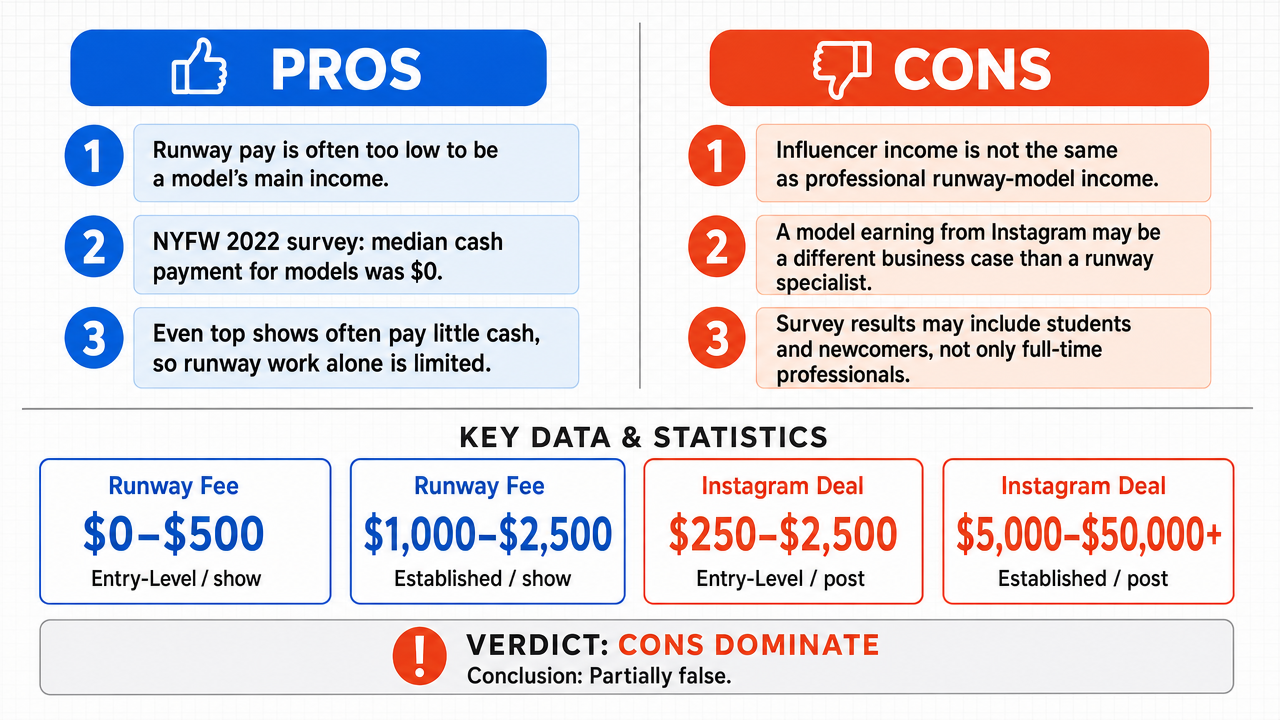
- ■Runway compensation is structurally insufficient as a primary income source because luxury houses and designers treat runway appearances as prestige engagements , often paying models in 'trade ' (clothing from the collection) or nominal fees rarely exceeding a few hundred dollars per show.
- ■A 2022 Model Alliance survey found that models walking New York Fashion Week received a median cash payment of just $0, with many compensated exclusively in clothing vouchers or store credit , suggesting runway fees cannot be a primary income source.
- ■Even established models at top-tier shows receive minimal cash compensation , reinforcing that runway work alone cannot constitute a primary income stream for fashion week participants.
❌ Key ANTI arguments:
- ■The affirmative commits a fundamental substitution of proxies by citing the income of 'influencers ' or 'digital creators ' and treating it as the economic reality of professional fashion models, without providing a transfer operator linking these two distinct professional categories.
- ■A model with a massive Instagram following who monetizes their digital presence is not the same economic unit as a professional runway model whose career is built on editorial and runway contracts.
- ■The Model Alliance survey aggregated data from a broad pool of participants, including students, part-timers, and newcomers — a non-professional tier — and therefore does not establish the income structure of professional runway models.
💭 Conclusion: Partially false. The draft reasoning incorrectly claims the Model Alliance survey 'does not establish that the $0 median cash payment applies specifically to professional runway models.' The evidence explicitly states the opposite: the survey sampled 85 models who actually walked in New York Fashion Week , and since professional models walk NYFW , the $0 median applies to them as well. The anti side's legitimate critique is therefore narrower — the survey's heterogeneity (including students, part-timers, and newcomers) dilutes its applicability to top-tier professionals specifically, not that it excluded professionals entirely. The anti side's stronger point — that the affirmative conflates social media influencers with professional runway models — is well supported by the evidence, which distinguishes 'influencers' or 'digital creators ' as a separate economic entity from professional fashion models. The structural argument about bundled talent contracts versus per-post fees is also supported. Confidence is moderate at 60% because while the anti side's conflation critique is compelling, the affirmative's core data point (the $0 median among NYFW models) does apply to the surveyed population including professionals, weakening the sampling-flaws argument.
🔬 DeepResearch Result: likely FALSE ❌ (62%)
Assertion: The primary income source for models participating in major fashion weeks like Milan or New York is derived from Instagram brand deals rather than direct payments from runway shows.
Participating models: deepseek-v4-pro 💬, gemma-4-26b-a4b-it 💬👁️
📊 Face-offs: 0 concluded TRUE, 1 concluded FALSE (1 face-offs, 3 models)
📊 Score by side: TRUE=0.00, FALSE=0.62
🏅 Model score changes:
minimax-m3 💬👁️: +6
✅ PRO Arguments:
- ■Runway compensation is structurally insufficient as a primary income source because luxury houses and designers treat runway appearances as prestige engagements , often paying models in 'trade ' (clothing from the collection) or nominal fees rarely exceeding a few hundred dollars per show. deepseek-v4-pro 💬
- ■A 2022 Model Alliance survey found that models walking New York Fashion Week received a median cash payment of just $0, with many compensated exclusively in clothing vouchers or store credit , suggesting runway fees cannot be a primary income source. deepseek-v4-pro 💬
- ■Even established models at top-tier shows receive minimal cash compensation , reinforcing that runway work alone cannot constitute a primary income stream for fashion week participants. deepseek-v4-pro 💬
- ■The Model Alliance survey sampled models who actually walked in New York Fashion Week — the very population defined by the claim — so the $0 median cash payment applies to professional models as well, not just newcomers. deepseek-v4-pro 💬
❌ ANTI Arguments:
- ■The affirmative commits a fundamental substitution of proxies by citing the income of 'influencers ' or 'digital creators ' and treating it as the economic reality of professional fashion models, without providing a transfer operator linking these two distinct professional categories. gemma-4-26b-a4b-it 💬👁️
- ■A model with a massive Instagram following who monetizes their digital presence is not the same economic unit as a professional runway model whose career is built on editorial and runway contracts. gemma-4-26b-a4b-it 💬👁️
- ■The Model Alliance survey aggregated data from a broad pool of participants, including students, part-timers, and newcomers — a non-professional tier — and therefore does not establish the income structure of professional runway models. gemma-4-26b-a4b-it 💬👁️
- ■The affirmative's claim that the $0 median applies to 'professional models' is an unstated assumption that ignores the structural reality of how high-fashion contracts function, where top-tier models receive substantial fees not captured by broad surveys. gemma-4-26b-a4b-it 💬👁️
💭 Reasoning: Partially false. The draft reasoning incorrectly claims the Model Alliance survey 'does not establish that the $0 median cash payment applies specifically to professional runway models.' The evidence explicitly states the opposite: the survey sampled 85 models who actually walked in New York Fashion Week, and since professional models walk NYFW , the $0 median applies to them as well. The anti side's legitimate critique is therefore narrower — the survey's heterogeneity (including students, part-timers, and newcomers) dilutes its applicability to top-tier professionals specifically, not that it excluded professionals entirely. The anti side's stronger point — that the affirmative conflates social media influencers with professional runway models — is well supported by the evidence, which distinguishes 'influencers' or 'digital creators' as a separate economic entity from professional fashion models. The structural argument about bundled talent contracts versus per-post fees is also supported. Confidence is moderate at 60% because while the anti side's conflation critique is compelling, the affirmative's core data point (the $0 median among NYFW models) does apply to the surveyed population including professionals, weakening the sampling-flaws argument.
📋 PRO Facts:
• A 2022 Model Alliance survey of 85 models who walked New York Fashion Week found a median cash payment of $0, with 54% receiving no cash compensation at all.
• Many NYFW models were compensated exclusively in clothing vouchers or store credit rather than cash.
• Runway fees at major fashion weeks rarely exceed a few hundred dollars per show for most models.
📋 ANTI Facts:
• Professional runway models and Instagram influencers/digital creators are distinct economic categories with different income structures.
• High-fashion contracts for top-tier professional models function differently from the broad compensation patterns captured in general surveys, bundling runway, campaigns, and lookbooks into comprehensive talent agreements.
• The Model Alliance survey aggregated data from a broad, heterogeneous pool of participants that included students, part-time workers, and newcomers, not exclusively professional runway models.
| Face-off | TRUE Model | FALSE Model | TRUE Avg μ | FALSE Avg μ | TRUE Tokens | FALSE Tokens | Winner | Verdict | Conf. |
|---|---|---|---|---|---|---|---|---|---|
| #1 | deepseek-v4-pro 💬 | gemma-4-26b-a4b-it 💬👁️ | 0.507 | 0.324 | 6 | 2 | TRUE | FALSE | 62% |
The following technical terms, abbreviations, and domain-specific concepts are referenced throughout this debate transcript. Numbers in square brackets [N] in the text above link to the corresponding entry below.
[1] ad hoc rescue — In debate logic, a maneuver in which a participant introduces a new clause or qualification solely to deflect a counterargument, rather than to advance the original position.
[2] agency commissions — The percentage of a model's earnings that a modeling agency retains as its fee; in the transcript cited at 20% of gross income.
[3] booking schedule — The roster of confirmed runway or editorial assignments a model secures for a given fashion season.
[4] brand deals — Paid endorsement or sponsorship arrangements in which a model promotes a brand's products, typically via social media content.
[5] cash compensation — Monetary payment, as distinguished from in-kind compensation such as clothing, vouchers, or store credit.
[6] clothing vouchers — Credits redeemable for garments from a designer's collection, used as a non-cash form of model compensation.
[7] digital creators — Individuals who produce and distribute content on online platforms, often monetizing their audience through sponsorships and partnerships.
[8] economic unit — A distinct entity whose income, costs, and revenue streams are analyzed as a single coherent whole.
[9] editorial contracts — Work agreements covering magazine shoots, lookbooks, and other print or digital fashion-editorial features, as distinct from runway bookings.
[10] fashion week — A semi-annual industry event (e.g., New York, Milan) during which designers present seasonal collections via runway shows.
[11] gross — Total revenue or earnings before deductions such as agency commissions or expenses are subtracted.
[12] hidden premise — An assumption that is not explicitly stated but is required for an argument's conclusion to follow from its premises.
[13] high-fashion — The segment of the fashion industry associated with luxury designer houses, couture, and prestige runway presentations.
[14] influencers — Social media personalities whose audience reach enables them to monetize content through brand partnerships and sponsored posts.
[15] logical leap — A reasoning step that draws a conclusion without adequate supporting evidence or intermediate justification.
[16] luxury houses — Established high-end fashion brands (e.g., Chanel, Gucci) that produce couture and ready-to-wear collections.
[17] median — The middle value in a dataset such that half the observations fall above and half below it; in the transcript, the median cash payment for NYFW models was reported as $0.
[18] monetize — To convert an asset—such as a social media following—into revenue, typically through advertising, sponsorships, or direct brand payments.
[19] new faces — Unestablished or early-career models represented by an agency, often booked for portfolio-building purposes rather than fee-paying work.
[20] NYFW — New York Fashion Week — The semi-annual fashion week event held in New York City, featuring runway presentations by American and international designers.
[21] portfolio building — The practice of accepting lower-paying or unpaid work in order to accumulate professional images and credits that enhance future bookings.
[22] prestige engagements — Industry appearances valued primarily for their reputational or career-advancement benefits rather than their direct financial compensation.
[23] projection — The act of extrapolating findings from a sampled group onto a broader population, which requires justification that the sample is representative.
[24] restricted population — A subset of a larger group whose characteristics are used to make claims about the whole, potentially limiting the validity of the inference.
[25] runway — The catwalk used in fashion shows, or by extension, the live presentation of a designer's collection to an audience.
[26] store credit — A non-cash form of compensation redeemable for merchandise at a specific retailer, used in lieu of monetary payment.
[27] substitution error — A logical fallacy in which evidence about one entity or population is used to support a claim about a different entity or population.
[28] substitution of proxies — A reasoning error in which a stand-in measure (proxy) is treated as equivalent to the actual quantity of interest, even though the two are not the same.
[29] trade — In-kind compensation in which a model is paid with goods—typically clothing from the collection—rather than cash.
[30] unstated assumption — A premise relied upon in an argument that has not been explicitly articulated or defended.
The following financial data tables were referenced during the debate exchanges:
| Income Source | Per Engagement (Entry-Level) | Per Engagement (Established) | Annual Potential (10 Shows/Posts) |
|---|---|---|---|
| Runway Show Fee | $0–$500 | $1,000–$2,500 | $0–$25,000 |
| Instagram Sponsored Post | $250–$2,500 | $5,000–$50,000+ | $2,500–$500,000+ |
Legend: Comparison of runway show fees versus Instagram sponsored post earnings for fashion week models. Runway figures reflect median survey data (Model Alliance, 2022) and industry reports; Instagram rates based on follower-count tiers and engagement metrics from influencer marketing platforms. Annual potential assumes 10 engagements per year for each category.
| Contract Component | Nature of Revenue | Economic Stability |
|---|---|---|
| Runway/Editorial Contracts | Multi-show/Multi-season bundles | High (Contractual Guarantee) |
| Instagram Brand Deals | Per-engagement/Transactional | Low (Variable/Non-guaranteed) |
| Global Campaign Contracts | Multi-year/Global rights | Very High (Core Income) |
Legend: Comparison of revenue structures for professional models. "Contractual Guarantee" refers to the legal obligation of the brand to pay the agreed rate regardless of social media volatility.
Face-off transcripts
- ■
Ownership & Trade Secrets. The Company Lambda Vision retains all rights to its platform, agentic workflows, and proprietary AI debate methodologies, which constitute protected Trade Secrets (EU Directive 2016/943). Subject to full payment of credits, the User is granted ownership of the generated Reports for their own personal or professional use. Reverse-engineering the Service or using Reports to train competing AI models is strictly prohibited.
- ■
No Professional Advice. Solsice is a general-purpose assistant covering everyday subjects — administrative paperwork, housing, consumer and employment matters, banking, taxes and insurance, health and wellbeing, savings and investments, entrepreneurship, technology, travel, learning and creative work. Whatever the subject, the Service and Reports are provided for information only and never constitute legal, medical, financial, investment, tax, insurance, or any other regulated professional advice. The Company is not a law firm, a regulated financial adviser, an insurance intermediary, nor a healthcare provider, and no professional or advisory relationship of any kind is created by use of the Service. Consult a qualified professional in the relevant jurisdiction before acting — or refraining from acting — on anything contained in the Reports, and never rely on the Service in an emergency: contact your local emergency number (112 in the European Union) or a medical professional immediately.
- ■
AI-Generated Content, Sources and Viewpoints. Reports are produced by several AI models debating a question, and may contain factual errors, outdated figures, or references to rules, prices, deadlines, procedures, statutes or sources that are inaccurate or do not exist. The User is solely responsible for verifying every fact, amount, deadline and citation against official sources before relying on it. Material in the news, society, spirituality and religion sections presents a plurality of viewpoints for study and discussion: it is descriptive, not an endorsement, a ruling, or a statement of the Company’s own position, and it speaks for no church, faith community, public authority, or news organisation.
- ■
Liability & Governing Law. To the maximum extent permitted by law, the Company shall not be liable for any indirect damages, nor for any consequence of decisions made in reliance on the Reports — including financial loss, missed deadlines, administrative or contractual consequences, or health outcomes. These Terms are governed by French law. Any disputes shall be subject to the exclusive jurisdiction of the Courts of Paris, France.