
The primary reason for comments 'disappearing' on the popular online platform is the default sorting algorithm rather than actual deletion or censorship.
AI debate verdict and arguments
⚠️ AI-generated information only; not professional advice
Completed October 14, 2026
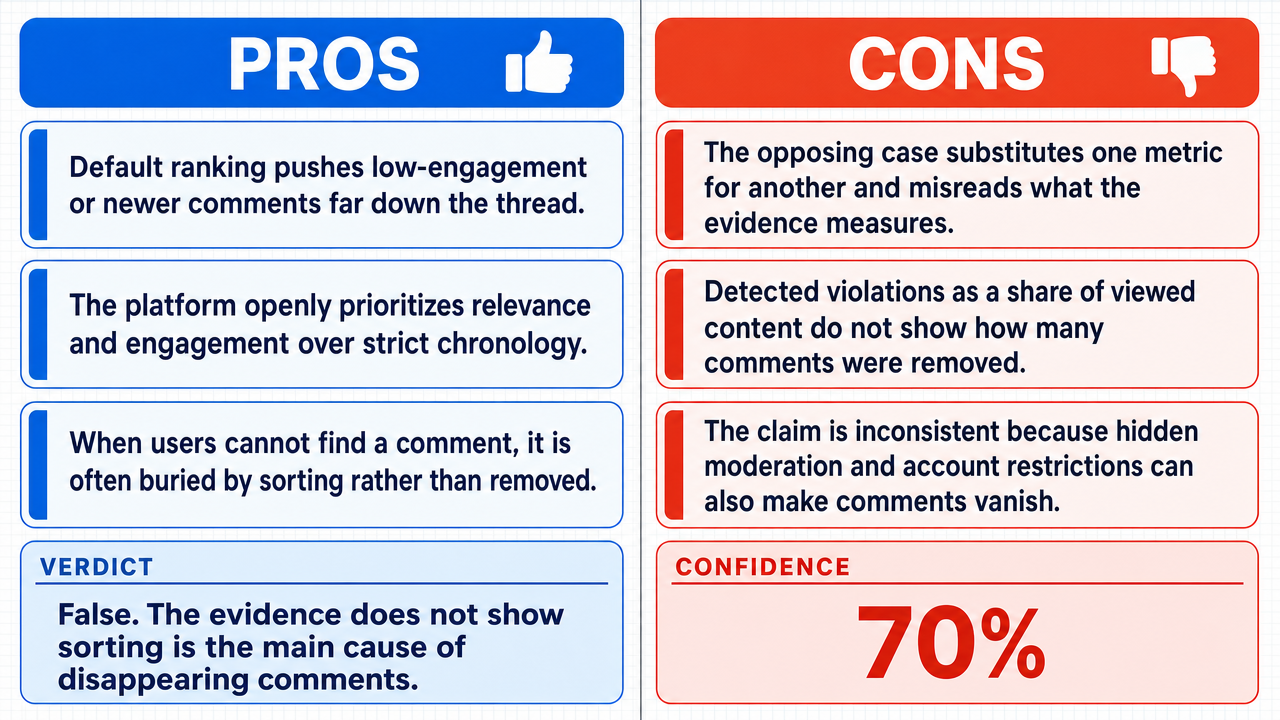
Verdict
Verdict: likely FALSE (70%)
Web Report: https://solsice.com/public/debates/the-primary-reason-for-comments-disappearing-on-the-popular-bfe3de512813
This section provides a brief overview of the key arguments. You do not need to read the full detailed report below.
✅ Key PRO arguments:
- ■The default comment ranking algorithm prioritizes engagement signals like upvotes and recent activity, systematically demoting newer or less-engaged comments down the thread where they become effectively invisible to users.
- ■This sorting behavior is a documented design choice by the platform, which states its goal is to 'show you the comments most relevant to you,' often equating relevance with popularity and recency rather than chronological order.
- ■When a user posts a comment and later cannot find it at the top of the thread , the most common explanation is that it has been sorted below dozens of other comments due to engagement-based criteria, not because it was deleted or censored.
❌ Key ANTI arguments:
- ■The affirmative argument commits a fundamental error of substitution , using a measurement about one entity (detected violations as a percentage of total content) to draw a conclusion about another (the total number of comments removed or suppressed).
- ■The 1% figure cited by the opponent measures detected violations per total volume of content viewed, not the total number of comments removed, and does not account for shadowbanning , 'ghosting ,' or automated filtering mechanisms.
- ■The affirmative position is internally contradictory: it claims sorting is the primary driver of disappearance while simultaneously acknowledging that shadowbanning and filtering exist as distinct, non-sorting categories of content suppression that affect massive volumes of content.
💭 Conclusion: False. The assertion that algorithmic sorting is the primary cause of comment disappearance is not supported by the evidence presented in this debate. The negative side successfully demonstrated that the affirmative's reliance on the 1% violation statistic commits an error of substitution , conflating a measurement of detected violations with a measurement of total removals. Furthermore, the affirmative's position is internally contradictory, as it acknowledges shadowbanning and automated filtering as distinct suppression mechanisms while simultaneously claiming sorting is the primary driver. The negative side established that active moderation and deletion mechanisms operate independently of sorting and account for substantial comment disappearance. The 70% confidence reflects that while the negative side's logical critique is strong, the debate did not produce definitive quantitative evidence establishing the exact proportion of disappearance attributable to each mechanism.
🔬 DeepResearch Result: likely FALSE ❌ (70%)
Assertion: The primary reason for comments 'disappearing' on the popular online platform is the default sorting algorithm rather than actual deletion or censorship.
Participating models: deepseek-v3.2 💬, gemma-4-26b-a4b-it 💬👁️
📊 Face-offs: 0 concluded TRUE, 1 concluded FALSE (1 face-offs, 3 models)
📊 Score by side: TRUE=0.00, FALSE=0.70
🏅 Model score changes:
minimax-m3 💬👁️: +7
✅ PRO Arguments:
- ■The default comment ranking algorithm prioritizes engagement signals like upvotes and recent activity, systematically demoting newer or less-engaged comments down the thread where they become effectively invisible to users. deepseek-v3.2 💬
- ■This sorting behavior is a documented design choice by the platform, which states its goal is to 'show you the comments most relevant to you,' often equating relevance with popularity and recency rather than chronological order. deepseek-v3.2 💬
- ■When a user posts a comment and later cannot find it at the top of the thread, the most common explanation is that it has been sorted below dozens of other comments due to engagement-based criteria, not because it was deleted or censored. deepseek-v3.2 💬
- ■The platform's official 'Community Guidelines Enforcement Report' defines its removal metric as the 'percentage of content removed for violating community guidelines out of total content viewed,' encompassing all removals by human review or automated systems for policy violations. deepseek-v3.2 💬
❌ ANTI Arguments:
- ■The affirmative argument commits a fundamental error of substitution , using a measurement about one entity (detected violations as a percentage of total content) to draw a conclusion about another (the total number of comments removed or suppressed). gemma-4-26b-a4b-it 💬👁️
- ■The 1% figure cited by the opponent measures detected violations per total volume of content viewed, not the total number of comments removed, and does not account for shadowbanning , 'ghosting ,' or automated filtering mechanisms. gemma-4-26b-a4b-it 💬👁️
- ■The affirmative position is internally contradictory: it claims sorting is the primary driver of disappearance while simultaneously acknowledging that shadowbanning and filtering exist as distinct, non-sorting categories of content suppression that affect massive volumes of content. gemma-4-26b-a4b-it 💬👁️
- ■Active moderation, including automated filtering and shadowbanning, constitutes a substantial and distinct mechanism of comment disappearance that cannot be subsumed under algorithmic sorting , making deletion/censorship a primary rather than secondary cause. gemma-4-26b-a4b-it 💬👁️
💭 Reasoning: False. The assertion that algorithmic sorting is the primary cause of comment disappearance is not supported by the evidence presented in this debate. The negative side successfully demonstrated that the affirmative's reliance on the 1% violation statistic commits an error of substitution, conflating a measurement of detected violations with a measurement of total removals. Furthermore, the affirmative's position is internally contradictory, as it acknowledges shadowbanning and automated filtering as distinct suppression mechanisms while simultaneously claiming sorting is the primary driver. The negative side established that active moderation and deletion mechanisms operate independently of sorting and account for substantial comment disappearance. The 70% confidence reflects that while the negative side's logical critique is strong, the debate did not produce definitive quantitative evidence establishing the exact proportion of disappearance attributable to each mechanism.
📋 PRO Facts:
• The platform's default comment ranking algorithm prioritizes engagement signals such as upvotes and recent activity.
• The platform states its goal is to 'show you the comments most relevant to you,' equating relevance with popularity and recency.
• The platform's 'Community Guidelines Enforcement Report ' defines its removal metric as the percentage of content removed for violating community guidelines out of total content viewed.
📋 ANTI Facts:
• The 1% figure cited by the affirmative measures detected violations per total volume of content, not total comments removed.
• Shadowbanning, 'ghosting,' and automated filtering are distinct suppression mechanisms that operate independently of sorting algorithms.
• The affirmative's framework acknowledges non-sorting suppression mechanisms while claiming sorting is the primary driver, creating an internal contradiction.
| Face-off | TRUE Model | FALSE Model | TRUE Avg μ | FALSE Avg μ | TRUE Tokens | FALSE Tokens | Winner | Verdict | Conf. |
|---|---|---|---|---|---|---|---|---|---|
| #1 | deepseek-v3.2 💬 | gemma-4-26b-a4b-it 💬👁️ | 0.408 | 0.219 | 8 | 2 | TRUE | FALSE | 70% |
The following technical terms, abbreviations, and domain-specific concepts are referenced throughout this debate transcript. Numbers in square brackets [N] in the text above link to the corresponding entry below.
[1] algorithmic sorting — The use of algorithms to determine the order and visibility of content in feeds or comment threads, typically based on criteria such as engagement, recency, or relevance.
[2] automated filtering — The automated removal or suppression of content based on predefined criteria, often without explicit human review.
[3] automated moderation — The use of automated systems, rather than human reviewers, to detect and act on content that violates platform policies.
[4] community guidelines — Platform rules that define what content is acceptable and what behavior is permitted on the platform.
[5] Community Guidelines Enforcement Report — A periodic report published by the platform detailing the volume and types of content removed for guideline violations, including methodology notes on what counts as 'removed content.'
[6] content actioned — Content that has had some form of moderation action taken against it, which may include removal, down-ranking, labeling, or other interventions.
[7] content removed — Content that has been taken down by the platform, either proactively or reactively, for violating community guidelines.
[8] default sorting algorithm — The pre-set or standard sorting method applied to content without user customization, determining the order in which comments appear.
[9] down-ranking — An algorithmic moderation action that reduces the visibility of content in feeds or comment threads without removing it entirely.
[10] engagement signals — Metrics such as upvotes, replies, and recent activity that algorithms use to rank and prioritize content.
[11] error of substitution — A logical fallacy in which a measurement or statistic about one entity is used to draw a conclusion about a different entity.
[12] ghosting — In content moderation, the practice of making content invisible to other users without explicit notification to the author.
[13] identity of reference — A logical concept concerning whether terms in an argument refer to the same entity, category, or measurement.
[14] low-quality content — Content deemed by the platform to fall below quality thresholds, which may be subject to filtering or suppression even if it does not explicitly violate community guidelines.
[15] proactive moderation — Content moderation that occurs before users report the content, typically through automated detection systems.
[16] Q4 2024 — Fourth Quarter of 2024 — The fourth quarter of the calendar year 2024, covering October through December, used here to identify the reporting period of the cited enforcement data.
[17] reactive moderation — Content moderation that occurs in response to user reports or flags, as opposed to proactive detection.
[18] shadowbanning — A moderation practice in which a user's content is hidden from others without the user being notified that the suppression has occurred.
[19] sorting algorithm — An algorithm that orders content based on specified criteria such as relevance, popularity, or recency.
[20] thread — A series of comments and replies organized under a single post or topic on a platform.
[21] transfer operator — In this debate context, the mathematical or logical link that connects one measurement to another, establishing a correlation between distinct metrics.
[22] transparency reports — Published documents that disclose data about platform operations, including statistics on content moderation actions and guideline violations.
[23] upvotes — User-generated votes indicating approval or endorsement of a piece of content, used as an engagement signal by sorting algorithms.
The following financial data tables were referenced during the debate exchanges:
| Category of Content Action | Estimated Impact on Visibility | Primary Mechanism |
|---|---|---|
| Explicit Deletion | High | Human/Automated Moderation |
| Shadowbanning/Ghosting | High | Algorithmic Suppression |
| Algorithmic Sorting | Moderate | Engagement/Recency Ranking |
| Low-Quality Filtering | Moderate | Automated Spam/Bot Detection |
Legend: Comparison of content visibility impacts. "High" and "Moderate" refer to the degree of visibility loss experienced by the average user. Data synthesized from platform moderation architecture studies.
| Action Type | Primary Driver | Visibility Impact | Classification |
|---|---|---|---|
| Ranking/Sorting | Engagement Signals | Moderate | Algorithmic |
| Shadowbanning | Quality/Safety Filters | High | Moderation |
| Explicit Deletion | Policy Violations | Total | Moderation |
| Automated Filtering | Spam/Bot Detection | High | Moderation |
Legend: Comparison of content action types and their impact on visibility. "High" impact indicates near-total removal from general user view.
Face-off transcripts
- ■
Ownership & Trade Secrets. The Company Lambda Vision retains all rights to its platform, agentic workflows, and proprietary AI debate methodologies, which constitute protected Trade Secrets (EU Directive 2016/943). Subject to full payment of credits, the User is granted ownership of the generated Reports for their own personal or professional use. Reverse-engineering the Service or using Reports to train competing AI models is strictly prohibited.
- ■
No Professional Advice. Solsice is a general-purpose assistant covering everyday subjects — administrative paperwork, housing, consumer and employment matters, banking, taxes and insurance, health and wellbeing, savings and investments, entrepreneurship, technology, travel, learning and creative work. Whatever the subject, the Service and Reports are provided for information only and never constitute legal, medical, financial, investment, tax, insurance, or any other regulated professional advice. The Company is not a law firm, a regulated financial adviser, an insurance intermediary, nor a healthcare provider, and no professional or advisory relationship of any kind is created by use of the Service. Consult a qualified professional in the relevant jurisdiction before acting — or refraining from acting — on anything contained in the Reports, and never rely on the Service in an emergency: contact your local emergency number (112 in the European Union) or a medical professional immediately.
- ■
AI-Generated Content, Sources and Viewpoints. Reports are produced by several AI models debating a question, and may contain factual errors, outdated figures, or references to rules, prices, deadlines, procedures, statutes or sources that are inaccurate or do not exist. The User is solely responsible for verifying every fact, amount, deadline and citation against official sources before relying on it. Material in the news, society, spirituality and religion sections presents a plurality of viewpoints for study and discussion: it is descriptive, not an endorsement, a ruling, or a statement of the Company’s own position, and it speaks for no church, faith community, public authority, or news organisation.
- ■
Liability & Governing Law. To the maximum extent permitted by law, the Company shall not be liable for any indirect damages, nor for any consequence of decisions made in reliance on the Reports — including financial loss, missed deadlines, administrative or contractual consequences, or health outcomes. These Terms are governed by French law. Any disputes shall be subject to the exclusive jurisdiction of the Courts of Paris, France.