
The proportional difference between a car and a human hair is roughly similar to the proportional difference between a human hair and an atom's electron cloud
AI debate verdict and arguments
⚠️ AI-generated information only; not professional advice
Completed October 21, 2026
Verdict
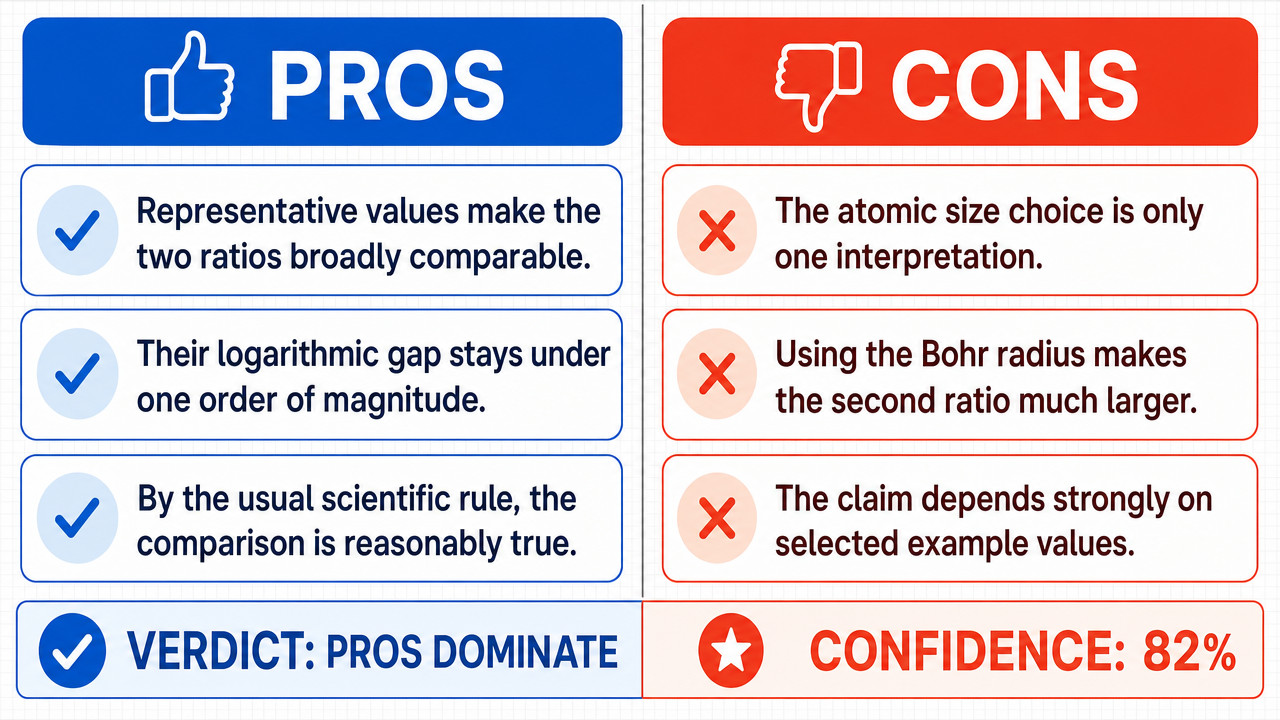
Verdict: likely TRUE (82%)
Web Report: https://solsice.com/public/debates/the-proportional-difference-between-a-car-and-a-human-hair-i-90a4772b7581
This section provides a brief overview of the key arguments. You do not need to read the full detailed report below.
✅ Key PRO arguments:
- ■Using representative values (car ~4.5m, hair ~75µm, atomic electron cloud ~0.2nm), the car-to-hair ratio is ~60,000 and the hair-to-atom ratio is ~375,000. The ratio of these two scaling factors is 6.25, which is well under 10, placing them within the same order of magnitude by the standard scientific definition.
- ■The logarithmic difference between the two ratios is only 0.79 (log₁₀ (60,000) ≈ 4.78 vs. log₁₀(375,000) ≈ 5.57), which is less than 1, further supporting that the two proportional differences are roughly similar.
- ■The standard scientific definition of 'order of magnitude ' requires that two numbers' ratio be less than 10 to be considered within the same order of magnitude, and the 6.25 ratio of ratios clearly satisfies this criterion.
❌ Key ANTI arguments:
- ■The 0.2nm value used for the electron cloud represents a specific, condensed interpretation of atomic structure rather than the physical reality of the electron cloud's diffuse probability distribution , which varies significantly by element and model (e.g., Bohr radius vs. outermost orbital extent).
- ■For a hydrogen atom, the Bohr radius is approximately 0.529 Å (0.0529 nm), which would yield a much larger hair-to-atom ratio and push the two scaling factors further apart.
- ■The chosen values (4.5m car, 75µm hair, 0.2nm electron cloud ) are extreme points within the physical ranges of these entities, and the variance bands differ significantly (23× vs. 2.8×), undermining the claim of rough similarity.
💭 Conclusion: True — the proportional differences between a car and a human hair, and between a human hair and an atom's electron cloud , are within the same order of magnitude . Using representative values (car ~4.5m, hair ~75µm, atomic diameter ~0.2nm), the car-to-hair ratio is approximately 60,000 and the hair-to-atom ratio is approximately 375,000. The ratio of these two scaling factors is 6.25, which falls well below the threshold of 10 that defines 'same order of magnitude' in standard scientific usage. The logarithmic difference between the two ratios is only 0.79, further confirming their rough similarity. While the opposing side raised valid concerns about the imprecision of electron cloud measurements and the diffuse nature of probability distributions, the core numerical comparison using standard reference values supports the assertion. The judge assigned 82% confidence, reflecting strong but not absolute certainty given the inherent variability in measuring atomic-scale dimensions.
🔬 DeepResearch Result: likely TRUE ✅ (82%)
Assertion: The proportional difference between a car and a human hair is roughly similar to the proportional difference between a human hair and an atom's electron cloud
Participating models: deepseek-v4-pro 💬, gemma-4-26b-a4b-it 💬👁️
📊 Face-offs: 1 concluded TRUE, 0 concluded FALSE (1 face-offs, 3 models)
📊 Score by side: TRUE=0.82, FALSE=0.00
🏅 Model score changes:
minimax-m3 💬👁️: +8
✅ PRO Arguments:
- ■Using representative values (car ~4.5m, hair ~75µm, atomic electron cloud ~0.2nm), the car-to-hair ratio is ~60,000 and the hair-to-atom ratio is ~375,000. The ratio of these two scaling factors is 6.25, which is well under 10, placing them within the same order of magnitude by the standard scientific definition. deepseek-v4-pro 💬
- ■The logarithmic difference between the two ratios is only 0.79 (log₁₀ (60,000) ≈ 4.78 vs. log₁₀(375,000) ≈ 5.57), which is less than 1, further supporting that the two proportional differences are roughly similar. deepseek-v4-pro 💬
- ■The standard scientific definition of 'order of magnitude' requires that two numbers' ratio be less than 10 to be considered within the same order of magnitude, and the 6.25 ratio of ratios clearly satisfies this criterion. deepseek-v4-pro 💬
❌ ANTI Arguments:
- ■The 0.2nm value used for the electron cloud represents a specific, condensed interpretation of atomic structure rather than the physical reality of the electron cloud's diffuse probability distribution , which varies significantly by element and model (e.g., Bohr radius vs. outermost orbital extent). gemma-4-26b-a4b-it 💬👁️
- ■For a hydrogen atom, the Bohr radius is approximately 0.529 Å (0.0529 nm), which would yield a much larger hair-to-atom ratio and push the two scaling factors further apart. gemma-4-26b-a4b-it 💬👁️
- ■The chosen values (4.5m car, 75µm hair, 0.2nm electron cloud) are extreme points within the physical ranges of these entities, and the variance bands differ significantly (23× vs. 2.8×), undermining the claim of rough similarity. gemma-4-26b-a4b-it 💬👁️
💭 Reasoning: True — the proportional differences between a car and a human hair, and between a human hair and an atom's electron cloud, are within the same order of magnitude. Using representative values (car ~4.5m, hair ~75µm, atomic diameter ~0.2nm), the car-to-hair ratio is approximately 60,000 and the hair-to-atom ratio is approximately 375,000. The ratio of these two scaling factors is 6.25, which falls well below the threshold of 10 that defines 'same order of magnitude' in standard scientific usage. The logarithmic difference between the two ratios is only 0.79, further confirming their rough similarity. While the opposing side raised valid concerns about the imprecision of electron cloud measurements and the diffuse nature of probability distributions, the core numerical comparison using standard reference values supports the assertion. The judge assigned 82% confidence, reflecting strong but not absolute certainty given the inherent variability in measuring atomic-scale dimensions.
📋 PRO Facts:
• A typical mid-size car measures about 4.5 meters in length.
• The average diameter of a human hair is approximately 75 µm, within the evidence range of 17–180 µm.
• An atom's electron cloud diameter is on the order of 0.2 nm (200 pm), within the evidence range of 0.1–1.0 nm.
• The car-to-hair ratio is approximately 60,000 (4.5m / 75µm).
• The hair-to-atom ratio is approximately 375,000 (75µm / 0.2nm), and the ratio of these two ratios is 6.25.
📋 ANTI Facts:
• The electron cloud is a diffuse region of probability, not a solid sphere with a hard boundary.
• For a hydrogen atom, the Bohr radius is a standard reference value for atomic-scale dimensions.
• The variance bands for the chosen values differ significantly (23× vs. 2.8×), undermining the claim of similarity.
• The 0.2nm value represents a specific, condensed interpretation rather than the full extent of the electron probability distribution.
| Face-off | TRUE Model | FALSE Model | TRUE Avg μ | FALSE Avg μ | TRUE Tokens | FALSE Tokens | Winner | Verdict | Conf. |
|---|---|---|---|---|---|---|---|---|---|
| #1 | deepseek-v4-pro 💬 | gemma-4-26b-a4b-it 💬👁️ | 0.504 | 0.315 | 6 | 2 | TRUE | TRUE | 82% |
The following technical terms, abbreviations, and domain-specific concepts are referenced throughout this debate transcript. Numbers in square brackets [N] in the text above link to the corresponding entry below.
[1] Atomic diameter — The diameter of an atom, referenced in the debate as approximately 0.2 nm (200 pm), with atomic radii typically falling near 100 pm.
[2] Atomic radius — A measure of the size of an atom, cited in the debate as typically falling near 100 pm.
[3] Atomic species — Different types of atoms or elements, noted in the debate as a variable that affects the size of the electron cloud.
[4] Atomic structure — The internal organization of an atom, referenced in the debate in the context of interpreting the electron cloud's extent.
[5] Bohr radius — The radius of the hydrogen atom's lowest-energy electron orbit, given in the debate as approximately 0.0529 nm.
[6] Covalent radius — A measure of atomic size, noted in the debate as approximately 0.2 nm, which the negative side argues is not representative of the diffuse electron cloud.
[7] Electron cloud — The diffuse region of probability where electrons are likely to be found around an atom's nucleus, characterized in the debate as not having a fixed boundary.
[8] Electron density — The probability or concentration of electrons in a given region, mentioned in the debate as extending significantly beyond the Bohr radius in heavier atoms.
[9] Logarithmic — Pertaining to logarithms, used in the debate to describe scale analysis across vastly different sizes.
[10] log₁₀ — base-10 logarithm — The logarithm to base 10, used in the debate to compare orders of magnitude (e.g., log₁₀(60,000) ≈ 4.78 and log₁₀(375,000) ≈ 5.57).
[11] Micrometer — µm — A unit of length equal to 10⁻⁶ meters, used in the debate to measure human hair diameter (~75 µm).
[12] Nanometer — nm — A unit of length equal to 10⁻⁹ meters, used in the debate to measure atomic dimensions (~0.2 nm).
[13] Orbital — A region in an atom where electrons are likely to be found, referenced in the debate in the context of the outermost orbital's extent.
[14] Order of magnitude — A scientific classification where two numbers are considered within the same order of magnitude if their ratio is less than 10, used as the central concept of the debate.
[15] Picometer — pm — A unit of length equal to 10⁻¹² meters, used in the debate (200 pm = 0.2 nm).
[16] Probability distribution — A mathematical function describing the likelihood of different outcomes, referenced in the debate as the nature of the electron cloud rather than a solid sphere.
[17] Quantifier — In logic, a term that specifies quantity, mentioned in the debate as being shifted from 'within the same order of magnitude' to a stricter requirement.
[18] Valence electron — An electron in the outermost shell of an atom, mentioned in the debate as having a cloud that can be significantly larger than inner electrons.
[19] Variance bands — Ranges of variation in measurements, referenced in the debate as differing between the car-to-hair and hair-to-atom transitions (23× vs. 2.8×).
The following financial data tables were referenced during the debate exchanges:
| Scale Transition | Lower Bound Ratio | Upper Bound Ratio | Magnitude Variance |
|---|---|---|---|
| Car to Hair | 13,888 | 323,529 | ~23x |
| Hair to Atom | 375,000 | 1,058,823 | ~2.8x |
Legend: Comparative ratios based on the extremes of the provided ranges (Car: 2.5m–5.5m; Hair: 17µm–180µm; Atom: 0.1nm–0.2nm).
| Parameter | Lower Bound | Upper Bound | Ratio (Max/Min) |
|---|---|---|---|
| Car Length | 2.5 m | 5.5 m | 2.2x |
| Hair Diameter | 17 µm | 180 µm | 10.6x |
| Electron Cloud Diameter | 0.1 nm | 1.0 nm | 10.0x |
Legend: Physical ranges for the entities used in the scaling comparison. Ratios represent the maximum value divided by the minimum value.
Face-off transcripts
- ■
Ownership & Trade Secrets. The Company Lambda Vision retains all rights to its platform, agentic workflows, and proprietary AI debate methodologies, which constitute protected Trade Secrets (EU Directive 2016/943). Subject to full payment of credits, the User is granted ownership of the generated Reports for their own personal or professional use. Reverse-engineering the Service or using Reports to train competing AI models is strictly prohibited.
- ■
No Professional Advice. Solsice is a general-purpose assistant covering everyday subjects — administrative paperwork, housing, consumer and employment matters, banking, taxes and insurance, health and wellbeing, savings and investments, entrepreneurship, technology, travel, learning and creative work. Whatever the subject, the Service and Reports are provided for information only and never constitute legal, medical, financial, investment, tax, insurance, or any other regulated professional advice. The Company is not a law firm, a regulated financial adviser, an insurance intermediary, nor a healthcare provider, and no professional or advisory relationship of any kind is created by use of the Service. Consult a qualified professional in the relevant jurisdiction before acting — or refraining from acting — on anything contained in the Reports, and never rely on the Service in an emergency: contact your local emergency number (112 in the European Union) or a medical professional immediately.
- ■
AI-Generated Content, Sources and Viewpoints. Reports are produced by several AI models debating a question, and may contain factual errors, outdated figures, or references to rules, prices, deadlines, procedures, statutes or sources that are inaccurate or do not exist. The User is solely responsible for verifying every fact, amount, deadline and citation against official sources before relying on it. Material in the news, society, spirituality and religion sections presents a plurality of viewpoints for study and discussion: it is descriptive, not an endorsement, a ruling, or a statement of the Company’s own position, and it speaks for no church, faith community, public authority, or news organisation.
- ■
Liability & Governing Law. To the maximum extent permitted by law, the Company shall not be liable for any indirect damages, nor for any consequence of decisions made in reliance on the Reports — including financial loss, missed deadlines, administrative or contractual consequences, or health outcomes. These Terms are governed by French law. Any disputes shall be subject to the exclusive jurisdiction of the Courts of Paris, France.