
The protagonist's voicelessness and inability to enter her first home signify a final, irreversible separation from her past and loved ones.
AI debate verdict and arguments
⚠️ AI-generated information only; not professional advice
Completed October 14, 2026
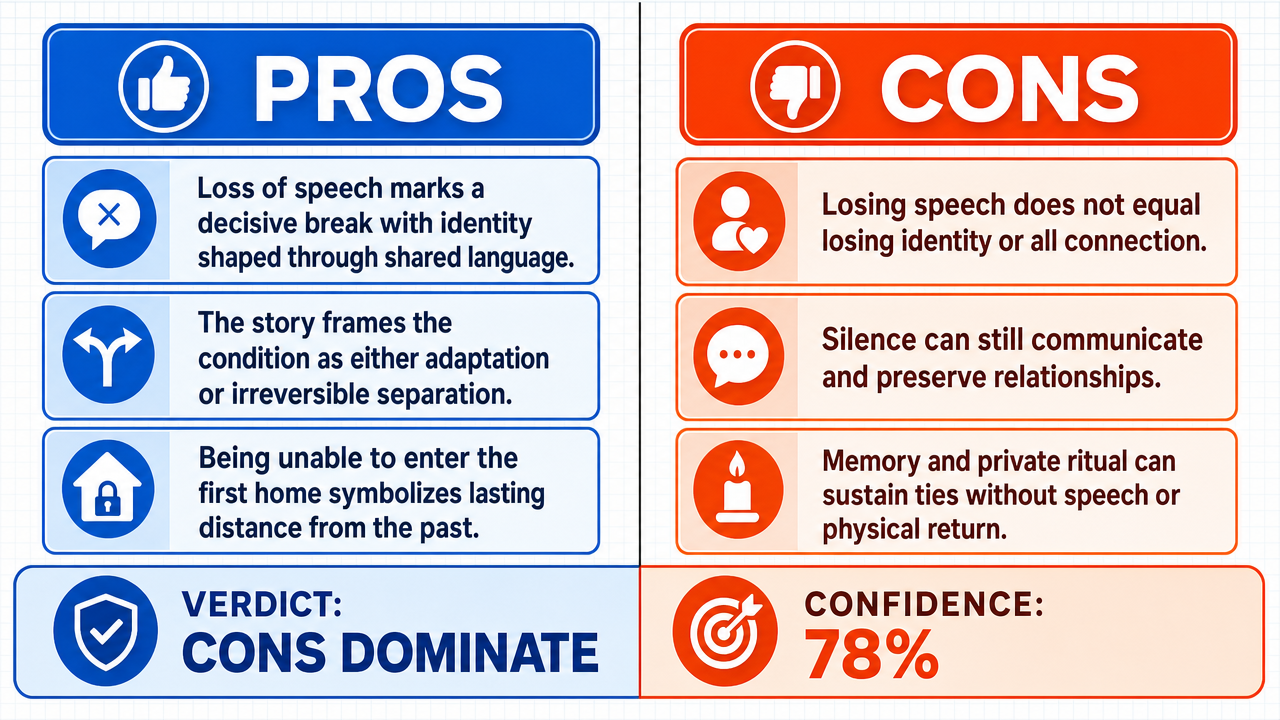
Verdict
Verdict: likely FALSE (78%)
Web Report: https://solsice.com/public/debates/the-protagonist-s-voicelessness-and-inability-to-enter-her-f-8c8186f10459
This section provides a brief overview of the key arguments. You do not need to read the full detailed report below.
✅ Key PRO arguments:
- ■The protagonist's loss of speech constitutes a definitive break from her personal narrative and identity, which are rooted in shared language with loved ones; citing Ashima in Lahiri's 'The Namesake,' aphasia following loss marks a point of no return in the protagonist's relationship to her past.
- ■The narrative presents a false dichotomy : the protagonist's condition must be either a transformative adaptation enabling continued connection or a sign of irreversible separation , and since the text shows no construction of a new viable identity through alternative means, the latter must hold.
- ■Physical barriers such as being barred from one's first home function as symbolic confirmation that the spatial and emotional geography of the past is permanently inaccessible, reinforcing the severance initiated by voicelessness .
❌ Key ANTI arguments:
- ■The assertion commits a flawed substitution of proxy : the loss of one specific communicative channel (speech) is conflated with the total loss of identity and connection, ignoring that memory, ritual, and silent presence remain viable channels of attachment to the past.
- ■In many literary frameworks, silence is not merely an absence but a meaningful communicative act that can sustain rather than sever relational bonds, meaning voicelessness need not signify irreversible separation .
- ■The binary framing of the PRO side is false: internal channels of connection can remain intact through memory, trauma-processing , or silent ritual without requiring either a full transformative adaptation or a terminal rupture , leaving open a spectrum of continued attachment.
💭 Conclusion: False. The winning side correctly identified that the PRO position rests on a flawed conflation of one communicative channel (speech) and one spatial access (entry to a former home) with the totality of the protagonist's relationship to her past and loved ones. The ANTI arguments demonstrated that memory, ritual, silent presence, and symbolic inhabitation constitute legitimate alternative channels of connection that the PRO side failed to adequately refute. The PRO side's reliance on a binary framing—either transformative adaptation or irreversible separation —was effectively dismantled by showing that continued attachment can persist through intermediate states. The judge's 78% confidence reflects that while the FALSE position is well-supported, the compound nature of the claim (voicelessness AND physical barrier AND finality AND separation from both past and loved ones) leaves some sub-claims only partially addressed.
🔬 DeepResearch Result: likely FALSE ❌ (78%)
Assertion: The protagonist's voicelessness and inability to enter her first home signify a final, irreversible separation from her past and loved ones.
Participating models: deepseek-v3.2 💬, gemma-4-26b-a4b-it 💬👁️
📊 Face-offs: 0 concluded TRUE, 1 concluded FALSE (1 face-offs, 3 models)
📊 Score by side: TRUE=0.00, FALSE=0.78
🏅 Model score changes:
minimax-m3 💬👁️: +8
✅ PRO Arguments:
- ■The protagonist's loss of speech constitutes a definitive break from her personal narrative and identity, which are rooted in shared language with loved ones; citing Ashima in Lahiri's 'The Namesake,' aphasia following loss marks a point of no return in the protagonist's relationship to her past. deepseek-v3.2 💬
- ■The narrative presents a false dichotomy : the protagonist's condition must be either a transformative adaptation enabling continued connection or a sign of irreversible separation, and since the text shows no construction of a new viable identity through alternative means, the latter must hold. deepseek-v3.2 💬
- ■Physical barriers such as being barred from one's first home function as symbolic confirmation that the spatial and emotional geography of the past is permanently inaccessible, reinforcing the severance initiated by voicelessness. deepseek-v3.2 💬
❌ ANTI Arguments:
- ■The assertion commits a flawed substitution of proxy : the loss of one specific communicative channel (speech) is conflated with the total loss of identity and connection, ignoring that memory, ritual, and silent presence remain viable channels of attachment to the past. gemma-4-26b-a4b-it 💬👁️
- ■In many literary frameworks, silence is not merely an absence but a meaningful communicative act that can sustain rather than sever relational bonds, meaning voicelessness need not signify irreversible separation. gemma-4-26b-a4b-it 💬👁️
- ■The binary framing of the PRO side is false: internal channels of connection can remain intact through memory, trauma-processing , or silent ritual without requiring either a full transformative adaptation or a terminal rupture , leaving open a spectrum of continued attachment. gemma-4-26b-a4b-it 💬👁️
- ■Physical inability to enter a former home does not necessarily negate emotional or mnemonic access to it; the past can be inhabited through recollection and symbolic presence even when literal spatial re-entry is blocked. gemma-4-26b-a4b-it 💬👁️
💭 Reasoning: False. The winning side correctly identified that the PRO position rests on a flawed conflation of one communicative channel (speech) and one spatial access (entry to a former home) with the totality of the protagonist's relationship to her past and loved ones. The ANTI arguments demonstrated that memory, ritual, silent presence, and symbolic inhabitation constitute legitimate alternative channels of connection that the PRO side failed to adequately refute. The PRO side's reliance on a binary framing—either transformative adaptation or irreversible separation—was effectively dismantled by showing that continued attachment can persist through intermediate states. The judge's 78% confidence reflects that while the FALSE position is well-supported, the compound nature of the claim (voicelessness AND physical barrier AND finality AND separation from both past and loved ones) leaves some sub-claims only partially addressed.
📋 PRO Facts:
• Literary analysis of trauma narratives indicates that aphasia or elective muteness following loss often marks a point of no return in a protagonist's trajectory.
• In Jhumpa Lahiri's 'The Namesake,' Ashima's muteness following Ashoke's death is presented as reflecting the irreversible dissolution of their shared life.
📋 ANTI Facts:
• The absence of one communicative channel does not negate the existence of others such as memory, ritual, or silent presence.
• In literary frameworks, silence can function as a meaningful communicative act rather than merely an absence of speech.
• Internal channels of connection to the past can remain intact through memory, trauma-processing, or silent ritual without requiring a full transformative adaptation.
| Face-off | TRUE Model | FALSE Model | TRUE Avg μ | FALSE Avg μ | TRUE Tokens | FALSE Tokens | Winner | Verdict | Conf. |
|---|---|---|---|---|---|---|---|---|---|
| #1 | deepseek-v3.2 💬 | gemma-4-26b-a4b-it 💬👁️ | 0.450 | 0.377 | 8 | 2 | TRUE | FALSE | 78% |
The following technical terms, abbreviations, and domain-specific concepts are referenced throughout this debate transcript. Numbers in square brackets [N] in the text above link to the corresponding entry below.
[1] aphasia — A medical/literary term referring to the loss of the ability to speak or understand language, cited in the debate as a marker of irreversible loss following trauma.
[2] binary outcomes — A logical framing in which only two mutually exclusive possibilities are presented; the Negative argues the Affirmative wrongly reduces the protagonist's condition to a binary of 'adaptation' versus 'separation.'
[3] broken lineage — A literary term used in the debate to describe a disrupted generational or familial continuity, symbolized by the protagonist's inability to return to her childhood home.
[4] communicative channel — A medium through which connection or meaning is transmitted; the Negative argues that the loss of speech does not eliminate other channels such as memory, ritual, or silent presence.
[5] elective muteness — A psychological/literary condition in which a character deliberately chooses not to speak; cited alongside aphasia as a trauma response marking a point of no return.
[6] external symptom — An observable manifestation of an internal state; the Negative contends that the Affirmative illegitimately infers total severance of identity from a single external symptom (loss of speech).
[7] false dichotomy — A logical fallacy in which two options are presented as the only possibilities when additional alternatives exist; the Affirmative accuses the Negative of constructing a false dichotomy between 'adaptation' and 'separation.'
[8] figurative inability — A symbolic or metaphorical incapacity, as opposed to a literal one; used in the debate to describe the protagonist's blocked return to her childhood home as both literal and symbolic.
[9] flawed substitution of proxy — A logical error identified by the Negative in which the loss of one specific communicative mode (speech) is substituted as a proxy for the total loss of identity and connection.
[10] hybrid identity — A literary/cultural-studies concept describing a self formed from multiple cultural or narrative sources; referenced in the debate as a possible outcome the Affirmative argues the protagonist does not achieve.
[11] internal narrative — The ongoing psychic story a character maintains about herself; the Negative argues this narrative persists and continues to hold the past even when speech is lost.
[12] irreversible separation — The central claim of the original assertion, holding that the protagonist's voicelessness and barred entry constitute a permanent, unrecoverable break from her past and loved ones.
[13] logical leap — An inference that draws a conclusion without sufficient supporting evidence; the Negative charges the Affirmative with a logical leap in equating absence of speech with total severance of connection.
[14] narrative identity — A literary/philosophical concept in which a person's sense of self is constructed through the stories they tell and share; the Affirmative argues this identity is rooted in shared language with loved ones.
[15] non-verbal communion — A mode of connection with the past or with others that operates without speech; the Negative argues silence can enable a deeper non-verbal communion rather than signaling disconnection.
[16] permanent severance — The Affirmative's core characterization of the protagonist's condition as an unresolvable break from her history and family.
[17] point of no return — A narrative threshold beyond which the protagonist's previous self or relationships cannot be recovered; cited in the debate as the function of post-trauma muteness.
[18] psychic link — An internal psychological connection to the past; the Negative argues such a link can persist through memory and trauma-processing without requiring adaptation or reconfiguration.
[19] sealed memorial — A literary image used by the Affirmative to describe the barred childhood home as a memorial the protagonist can observe from outside but not enter or inhabit.
[20] shared language — The common linguistic and symbolic system through which family members construct identity and memory; the Affirmative argues the protagonist's identity is rooted in this shared language.
[21] silent ritual — A repeated non-verbal practice through which connection to the past is maintained; the Negative cites silent ritual as an alternative channel that preserves psychic links without speech.
[22] symbolic barriers — Non-physical obstacles that carry metaphorical meaning in a narrative; the Affirmative treats the protagonist's voicelessness and blocked threshold as symbolic barriers confirming severance.
[23] terminal rupture — A final, complete break in the protagonist's connection to her past; the Negative contests the Affirmative's framing of voicelessness and physical barriers as a terminal rupture.
[24] threshold — In literary analysis, a liminal boundary (such as a doorway) that marks the transition between one state of identity and another; the debate treats the home's threshold as a symbol of belonging.
[25] transformative adaptation — The Negative's counter-framing of voicelessness and physical barriers as adaptive processes that allow continued connection to the past rather than severing it.
[26] trauma narratives — A genre of literary analysis examining how stories represent and structure the experience of trauma; cited by the Affirmative to support the claim that post-loss muteness marks an irreversible break.
[27] trauma-processing — The psychological work of integrating a traumatic experience; the Negative argues that trauma-processing can maintain a continuous, non-severed connection to the past.
[28] voicelessness — The condition of being unable or unwilling to speak, treated in the debate as both a literal loss of speech and a symbolic marker of separation from shared identity.
Face-off transcripts
- ■
Ownership & Trade Secrets. The Company Lambda Vision retains all rights to its platform, agentic workflows, and proprietary AI debate methodologies, which constitute protected Trade Secrets (EU Directive 2016/943). Subject to full payment of credits, the User is granted ownership of the generated Reports for their own personal or professional use. Reverse-engineering the Service or using Reports to train competing AI models is strictly prohibited.
- ■
No Professional Advice. Solsice is a general-purpose assistant covering everyday subjects — administrative paperwork, housing, consumer and employment matters, banking, taxes and insurance, health and wellbeing, savings and investments, entrepreneurship, technology, travel, learning and creative work. Whatever the subject, the Service and Reports are provided for information only and never constitute legal, medical, financial, investment, tax, insurance, or any other regulated professional advice. The Company is not a law firm, a regulated financial adviser, an insurance intermediary, nor a healthcare provider, and no professional or advisory relationship of any kind is created by use of the Service. Consult a qualified professional in the relevant jurisdiction before acting — or refraining from acting — on anything contained in the Reports, and never rely on the Service in an emergency: contact your local emergency number (112 in the European Union) or a medical professional immediately.
- ■
AI-Generated Content, Sources and Viewpoints. Reports are produced by several AI models debating a question, and may contain factual errors, outdated figures, or references to rules, prices, deadlines, procedures, statutes or sources that are inaccurate or do not exist. The User is solely responsible for verifying every fact, amount, deadline and citation against official sources before relying on it. Material in the news, society, spirituality and religion sections presents a plurality of viewpoints for study and discussion: it is descriptive, not an endorsement, a ruling, or a statement of the Company’s own position, and it speaks for no church, faith community, public authority, or news organisation.
- ■
Liability & Governing Law. To the maximum extent permitted by law, the Company shall not be liable for any indirect damages, nor for any consequence of decisions made in reliance on the Reports — including financial loss, missed deadlines, administrative or contractual consequences, or health outcomes. These Terms are governed by French law. Any disputes shall be subject to the exclusive jurisdiction of the Courts of Paris, France.