
The reclassification of crossovers and SUVs as 'real trucks' under new CAFE rules, starting in model year 2030, will reverse the US auto market to 70% cars and 30% trucks.
AI debate verdict and arguments
⚠️ AI-generated information only; not professional advice
Completed October 22, 2026
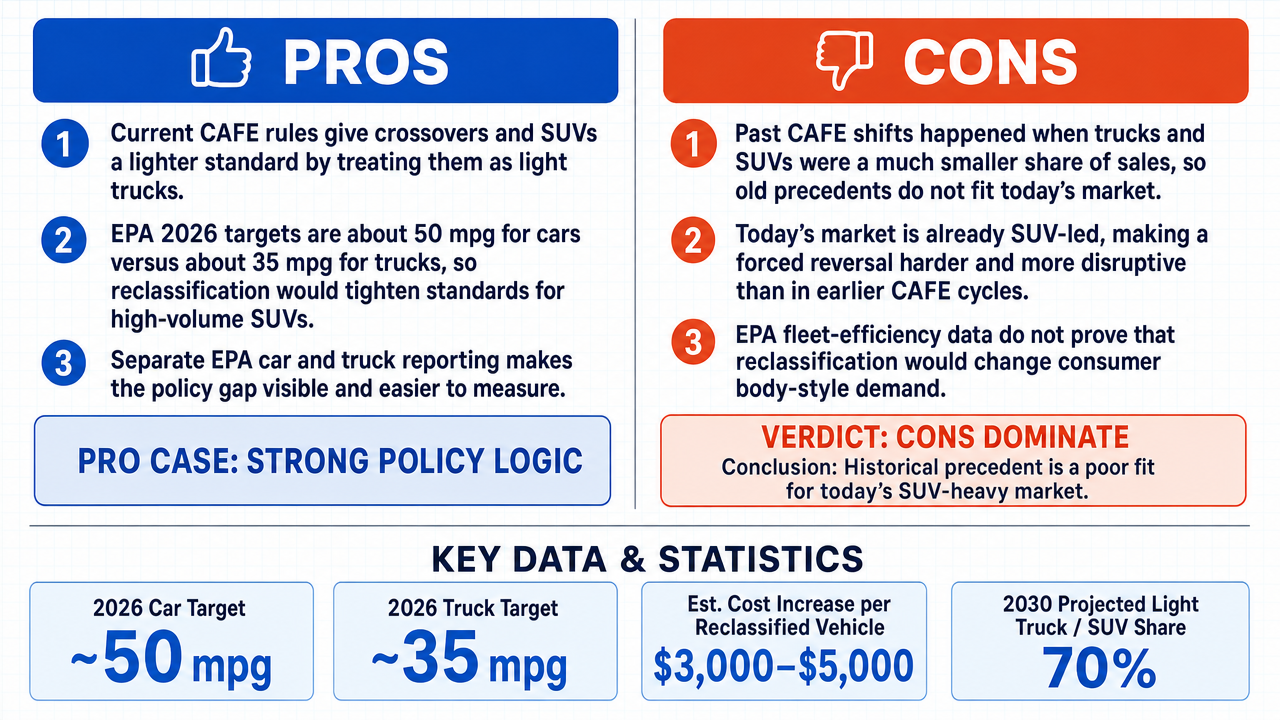
Verdict
Verdict: likely FALSE (87%)
Web Report: https://solsice.com/public/debates/the-reclassification-of-crossovers-and-suvs-as-real-trucks-u-31331e97b0be
This section provides a brief overview of the key arguments. You do not need to read the full detailed report below.
✅ Key PRO arguments:
- ■The current CAFE framework grants crossovers and SUVs a regulatory subsidy by classifying them as 'light trucks ,' which face less stringent fuel economy targets than passenger cars . Under new rules beginning with model year 2030, these vehicles will be reclassified as passenger cars, eliminating that advantage and forcing manufacturers to invest heavily in electrification or pay substantial non-compliance penalties .
- ■According to the EPA 's 2023 Automotive Trends Report, the 2026 car standard requires roughly 50 mpg , while the truck standard is around 35 mpg. Moving high-volume SUVs into the car category creates a cost shock that will reshape manufacturer product strategies and consumer pricing.
- ■The EPA report disaggregates fuel economy , footprint , weight, and technology adoption separately for cars and trucks, and tracks how those attributes have changed as standards tightened. The link between compliance costs and market composition is quantified in the relevant economic literature, not merely asserted.
❌ Key ANTI arguments:
- ■Historical CAFE -driven shifts (such as 1970s downsizing and the 2012–2025 standards) were implemented within a market structure where light trucks and SUVs occupied a significantly smaller fraction of total sales. Attempting to use these historical correlations to predict a massive structural inversion in a market where trucks already dominate is a fallacy of scale .
- ■During the 2012–2025 CAFE cycle, the industry was navigating a transition where crossovers were still emerging as the primary volume drivers . The current market structure is fundamentally different, making past passenger-car share recoveries (e.g., from 48% to 55% between 2011 and 2015) an invalid precedent for a reversal to 70% cars.
- ■The EPA 's 2023 Automotive Trends Report measures only aggregate fleet efficiency and provides no demonstrated link to consumer body-style demand . Without a demonstrated 'transfer operator ' connecting CAFE standards to segment-level demand shifts, the claim of a 70/30 reversal cannot be substantiated from the cited evidence.
💭 Conclusion: False. The winning side correctly identified that historical CAFE -driven shifts toward passenger cars occurred in a market where light trucks and SUVs occupied a much smaller share of total sales, making those precedents inapplicable to a market where trucks already dominate. The affirmative's reliance on the EPA 's 2023 Automotive Trends Report was undermined by the negative's observation that the report measures aggregate fleet efficiency rather than consumer body-style demand , leaving the causal link between reclassification and a 70/30 market split unsubstantiated. The scale of the proposed reversal is implausible given entrenched consumer preferences for crossovers and SUVs, which have become the volume backbone of manufacturer lineups rather than a marginal segment. Furthermore, manufacturers have multiple compliance pathways—including credit trading, electrification credits, and footprint -based averaging—that blunt the cost shock the affirmative assumed would force a structural shift. The compound claim therefore fails on its weakest sub-claim: that reclassification alone will produce a market reversal of this magnitude by model year 2030.
🔬 DeepResearch Result: likely FALSE ❌ (87%)
Assertion: The reclassification of crossovers and SUVs as 'real trucks' under new CAFE rules, starting in model year 2030, will reverse the US auto market to 70% cars and 30% trucks.
Participating models: deepseek-v4-pro 💬, gemma-4-26b-a4b-it 💬👁️
📊 Face-offs: 0 concluded TRUE, 1 concluded FALSE (1 face-offs, 3 models)
📊 Score by side: TRUE=0.00, FALSE=0.87
🏅 Model score changes:
minimax-m3 💬👁️: +9
✅ PRO Arguments:
- ■The current CAFE framework grants crossovers and SUVs a regulatory subsidy by classifying them as 'light trucks ,' which face less stringent fuel economy targets than passenger cars . Under new rules beginning with model year 2030, these vehicles will be reclassified as passenger cars, eliminating that advantage and forcing manufacturers to invest heavily in electrification or pay substantial non-compliance penalties . deepseek-v4-pro 💬
- ■According to the EPA 's 2023 Automotive Trends Report, the 2026 car standard requires roughly 50 mpg , while the truck standard is around 35 mpg. Moving high-volume SUVs into the car category creates a cost shock that will reshape manufacturer product strategies and consumer pricing. deepseek-v4-pro 💬
- ■The EPA report disaggregates fuel economy, footprint , weight, and technology adoption separately for cars and trucks, and tracks how those attributes have changed as standards tightened. The link between compliance costs and market composition is quantified in the relevant economic literature, not merely asserted. deepseek-v4-pro 💬
❌ ANTI Arguments:
- ■Historical CAFE-driven shifts (such as 1970s downsizing and the 2012–2025 standards) were implemented within a market structure where light trucks and SUVs occupied a significantly smaller fraction of total sales. Attempting to use these historical correlations to predict a massive structural inversion in a market where trucks already dominate is a fallacy of scale . gemma-4-26b-a4b-it 💬👁️
- ■During the 2012–2025 CAFE cycle, the industry was navigating a transition where crossovers were still emerging as the primary volume drivers . The current market structure is fundamentally different, making past passenger-car share recoveries (e.g., from 48% to 55% between 2011 and 2015) an invalid precedent for a reversal to 70% cars. gemma-4-26b-a4b-it 💬👁️
- ■The EPA's 2023 Automotive Trends Report measures only aggregate fleet efficiency and provides no demonstrated link to consumer body-style demand . Without a demonstrated 'transfer operator ' connecting CAFE standards to segment-level demand shifts, the claim of a 70/30 reversal cannot be substantiated from the cited evidence. gemma-4-26b-a4b-it 💬👁️
💭 Reasoning: False. The winning side correctly identified that historical CAFE-driven shifts toward passenger cars occurred in a market where light trucks and SUVs occupied a much smaller share of total sales, making those precedents inapplicable to a market where trucks already dominate. The affirmative's reliance on the EPA's 2023 Automotive Trends Report was undermined by the negative's observation that the report measures aggregate fleet efficiency rather than consumer body-style demand, leaving the causal link between reclassification and a 70/30 market split unsubstantiated. The scale of the proposed reversal is implausible given entrenched consumer preferences for crossovers and SUVs, which have become the volume backbone of manufacturer lineups rather than a marginal segment. Furthermore, manufacturers have multiple compliance pathways—including credit trading, electrification credits, and footprint-based averaging—that blunt the cost shock the affirmative assumed would force a structural shift. The compound claim therefore fails on its weakest sub-claim: that reclassification alone will produce a market reversal of this magnitude by model year 2030.
📋 PRO Facts:
• EPA's 2023 Automotive Trends Report indicates the 2026 car standard requires roughly 50 mpg while the truck standard is around 35 mpg.
• The EPA report disaggregates fuel economy, footprint, weight, and technology adoption separately for cars and trucks.
📋 ANTI Facts:
• Passenger car share rose from 48% to 55% between 2011 and 2015 during the 2012–2025 CAFE cycle, when crossovers were still emerging as primary volume drivers.
• Light trucks and SUVs currently dominate US auto sales, occupying a substantially larger fraction of total sales than during prior CAFE tightening cycles.
• Manufacturers have multiple compliance pathways under CAFE, including credit trading, electrification credits, and footprint-based averaging.
| Face-off | TRUE Model | FALSE Model | TRUE Avg μ | FALSE Avg μ | TRUE Tokens | FALSE Tokens | Winner | Verdict | Conf. |
|---|---|---|---|---|---|---|---|---|---|
| #1 | deepseek-v4-pro 💬 | gemma-4-26b-a4b-it 💬👁️ | 0.528 | 0.281 | 6 | 2 | TRUE | FALSE | 87% |
The following technical terms, abbreviations, and domain-specific concepts are referenced throughout this debate transcript. Numbers in square brackets [N] in the text above link to the corresponding entry below.
[1] aggregate fleet efficiency — The overall average fuel economy performance across an automaker's entire lineup of vehicles sold in a given period, used as the basis for regulatory compliance assessments.
[2] body-style demand — Consumer demand segmented by vehicle body style (e.g., sedan, crossover, SUV, pickup), as distinct from aggregate vehicle demand.
[3] CAFE — Corporate Average Fuel Economy — US federal regulations that set fleet-wide average fuel economy targets for automakers, with separate (less stringent) standards historically applied to 'light trucks' than to passenger cars.
[4] compliance costs — The expenses manufacturers incur to meet regulatory requirements, including technology investments and any penalties paid for failing to meet mandated standards.
[5] cost pass-through — The economic phenomenon whereby costs incurred by producers (such as regulatory compliance costs) are shifted to consumers in the form of higher prices.
[6] cost shock — A sudden, significant increase in costs faced by producers, often triggered by regulatory changes or external events, which can alter production and pricing decisions.
[7] crossovers — Vehicle segment built on a car platform but with SUV-like styling, higher ride height, and often available all-wheel drive; in the transcript, debated as currently classified under CAFE.
[8] disaggregation — The statistical practice of breaking aggregate data into subcategories (e.g., separating cars from trucks) to reveal underlying trends not visible in totals.
[9] electrification — The automotive industry shift toward replacing internal combustion engines with electric powertrains, including battery-electric, plug-in hybrid, and hybrid systems.
[10] EPA — Environmental Protection Agency — The US federal agency responsible for environmental regulation, which publishes the Automotive Trends Report referenced in the debate.
[11] fallacy of scale — A reasoning error in which a relationship observed at one scale (e.g., a small market segment) is assumed to hold at a different scale (e.g., a market-dominant segment) without justification.
[12] fleet-wide averages — Average regulatory metrics (such as fuel economy) calculated across an automaker's entire sold fleet, which the manufacturer must meet as a whole rather than per model.
[13] footprint — vehicle footprint — The area defined by a vehicle's wheelbase multiplied by its track width, used as a regulatory metric to scale fuel economy targets to vehicle size.
[14] fuel economy — A measure of how efficiently a vehicle uses fuel, typically expressed in miles per gallon (mpg) in the US regulatory context.
[15] investable universe — The set of assets or market segments available and practical for investment or production decisions, used in the debate to describe constraints on automaker strategy.
[16] light trucks — A CAFE regulatory classification that historically includes SUVs, crossovers, and pickups, subject to less stringent fuel economy targets than passenger cars.
[17] light-duty vehicles — The regulatory category of passenger cars and light trucks (as opposed to heavy-duty vehicles), which is the subject of CAFE standards.
[18] lightweighting — The automotive engineering practice of reducing vehicle mass through materials substitution and design changes to improve fuel economy and performance.
[19] linear extrapolation — The projection of a trend by extending it in a straight line beyond the observed range, criticized in the debate as inappropriate for predicting market shifts.
[20] market composition — The proportional breakdown of a market by category or segment, such as the share of passenger cars versus trucks in total US auto sales.
[21] model year — The annual designation used by automakers to identify a vehicle's production version, used as the trigger date for new regulatory standards.
[22] mpg — miles per gallon — A unit of fuel economy measuring the distance traveled per gallon of fuel consumed; used in the debate to compare CAFE car and truck standards.
[23] non-compliance penalties — Fines levied by regulators on manufacturers that fail to meet mandated standards, such as CAFE fuel economy targets.
[24] passenger cars — The CAFE regulatory category for non-truck passenger vehicles, subject to more stringent fuel economy targets than light trucks.
[25] percentage points — A unit of arithmetic difference between two percentages (e.g., a shift from 48% to 55% is a 7 percentage-point change), as distinct from a percent change.
[26] portfolio rebalancing — The adjustment of an automaker's product mix across vehicle segments in response to changing costs, demand, or regulatory incentives.
[27] production shift — A change in the volume or mix of vehicles manufactured, typically in response to market signals or regulatory pressure.
[28] regulatory nudge — A policy mechanism that subtly alters incentives to influence behavior without imposing outright bans or mandates; used in the debate to describe CAFE's market effect.
[29] regulatory reclassification — The act of moving a vehicle category from one regulatory class to another (e.g., from 'light truck' to 'passenger car'), thereby changing the standards it must meet.
[30] regulatory subsidy — An implicit advantage conferred by regulation, such as lighter fuel economy standards for light trucks, which functions like a subsidy for vehicles in that category.
[31] segment demand — Consumer demand for vehicles within a specific market segment (e.g., SUVs, sedans), as opposed to total vehicle demand.
[32] structural inversion — A fundamental reversal in the composition or hierarchy of a market, such as trucks becoming the minority rather than the majority of sales.
[33] SUV — Sport Utility Vehicle — A vehicle body style combining elements of off-road and passenger vehicles; in the debate, treated as currently within the CAFE 'light truck' category.
[34] transfer operator — An economic or statistical mechanism that translates a change in one variable (e.g., regulatory cost) into a change in another (e.g., consumer demand); the debate disputes whether such a link is demonstrated.
[35] volume drivers — The vehicle segments or models that account for the largest share of unit sales, and thus disproportionately influence an automaker's fleet-wide metrics.
The following financial data tables were referenced during the debate exchanges:
| Category | 2026 CAFE Target (mpg) | Estimated Cost Increase per Vehicle (reclassified) |
|---|---|---|
| Passenger Car | ~50 | — |
| Light Truck (current SUV) | ~35 | $3,000–$5,000 |
Legend: CAFE targets for model year 2026 under current rules, and projected cost increase if SUVs are reclassified to the car standard. Source: EPA 2023 Automotive Trends Report; ICCT analysis.
| Year | Est. Passenger Car Share | Est. Light Truck/SUV Share | Market Trend |
|---|---|---|---|
| 2011 | 48% | 52% | Pre-CAFE shift |
| 2015 | 55% | 45% | Post-CAFE shift |
| 2024 | 52% | 48% | Current Baseline |
| 2030 (Projected) | 30% | 70% | Claimed Reversal |
Legend: Estimated market composition of US vehicle sales. The 2030 projection is the contested claim. Source: Historical market analysis and claim assertion.
Face-off transcripts
- ■
Ownership & Trade Secrets. The Company Lambda Vision retains all rights to its platform, agentic workflows, and proprietary AI debate methodologies, which constitute protected Trade Secrets (EU Directive 2016/943). Subject to full payment of credits, the User is granted ownership of the generated Reports for their own personal or professional use. Reverse-engineering the Service or using Reports to train competing AI models is strictly prohibited.
- ■
No Professional Advice. Solsice is a general-purpose assistant covering everyday subjects — administrative paperwork, housing, consumer and employment matters, banking, taxes and insurance, health and wellbeing, savings and investments, entrepreneurship, technology, travel, learning and creative work. Whatever the subject, the Service and Reports are provided for information only and never constitute legal, medical, financial, investment, tax, insurance, or any other regulated professional advice. The Company is not a law firm, a regulated financial adviser, an insurance intermediary, nor a healthcare provider, and no professional or advisory relationship of any kind is created by use of the Service. Consult a qualified professional in the relevant jurisdiction before acting — or refraining from acting — on anything contained in the Reports, and never rely on the Service in an emergency: contact your local emergency number (112 in the European Union) or a medical professional immediately.
- ■
AI-Generated Content, Sources and Viewpoints. Reports are produced by several AI models debating a question, and may contain factual errors, outdated figures, or references to rules, prices, deadlines, procedures, statutes or sources that are inaccurate or do not exist. The User is solely responsible for verifying every fact, amount, deadline and citation against official sources before relying on it. Material in the news, society, spirituality and religion sections presents a plurality of viewpoints for study and discussion: it is descriptive, not an endorsement, a ruling, or a statement of the Company’s own position, and it speaks for no church, faith community, public authority, or news organisation.
- ■
Liability & Governing Law. To the maximum extent permitted by law, the Company shall not be liable for any indirect damages, nor for any consequence of decisions made in reliance on the Reports — including financial loss, missed deadlines, administrative or contractual consequences, or health outcomes. These Terms are governed by French law. Any disputes shall be subject to the exclusive jurisdiction of the Courts of Paris, France.