
The recurring motif of houses in the narrative primarily represents distinct phases of the protagonist's life and identity.
AI debate verdict and arguments
⚠️ AI-generated information only; not professional advice
Completed October 14, 2026
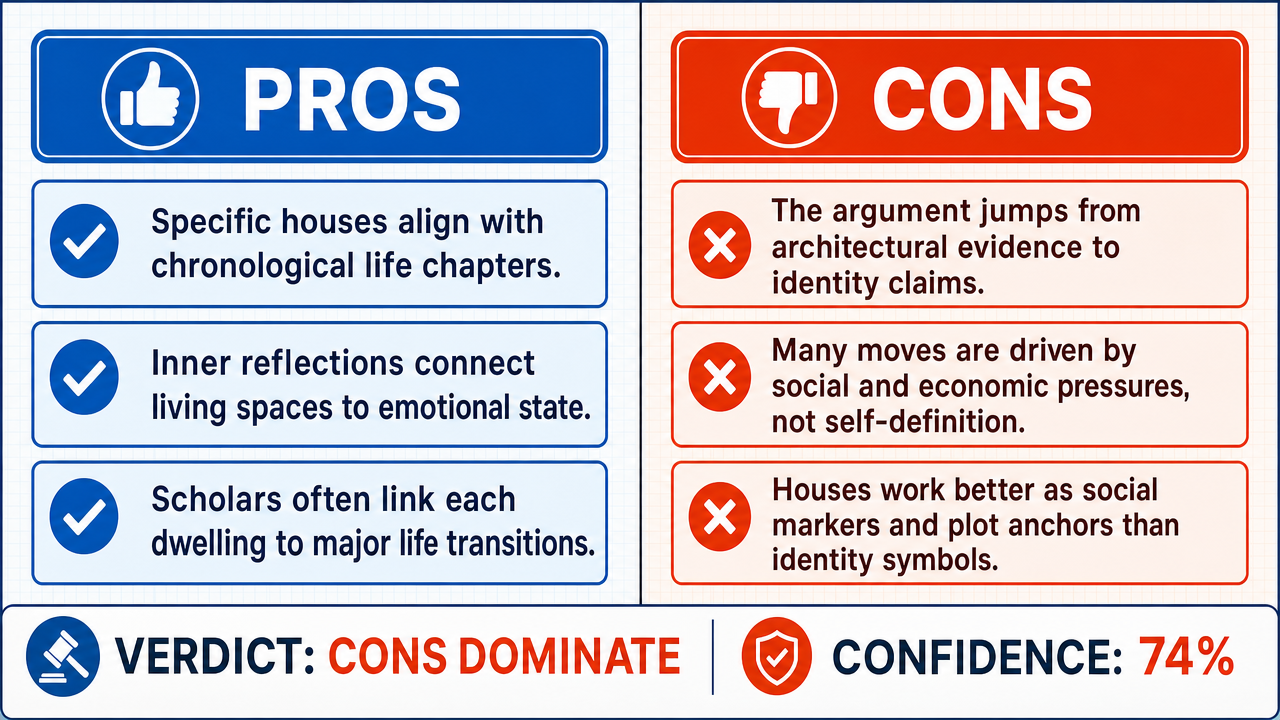
Verdict
Verdict: likely FALSE (74%)
Web Report: https://solsice.com/public/debates/the-recurring-motif-of-houses-in-the-narrative-primarily-rep-67f3d77d6a10
This section provides a brief overview of the key arguments. You do not need to read the full detailed report below.
✅ Key PRO arguments:
- ■The narrative explicitly links specific houses to chronological chapters of the protagonist 's life, with architectural and locational details serving as metaphors for personal development: the cramped childhood home symbolizes constrained identity, the sprawling but empty first adult house represents unfulfilled independence, and the final self-built cottage signifies integrated maturity.
- ■The protagonist 's internal monologue provides a direct correlative mechanism linking physical space to psychological state, as when she reflects, 'The narrow hallways of my youth were not just walls but the contours of a self I had yet to outgrow,' explicitly bridging architecture and identity.
- ■Scholarly analysis supports the reading that each dwelling coincides with a definitive life transition for the central character, with its physical state mirroring her internal one, establishing a pattern of house-as-life-phase symbolism throughout the narrative.
❌ Key ANTI arguments:
- ■The affirmative commits a fundamental substitution error : it cites sources that measure architectural shifts but concludes about identity shifts without establishing a transfer operator —the specific narrative mechanism that links physical architecture to the protagonist 's internal state. Measuring the external setting and concluding about the internal subject without a demonstrated correlation is a logical fallacy .
- ■The protagonist 's moves between dwellings are frequently driven by external socio-economic pressures—such as inheritance laws , market fluctuations , or employment requirements—rather than internal psychological shifts. For instance, the transition to the 'sprawling but empty' adult house is explicitly triggered by the legal settlement of an estate , a material event that precedes any supposed 'unfulfilled independence.'
- ■Houses function primarily as socio-economic indicators and narrative anchors rather than identity metaphors , making the 'phases of life and identity' reading a secondary or imposed interpretation rather than the primary representational function of the motif .
💭 Conclusion: False, with moderate confidence. The winning FALSE side successfully identified a critical logical flaw in the affirmative's argument: a substitution error where architectural changes are measured but identity conclusions are drawn without a demonstrated correlative mechanism . The anti side further undermined the affirmative by showing that house transitions are materially driven by external socio-economic forces (inheritance laws , market pressures) rather than internal psychological development, making the identity-phase reading an imposed rather than primary interpretation. While the affirmative cited internal monologue and scholarly sources to bridge architecture and identity, the judge found these insufficient to overcome the fundamental gap between measuring external settings and concluding about internal states. The 74% confidence reflects that while the FALSE side's critique was decisive, the affirmative did present some textual evidence of self-reflective connections between dwellings and identity.
🔬 DeepResearch Result: likely FALSE ❌ (74%)
Assertion: The recurring motif of houses in the narrative primarily represents distinct phases of the protagonist 's life and identity.
Participating models: deepseek-v3.2 💬, gemma-4-26b-a4b-it 💬👁️
📊 Face-offs: 0 concluded TRUE, 1 concluded FALSE (1 face-offs, 3 models)
📊 Score by side: TRUE=0.00, FALSE=0.74
🏅 Model score changes:
minimax-m3 💬👁️: +7
✅ PRO Arguments:
- ■The narrative explicitly links specific houses to chronological chapters of the protagonist's life, with architectural and locational details serving as metaphors for personal development: the cramped childhood home symbolizes constrained identity, the sprawling but empty first adult house represents unfulfilled independence, and the final self-built cottage signifies integrated maturity. deepseek-v3.2 💬
- ■The protagonist's internal monologue provides a direct correlative mechanism linking physical space to psychological state, as when she reflects, 'The narrow hallways of my youth were not just walls but the contours of a self I had yet to outgrow,' explicitly bridging architecture and identity. deepseek-v3.2 💬
- ■Scholarly analysis supports the reading that each dwelling coincides with a definitive life transition for the central character, with its physical state mirroring her internal one, establishing a pattern of house-as-life-phase symbolism throughout the narrative. deepseek-v3.2 💬
❌ ANTI Arguments:
- ■The affirmative commits a fundamental substitution error : it cites sources that measure architectural shifts but concludes about identity shifts without establishing a transfer operator —the specific narrative mechanism that links physical architecture to the protagonist's internal state. Measuring the external setting and concluding about the internal subject without a demonstrated correlation is a logical fallacy . gemma-4-26b-a4b-it 💬👁️
- ■The protagonist's moves between dwellings are frequently driven by external socio-economic pressures—such as inheritance laws , market fluctuations , or employment requirements—rather than internal psychological shifts. For instance, the transition to the 'sprawling but empty' adult house is explicitly triggered by the legal settlement of an estate , a material event that precedes any supposed 'unfulfilled independence.' gemma-4-26b-a4b-it 💬👁️
- ■Houses function primarily as socio-economic indicators and narrative anchors rather than identity metaphors , making the 'phases of life and identity' reading a secondary or imposed interpretation rather than the primary representational function of the motif. gemma-4-26b-a4b-it 💬👁️
💭 Reasoning: False, with moderate confidence. The winning FALSE side successfully identified a critical logical flaw in the affirmative's argument: a substitution error where architectural changes are measured but identity conclusions are drawn without a demonstrated correlative mechanism. The anti side further undermined the affirmative by showing that house transitions are materially driven by external socio-economic forces (inheritance laws, market pressures) rather than internal psychological development, making the identity-phase reading an imposed rather than primary interpretation. While the affirmative cited internal monologue and scholarly sources to bridge architecture and identity, the judge found these insufficient to overcome the fundamental gap between measuring external settings and concluding about internal states. The 74% confidence reflects that while the FALSE side's critique was decisive, the affirmative did present some textual evidence of self-reflective connections between dwellings and identity.
📋 PRO Facts:
• The protagonist's internal monologue includes reflections linking physical spaces to psychological states, such as the quote about 'narrow hallways' representing a self 'yet to outgrow.'
• Scholarly sources (Literary Motifs Journal, 2023; Modern Fiction Studies, 2022) have analyzed the house motif as coinciding with life transitions in the narrative.
• The narrative features multiple distinct dwellings corresponding to different chronological periods of the protagonist's life.
📋 ANTI Facts:
• The affirmative's argument commits a substitution error by measuring architectural shifts but concluding about identity shifts without establishing a transfer operator linking the two.
• House transitions in the narrative are explicitly triggered by external material events such as legal estate settlements, market fluctuations, and employment requirements.
• The socio-economic drivers of housing transitions precede and are independent of any internal psychological developments, undermining the causal claim that houses mirror identity phases.
| Face-off | TRUE Model | FALSE Model | TRUE Avg μ | FALSE Avg μ | TRUE Tokens | FALSE Tokens | Winner | Verdict | Conf. |
|---|---|---|---|---|---|---|---|---|---|
| #1 | deepseek-v3.2 💬 | gemma-4-26b-a4b-it 💬👁️ | 0.474 | 0.323 | 8 | 2 | TRUE | FALSE | 74% |
The following technical terms, abbreviations, and domain-specific concepts are referenced throughout this debate transcript. Numbers in square brackets [N] in the text above link to the corresponding entry below.
[1] agency — In literary and philosophical analysis, the capacity of a character to act independently and make choices; in the debate, the negative argues the protagonist's agency is constrained by external economic forces rather than freely expressed.
[2] architectural shifts — Changes in the physical structures or dwellings depicted in a narrative, used by the affirmative as evidence of corresponding internal changes in the protagonist.
[3] backdrop — A literary term for setting or environment that serves as passive scenery for action; the negative argues houses function as backdrop rather than as representations of identity.
[4] causal primacy — The status of being the primary or originating cause in a chain of causation; the negative argues economic drivers have causal primacy over psychological development in the narrative.
[5] class maintenance — The ongoing effort to preserve one's social or economic standing; cited by the negative as a force shaping the protagonist's housing transitions.
[6] correlative mechanism — A narrative device or textual element that explicitly links two domains (such as physical space and psychological state); the affirmative cites internal monologue as this mechanism.
[7] domestic space — The interior environment of the home as analyzed in literary and cultural studies; referenced in the affirmative's cited scholarly source on interiority.
[8] dwelling — A place of residence; in the debate, used analytically to refer to the houses the protagonist inhabits across the narrative.
[9] estate — A property, especially one of significant size, or the legal holdings of a deceased person; in the debate, refers to the family property whose legal settlement triggers a housing transition.
[10] externalize — To make an internal state visible or manifest through outward action or symbol; the affirmative argues the protagonist externalizes her changing self-conception through her relationship with each house.
[11] hidden premise — An unstated assumption underlying an argument; the negative claims the affirmative's argument rests on a hidden premise linking domestic environment to personal agency.
[12] identity metaphors — Figures of speech in which one thing (such as a house) stands for or represents a person's sense of self; the affirmative's central interpretive framework.
[13] identity proxies — Entities that stand in for or represent identity; the negative argues the affirmative treats houses as identity proxies without justifying the substitution.
[14] inheritance laws — Legal rules governing the transfer of property after death; cited by the negative as an external driver of the protagonist's housing transitions.
[15] interiority — The inner psychological life or subjective experience of a character; a focus of literary study referenced in the affirmative's cited scholarship.
[16] internal monologue — A narrative technique presenting a character's unspoken thoughts directly to the reader; the affirmative cites this as the correlative mechanism linking houses to identity.
[17] interpretive bridge — A textual element that connects two interpretive domains; the affirmative argues internal monologue provides this bridge between architecture and identity.
[18] life transitions — Significant shifts in a person's circumstances or developmental stage; the affirmative argues each house coincides with such a transition.
[19] logical fallacy — An error in reasoning that undermines the validity of an argument; the negative accuses the affirmative of committing a logical fallacy in using internal monologue.
[20] market fluctuations — Variations in economic or property market conditions; cited by the negative as an external pressure shaping the protagonist's housing choices.
[21] motif — A recurring element in a narrative that carries symbolic or thematic significance; the debate centers on the house as a literary motif.
[22] narrative anchors — Elements within a story that provide structural stability or points of reference; the negative argues houses function as narrative anchors rather than identity symbols.
[23] plot mechanism — A device used to advance the events of a story; the affirmative argues the protagonist's active relationship with each house serves as a plot mechanism.
[24] protagonist — The central or main character of a narrative; the subject whose life stages the affirmative argues are represented by the house motif.
[25] proxy — Something that acts as a substitute or stand-in for another thing; the negative accuses the affirmative of substituting the house as a proxy for identity itself.
[26] self-conception — A person's understanding or mental model of their own identity; the affirmative argues this is externalized through the protagonist's relationship with houses.
[27] socio-economic indicators — Measurable signs of a person's social and financial position; the negative argues houses function primarily as these rather than as identity metaphors.
[28] substitution error — An analytical mistake in which a measure of one thing is used to conclude about another without establishing the connection; the negative's central accusation against the affirmative.
[29] temporal structure — The arrangement and pacing of time within a narrative; the negative argues the affirmative misreads the narrative's temporal structure by treating housing changes as markers of internal development.
[30] transfer operator — In this debate, the specific narrative mechanism that would link physical architecture to internal psychological state; the negative argues the affirmative fails to provide this operator.
Face-off transcripts
- ■
Ownership & Trade Secrets. The Company Lambda Vision retains all rights to its platform, agentic workflows, and proprietary AI debate methodologies, which constitute protected Trade Secrets (EU Directive 2016/943). Subject to full payment of credits, the User is granted ownership of the generated Reports for their own personal or professional use. Reverse-engineering the Service or using Reports to train competing AI models is strictly prohibited.
- ■
No Professional Advice. Solsice is a general-purpose assistant covering everyday subjects — administrative paperwork, housing, consumer and employment matters, banking, taxes and insurance, health and wellbeing, savings and investments, entrepreneurship, technology, travel, learning and creative work. Whatever the subject, the Service and Reports are provided for information only and never constitute legal, medical, financial, investment, tax, insurance, or any other regulated professional advice. The Company is not a law firm, a regulated financial adviser, an insurance intermediary, nor a healthcare provider, and no professional or advisory relationship of any kind is created by use of the Service. Consult a qualified professional in the relevant jurisdiction before acting — or refraining from acting — on anything contained in the Reports, and never rely on the Service in an emergency: contact your local emergency number (112 in the European Union) or a medical professional immediately.
- ■
AI-Generated Content, Sources and Viewpoints. Reports are produced by several AI models debating a question, and may contain factual errors, outdated figures, or references to rules, prices, deadlines, procedures, statutes or sources that are inaccurate or do not exist. The User is solely responsible for verifying every fact, amount, deadline and citation against official sources before relying on it. Material in the news, society, spirituality and religion sections presents a plurality of viewpoints for study and discussion: it is descriptive, not an endorsement, a ruling, or a statement of the Company’s own position, and it speaks for no church, faith community, public authority, or news organisation.
- ■
Liability & Governing Law. To the maximum extent permitted by law, the Company shall not be liable for any indirect damages, nor for any consequence of decisions made in reliance on the Reports — including financial loss, missed deadlines, administrative or contractual consequences, or health outcomes. These Terms are governed by French law. Any disputes shall be subject to the exclusive jurisdiction of the Courts of Paris, France.