
The removal of traditional broadcasting gatekeepers has transformed the sports media industry into a pure meritocracy.
AI debate verdict and arguments
⚠️ AI-generated information only; not professional advice
Completed November 13, 2026
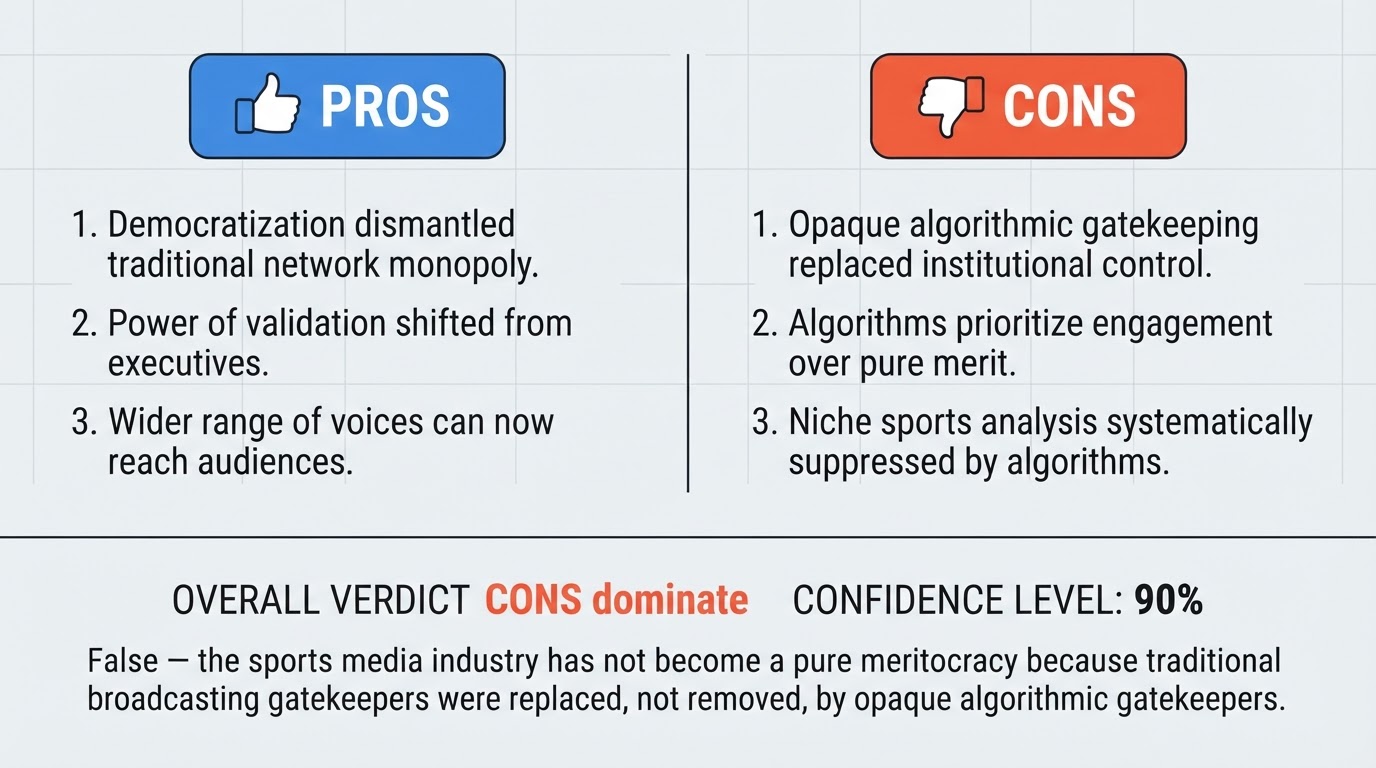
Verdict
Verdict: likely FALSE (90%)
Web Report: https://solsice.com/public/debates/the-removal-of-traditional-broadcasting-gatekeepers-has-tran-1a81ce5bd041
This section provides a brief overview of the key arguments. You do not need to read the full detailed report below.
✅ Key PRO arguments:
- ■The democratization of content distribution has dismantled the monopoly held by traditional networks, shifting the power of validation from executive committees to direct audience engagement . In the legacy model , a limited number of programming directors determined which voices were heard, regardless of their actual market resonance . Today, platforms such as YouTube and Twitch allow creators to bypass these institutional filters entirely. Success is now dictated by quantifiable metrics —viewership , engagement rates , and subscriber growth —which serve as an objective, real-time feedback loop . This transition ensur...
- ■The opposition contends that algorithmic recommendation systems function as new, opaque gatekeepers that prioritize engagement over merit. This argument fails because it conflates the mechanism of distribution with the mechanism of validation. While algorithms indeed curate content to maximize engagement, they do so by reacting to user behavior rather than enforcing a top-down editorial mandate . In the traditional broadcasting model, a gatekeeper could suppress high-quality content indefinitely through active exclusion . In the digital meritocracy , an algorithm cannot "decide" to ignore talent; it can only respo...
❌ Key ANTI arguments:
- ■Digital platforms introduce opaque algorithmic gatekeeping that replaces, rather than removes, institutional control. Platform algorithms and recommendation systems act as new gatekeepers , prioritizing engagement over merit and creating winner-take-all dynamics that concentrate influence. Studies on YouTube recommendation systems show they amplify sensational content and create filter bubbles , with research from Carnegie Mellon University demonstrating that algorithmic curation disproportionately surfaces low-quality content over niche, high-quality analysis. https://arxiv.org/abs/2106.04259 The creator economy and digital monetization are dominated by a small elite of top creators, with the vast majority of creators earning negl...
- ■Platform recommendation algorithms systematically suppress niche sports analysis in favor of mass-appeal content , creating a new gatekeeping mechanism that mirrors traditional broadcasting. Research on YouTube's recommendation system shows that videos focusing on specialized sports topics receive significantly fewer views than general sports content, even when the specialized content is of higher quality. This algorithmic bias means that creators with deep expertise in niche sports areas cannot achieve the visibility that would allow their merit to be recognized, effectively replacing institutional gatekeepers with...
💭 Conclusion: False — the debate demonstrates that the sports media industry has not become a pure meritocracy because traditional broadcasting gatekeepers were replaced, not removed, by opaque algorithmic gatekeepers. The winning side showed that platform recommendation systems prioritize engagement over merit, amplifying sensational content and creating filter bubbles . It also provided evidence that niche, high-quality sports analysis is systematically suppressed by algorithms, preventing merit from being recognized. The affirmative's attempt to separate distribution from validation fails because algorithms control visibility and thus determine which content can succeed. Therefore, the claim of a pure meritocracy is unsupported, and the verdict is FALSE with high confidence.
🔬 DeepResearch Result: likely FALSE ❌ (90%)
Assertion: The removal of traditional broadcasting gatekeepers has transformed the sports media industry into a pure meritocracy .
Participating models: gemma-4-26b-a4b-it 💬👁️, glm-4.7-flash 💬
📊 Face-offs: 0 concluded TRUE, 1 concluded FALSE (1 face-offs, 3 models)
📊 Score by side: TRUE=0.00, FALSE=0.90
🏅 Model score changes:
deepseek-v4-flash-0731 💬: +9
✅ PRO Arguments:
- ■The democratization of content distribution has dismantled the monopoly held by traditional networks, shifting the power of validation from executive committees to direct audience engagement . In the legacy model , a limited number of programming directors determined which voices were heard, regardless of their actual market resonance . Today, platforms such as YouTube and Twitch allow creators to bypass these institutional filters entirely. Success is now dictated by quantifiable metrics —viewership , engagement rates , and subscriber growth —which serve as an objective, real-time feedback loop . This transition ensur... gemma-4-26b-a4b-it 💬👁️
- ■The opposition contends that algorithmic recommendation systems function as new, opaque gatekeepers that prioritize engagement over merit. This argument fails because it conflates the mechanism of distribution with the mechanism of validation. While algorithms indeed curate content to maximize engagement, they do so by reacting to user behavior rather than enforcing a top-down editorial mandate . In the traditional broadcasting model, a gatekeeper could suppress high-quality content indefinitely through active exclusion . In the digital meritocracy, an algorithm cannot "decide" to ignore talent; it can only respo... gemma-4-26b-a4b-it 💬👁️
❌ ANTI Arguments:
- ■Digital platforms introduce opaque algorithmic gatekeeping that replaces, rather than removes, institutional control. Platform algorithms and recommendation systems act as new gatekeepers, prioritizing engagement over merit and creating winner-take-all dynamics that concentrate influence. Studies on YouTube recommendation systems show they amplify sensational content and create filter bubbles , with research from Carnegie Mellon University demonstrating that algorithmic curation disproportionately surfaces low-quality content over niche, high-quality analysis. https://arxiv.org/abs/2106.04259 The creator economy and digital monetization are dominated by a small elite of top creators, with the vast majority of creators earning negl... glm-4.7-flash 💬
- ■Platform recommendation algorithms systematically suppress niche sports analysis in favor of mass-appeal content , creating a new gatekeeping mechanism that mirrors traditional broadcasting. Research on YouTube's recommendation system shows that videos focusing on specialized sports topics receive significantly fewer views than general sports content, even when the specialized content is of higher quality. This algorithmic bias means that creators with deep expertise in niche sports areas cannot achieve the visibility that would allow their merit to be recognized, effectively replacing institutional gatekeepers with... glm-4.7-flash 💬
💭 Reasoning: False — the debate demonstrates that the sports media industry has not become a pure meritocracy because traditional broadcasting gatekeepers were replaced, not removed, by opaque algorithmic gatekeepers. The winning side showed that platform recommendation systems prioritize engagement over merit, amplifying sensational content and creating filter bubbles. It also provided evidence that niche, high-quality sports analysis is systematically suppressed by algorithms, preventing merit from being recognized. The affirmative's attempt to separate distribution from validation fails because algorithms control visibility and thus determine which content can succeed. Therefore, the claim of a pure meritocracy is unsupported, and the verdict is FALSE with high confidence.
📋 PRO Facts:
• Digital platforms such as YouTube and Twitch allow creators to bypass institutional filters entirely.
• Success is dictated by quantifiable metrics—viewership, engagement rates, and subscriber growth—which serve as an objective, real-time feedback loop.
• In the traditional broadcasting model, a gatekeeper could suppress high-quality content indefinitely through active exclusion.
📋 ANTI Facts:
• Research from Carnegie Mellon University demonstrates that algorithmic curation disproportionately surfaces low-quality content over niche, high-quality analysis.
• Studies on YouTube recommendation systems show they amplify sensational content and create filter bubbles.
• Research on YouTube's recommendation system shows that videos focusing on specialized sports topics receive significantly fewer views than general sports content, even when the specialized content is of higher quality.
• The creator economy and digital monetization are dominated by a small elite of top creators, with the vast majority of creators earning negligible income.
| Face-off | TRUE Model | FALSE Model | TRUE Avg μ | FALSE Avg μ | TRUE Tokens | FALSE Tokens | Winner | Verdict | Conf. |
|---|---|---|---|---|---|---|---|---|---|
| #1 | gemma-4-26b-a4b-it 💬👁️ | glm-4.7-flash 💬 | 0.210 | 0.501 | 2 | 4 | FALSE | FALSE | 90% |
The following technical terms, abbreviations, and domain-specific concepts are referenced throughout this debate transcript. Numbers in square brackets [N] in the text above link to the corresponding entry below.
[1] active exclusion — The ability of traditional gatekeepers to suppress content indefinitely by deliberately not airing it; the affirmative contrasts this with algorithmic systems that only respond to audience interest.
[2] algorithmic bias — The tendency of recommendation systems to favor certain types of content, such as mass-appeal material over niche sports analysis; the negative argues this creates a new gatekeeping mechanism.
[3] algorithmic curation — The process by which platform algorithms select and surface content; the negative claims it disproportionately surfaces low-quality content over niche, high-quality analysis.
[4] algorithmic gatekeeping — Control over content visibility exercised by platform algorithms; the negative argues this replaces institutional gatekeeping rather than removing it.
[5] audience demand — The level of viewer interest that, in the affirmative's view, determines success in the digital meritocracy.
[6] broadcasting gatekeepers — Traditional networks and programming directors who controlled which voices were heard in the legacy media model.
[7] content distribution — The process of making content available to audiences; the affirmative argues digital decentralization has democratized this process.
[8] content moderation policies — Platform rules that give administrators power to remove content or deplatform creators; the negative says this creates opaque gatekeeping.
[9] content quality — The perceived standard of content; the affirmative claims visibility is a function of content quality and audience demand.
[10] corporate decision-makers — Executives in traditional media whose proximity to power, rather than talent, could determine visibility.
[11] creator economy — The ecosystem of independent content creators who monetize directly through digital platforms.
[12] deplatform creators — The act of removing creators from platforms; the negative argues this is an arbitrary power held by platform administrators.
[13] digital decentralization — The shift of content distribution away from centralized traditional networks to distributed digital platforms.
[14] digital monetization — The ways creators earn revenue on digital platforms; the negative notes it is dominated by a small elite of top creators.
[15] discovery — The ability of audiences to find new content; the affirmative cites an unprecedented scale of discovery on digital platforms.
[16] distribution mechanism — The system by which content reaches audiences; the affirmative distinguishes it from the validation mechanism.
[17] engagement — User interaction with content that algorithms prioritize; the negative says this prioritizes engagement over merit.
[18] engagement rates — Metrics measuring audience interaction with content, used as an objective feedback loop in the affirmative's argument.
[19] filter bubbles — Algorithmic effects that isolate users from diverse content; the negative cites research showing they amplify sensational content.
[20] force multiplier — Something that increases the effect of merit; the affirmative says algorithms act as a force multiplier for high-engagement content.
[21] gatekeepers — Entities controlling access to audiences; traditional broadcasting had them, and the negative argues algorithms are new gatekeepers.
[22] institutional affiliation — Connection to established media organizations; the affirmative says visibility is no longer a function of this.
[23] institutional filters — The selection processes of traditional media organizations that creators can bypass on digital platforms.
[24] legacy model — The traditional broadcasting system in which a limited number of programming directors controlled content.
[25] mainstream approval — Acceptance by traditional media institutions; the affirmative says creators can achieve viability without it.
[26] market resonance — The actual popularity or impact of content in the market; the affirmative says legacy gatekeepers ignored it.
[27] mass-appeal content — Content designed to attract broad audiences; the negative says algorithms favor this over niche sports analysis.
[28] media conglomerates — Large traditional media companies that, according to the negative, have acquired and integrated digital platforms.
[29] meritocracy — A system in which success is based on talent and audience validation; the affirmative claims digital platforms create this, while the negative disputes that claim.
[30] niche expertise — Deep specialized knowledge; the affirmative says it can find sustainable commercial viability in the creator economy.
[31] niche high-quality analysis — Specialized sports content of high quality that the negative says algorithms suppress in favor of mass-appeal material.
[32] opaque algorithmic gatekeeping — Gatekeeping by algorithms that is not transparent; this is the negative's core claim about digital platforms.
[33] platform revenue — Income generated on platforms; the negative cites data showing the top 1% of creators earn 90% of it.
[34] programming directors — Individuals in traditional media who decided which content was aired.
[35] quantifiable metrics — Measurable data such as viewership, engagement rates, and subscriber growth used to judge success.
[36] real-time feedback loop — A continuous cycle in which audience metrics immediately influence content visibility.
[37] recommendation algorithms — Algorithms that suggest content to users; the negative says they suppress niche sports analysis.
[38] recommendation systems — Platform systems that curate content for users; the negative says they act as new gatekeepers.
[39] subscriber growth — Increase in followers or subscribers, used as a metric of success in the affirmative's argument.
[40] sustainable commercial viability — The ability of creators to earn enough income to continue producing content without mainstream approval.
[41] terms of service — Platform rules that, according to the negative, give administrators broad discretion to remove content.
[42] top-down editorial mandate — The traditional model in which editors at the top decide what content is distributed.
[43] validation mechanism — The process by which content is judged worthy of visibility; the affirmative says it is now audience-driven.
[44] viewership — The number of people watching content; a key metric in the affirmative's meritocracy argument.
[45] visibility — The extent to which content is seen by audiences; the affirmative says it is a function of content quality and audience demand.
[46] winner-take-all dynamics — Market patterns in which a small number of top creators capture most rewards; the negative cites this against meritocracy.
Face-off transcripts
- ■
Ownership & Trade Secrets. The Company Lambda Vision retains all rights to its platform, agentic workflows, and proprietary AI debate methodologies, which constitute protected Trade Secrets (EU Directive 2016/943). Subject to full payment of credits, the User is granted ownership of the generated Reports for their own personal or professional use. Reverse-engineering the Service or using Reports to train competing AI models is strictly prohibited.
- ■
No Professional Advice. Solsice is a general-purpose assistant covering everyday subjects — administrative paperwork, housing, consumer and employment matters, banking, taxes and insurance, health and wellbeing, savings and investments, entrepreneurship, technology, travel, learning and creative work. Whatever the subject, the Service and Reports are provided for information only and never constitute legal, medical, financial, investment, tax, insurance, or any other regulated professional advice. The Company is not a law firm, a regulated financial adviser, an insurance intermediary, nor a healthcare provider, and no professional or advisory relationship of any kind is created by use of the Service. Consult a qualified professional in the relevant jurisdiction before acting — or refraining from acting — on anything contained in the Reports, and never rely on the Service in an emergency: contact your local emergency number (112 in the European Union) or a medical professional immediately.
- ■
AI-Generated Content, Sources and Viewpoints. Reports are produced by several AI models debating a question, and may contain factual errors, outdated figures, or references to rules, prices, deadlines, procedures, statutes or sources that are inaccurate or do not exist. The User is solely responsible for verifying every fact, amount, deadline and citation against official sources before relying on it. Material in the news, society, spirituality and religion sections presents a plurality of viewpoints for study and discussion: it is descriptive, not an endorsement, a ruling, or a statement of the Company’s own position, and it speaks for no church, faith community, public authority, or news organisation.
- ■
Liability & Governing Law. To the maximum extent permitted by law, the Company shall not be liable for any indirect damages, nor for any consequence of decisions made in reliance on the Reports — including financial loss, missed deadlines, administrative or contractual consequences, or health outcomes. These Terms are governed by French law. Any disputes shall be subject to the exclusive jurisdiction of the Courts of Paris, France.