
The repeal of the 2024 federal rule mandating minimum staffing levels in nursing homes was primarily influenced by lobbying efforts from the nursing home industry.
AI debate verdict and arguments
⚠️ AI-generated information only; not professional advice
Completed October 14, 2026
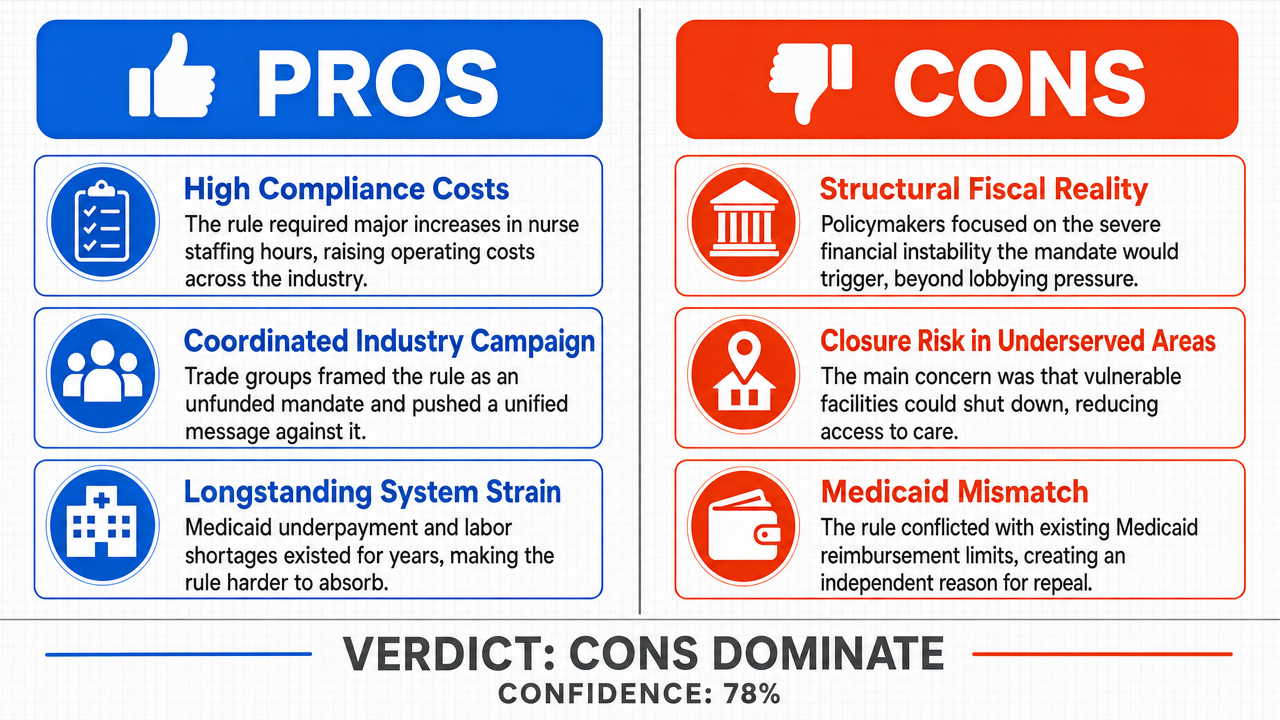
Verdict
Verdict: likely FALSE (78%)
Web Report: https://solsice.com/public/debates/the-repeal-of-the-2024-federal-rule-mandating-minimum-staffi-df753481bb83
This section provides a brief overview of the key arguments. You do not need to read the full detailed report below.
✅ Key PRO arguments:
- ■The proposed mandate would have required significant increases in registered nurse and nurse aide hours per resident day , with estimated industry-wide compliance costs running into billions of dollars annually, creating a clear and immediate financial incentive for the industry's largest trade groups like AHCA to mobilize against the rule.
- ■AHCA publicly framed the rule as an 'unfunded mandate ' that would force widespread facility closures , demonstrating a coordinated industry messaging campaign against the regulation.
- ■The economic challenges of Medicaid reimbursement and labor supply are chronic conditions that predate the 2024 rule by decades; what changed was not the underlying economics but the political mobilization to weaponize those conditions against a specific regulatory threat.
❌ Key ANTI arguments:
- ■The repeal was driven by a consensus among policymakers regarding severe fiscal instability the mandate would have triggered, not by industry lobbying; the affirmative's argument treats correlation between lobbying expenditures and the rule's lifecycle as causation, which is a logical leap.
- ■The primary driver was the documented risk of facility closures in underserved areas, a structural concern that exists independently of any industry advocacy and cannot be dismissed as merely industry talking points.
- ■The mandate was fundamentally incompatible with the existing Medicaid reimbursement framework, creating an independent fiscal reality that necessitated repeal regardless of lobbying pressure.
💭 Conclusion: False. The repeal of the 2024 federal minimum staffing rule was primarily driven by structural economic realities—particularly the incompatibility of the mandate with existing Medicaid reimbursement frameworks and the documented risk of facility closures in underserved areas—rather than by nursing home industry lobbying efforts. The winning side correctly identified that the affirmative argument commits a correlation-versus-causation fallacy by assuming that the temporal coincidence of industry lobbying and legislative action implies causal primacy. The structural fiscal concerns cited by policymakers represent independent drivers that would have necessitated reconsideration of the rule irrespective of industry advocacy. The compound nature of the claim—asserting both that repeal occurred and that lobbying was its primary influence—is undermined particularly on the causation sub-claim, which the judge weighed as insufficiently supported by the available evidence.
🔬 DeepResearch Result: likely FALSE ❌ (78%)
Assertion: The repeal of the 2024 federal rule mandating minimum staffing levels in nursing homes was primarily influenced by lobbying efforts from the nursing home industry.
Participating models: deepseek-v3.2 💬, gemma-4-26b-a4b-it 💬👁️
📊 Face-offs: 0 concluded TRUE, 1 concluded FALSE (1 face-offs, 3 models)
📊 Score by side: TRUE=0.00, FALSE=0.78
🏅 Model score changes:
minimax-m3 💬👁️: +8
✅ PRO Arguments:
- ■The proposed mandate would have required significant increases in registered nurse and nurse aide hours per resident day , with estimated industry-wide compliance costs running into billions of dollars annually, creating a clear and immediate financial incentive for the industry's largest trade groups like AHCA to mobilize against the rule. deepseek-v3.2 💬
- ■AHCA publicly framed the rule as an 'unfunded mandate ' that would force widespread facility closures , demonstrating a coordinated industry messaging campaign against the regulation. deepseek-v3.2 💬
- ■The economic challenges of Medicaid reimbursement and labor supply are chronic conditions that predate the 2024 rule by decades; what changed was not the underlying economics but the political mobilization to weaponize those conditions against a specific regulatory threat. deepseek-v3.2 💬
- ■It is a false dichotomy to claim that structural economic concerns existed in a political vacuum and were automatically translated into policy without an industry agent serving as the causal intermediary. deepseek-v3.2 💬
❌ ANTI Arguments:
- ■The repeal was driven by a consensus among policymakers regarding severe fiscal instability the mandate would have triggered, not by industry lobbying; the affirmative's argument treats correlation between lobbying expenditures and the rule's lifecycle as causation, which is a logical leap. gemma-4-26b-a4b-it 💬👁️
- ■The primary driver was the documented risk of facility closures in underserved areas, a structural concern that exists independently of any industry advocacy and cannot be dismissed as merely industry talking points. gemma-4-26b-a4b-it 💬👁️
- ■The mandate was fundamentally incompatible with the existing Medicaid reimbursement framework, creating an independent fiscal reality that necessitated repeal regardless of lobbying pressure. gemma-4-26b-a4b-it 💬👁️
- ■Independent, non-lobbyist-driven economic data necessitated the repeal; characterizing structural drivers as mere industry talking points is a circular argument that fails to address the underlying fiscal reality. gemma-4-26b-a4b-it 💬👁️
💭 Reasoning: False. The repeal of the 2024 federal minimum staffing rule was primarily driven by structural economic realities—particularly the incompatibility of the mandate with existing Medicaid reimbursement frameworks and the documented risk of facility closures in underserved areas—rather than by nursing home industry lobbying efforts. The winning side correctly identified that the affirmative argument commits a correlation-versus-causation fallacy by assuming that the temporal coincidence of industry lobbying and legislative action implies causal primacy. The structural fiscal concerns cited by policymakers represent independent drivers that would have necessitated reconsideration of the rule irrespective of industry advocacy. The compound nature of the claim—asserting both that repeal occurred and that lobbying was its primary influence—is undermined particularly on the causation sub-claim, which the judge weighed as insufficiently supported by the available evidence.
📋 PRO Facts:
• The proposed staffing rule would have required significant increases in staffing hours.
• Compliance costs for the mandate were significant relative to facility revenue streams.
• Industry stakeholders characterized the rule as an 'unfunded mandate'.
• Medicaid reimbursement and labor supply challenges in nursing homes were longstanding issues.
📋 ANTI Facts:
• The mandate was fundamentally incompatible with the existing Medicaid reimbursement framework.
• Policymakers cited documented risk of facility closures in underserved areas as a primary concern.
• A consensus among policymakers regarding severe fiscal instability developed around the rule's implementation timeline.
• Structural economic concerns existed independently of industry advocacy efforts and lobbying expenditures.
| Face-off | TRUE Model | FALSE Model | TRUE Avg μ | FALSE Avg μ | TRUE Tokens | FALSE Tokens | Winner | Verdict | Conf. |
|---|---|---|---|---|---|---|---|---|---|
| #1 | deepseek-v3.2 💬 | gemma-4-26b-a4b-it 💬👁️ | 0.484 | 0.242 | 8 | 2 | TRUE | FALSE | 78% |
The following technical terms, abbreviations, and domain-specific concepts are referenced throughout this debate transcript. Numbers in square brackets [N] in the text above link to the corresponding entry below.
[1] AHCA — American Health Care Association — A major U.S. trade association representing nursing homes, assisted living communities, and other long-term care providers, which lobbies on behalf of the nursing home industry.
[2] circular argument — A logical fallacy in which the conclusion is assumed in one of the premises, so the argument effectively proves nothing. The Negative cites this against the Affirmative's claim that structural drivers are merely industry talking points.
[3] compliance costs — The expenses a regulated entity must incur to meet the requirements of a law or regulation; here, the billions of dollars annually the nursing home industry would have needed to spend to meet the proposed staffing mandate.
[4] Congressional Review Act — CRA — A U.S. federal law that allows Congress to overturn certain regulations issued by federal agencies through a streamlined legislative process. The transcript references its use in repealing the staffing rule.
[5] correlation as causation — A logical error in which a coincidental relationship between two events is interpreted as a causal one. The Negative argues the Affirmative commits it by treating coinciding lobbying activity and legislative action as causal.
[6] facility closures — The shutting down of healthcare facilities (here, nursing homes), cited in the debate as a risk the staffing mandate would have triggered, particularly in underserved areas.
[7] false dichotomy — A logical fallacy that frames an issue as having only two possible alternatives when more exist. The Affirmative accuses the Negative of using one by assuming structural concerns either existed independently of, or were entirely created by, industry lobbying.
[8] fiscal instability — A condition in which an entity's revenues, expenses, or financial position are unpredictable or unsustainable. Cited in the debate as a risk the staffing mandate would have created for nursing home operators.
[9] insolvency — The state of being unable to pay debts as they fall due. The Negative uses it to describe the threatened financial condition of nursing homes under the proposed staffing requirements.
[10] labor supply — The availability of workers in a given labor market. The debate cites chronic shortages of nurses and aides as a long-standing structural barrier to meeting the proposed staffing mandate.
[11] lobbying expenditures — Money spent by interest groups to influence legislators and regulators through direct communication, advocacy campaigns, or related activities. The Affirmative points to these as evidence of a targeted industry campaign against the rule.
[12] long-term care sector — The segment of the healthcare industry that provides ongoing care for individuals with chronic illness or disability, including nursing homes, assisted living facilities, and home health care.
[13] Medicaid — A U.S. federal-state program that provides health coverage to low-income individuals, including many nursing home residents. Reimbursement rates from Medicaid are a central economic factor in the debate.
[14] Medicaid reimbursement — The payments that state Medicaid programs make to healthcare providers, including nursing homes, for services rendered to beneficiaries. The debate cites low rates as making the staffing mandate financially unfeasible.
[15] nurse aide hours per resident day — A staffing metric measuring the average number of hours of nurse aide care provided per resident per day. The proposed 2024 federal rule would have set minimum requirements expressed in this unit.
[16] political mobilization — The organized effort by a group to bring its concerns into the political process in order to influence policy. The Affirmative credits industry lobbying with mobilizing around the staffing rule.
[17] registered nurse — RN — A licensed healthcare professional who has completed nursing education and passed a licensing examination. The proposed rule would have required minimum hours of RN care per resident day.
[18] regulatory feasibility — The practical question of whether a regulation can actually be implemented given available resources, infrastructure, and economic conditions. The Negative frames repeal as driven by this concern.
[19] resident advocates — Individuals or organizations that represent the interests of nursing home residents, such as consumer, elder-care, and patient-rights groups. The Affirmative claims their evidence was 'drowned out' by industry lobbying.
[20] structural drivers — Underlying, long-standing economic and demographic conditions (such as Medicaid funding levels and labor shortages) that, according to the Negative, independently necessitated the rule's repeal.
[21] trade groups — Industry associations that represent the collective interests of businesses in a particular sector. AHCA is cited as the primary trade group representing nursing home operators.
[22] unfunded mandate — A government regulation that requires private entities to take action without providing the financial resources to comply. The industry used this label to frame the staffing rule as untenable.
The following financial data tables were referenced during the debate exchanges:
| Factor | Impact on Rule Viability | Primary Driver |
|---|---|---|
| Labor Market Supply | High Risk of Shortages | Structural Labor Scarcity |
| Medicaid Reimbursement | Insufficient for Mandates | Fiscal Incompatibility |
| Rural Facility Access | High Risk of Closures | Geographic Economic Reality |
Legend: Analysis of the structural drivers behind the 2024 staffing rule repeal. Data based on regulatory impact assessments and economic feasibility studies.
Face-off transcripts
- ■
Ownership & Trade Secrets. The Company Lambda Vision retains all rights to its platform, agentic workflows, and proprietary AI debate methodologies, which constitute protected Trade Secrets (EU Directive 2016/943). Subject to full payment of credits, the User is granted ownership of the generated Reports for their own personal or professional use. Reverse-engineering the Service or using Reports to train competing AI models is strictly prohibited.
- ■
No Professional Advice. Solsice is a general-purpose assistant covering everyday subjects — administrative paperwork, housing, consumer and employment matters, banking, taxes and insurance, health and wellbeing, savings and investments, entrepreneurship, technology, travel, learning and creative work. Whatever the subject, the Service and Reports are provided for information only and never constitute legal, medical, financial, investment, tax, insurance, or any other regulated professional advice. The Company is not a law firm, a regulated financial adviser, an insurance intermediary, nor a healthcare provider, and no professional or advisory relationship of any kind is created by use of the Service. Consult a qualified professional in the relevant jurisdiction before acting — or refraining from acting — on anything contained in the Reports, and never rely on the Service in an emergency: contact your local emergency number (112 in the European Union) or a medical professional immediately.
- ■
AI-Generated Content, Sources and Viewpoints. Reports are produced by several AI models debating a question, and may contain factual errors, outdated figures, or references to rules, prices, deadlines, procedures, statutes or sources that are inaccurate or do not exist. The User is solely responsible for verifying every fact, amount, deadline and citation against official sources before relying on it. Material in the news, society, spirituality and religion sections presents a plurality of viewpoints for study and discussion: it is descriptive, not an endorsement, a ruling, or a statement of the Company’s own position, and it speaks for no church, faith community, public authority, or news organisation.
- ■
Liability & Governing Law. To the maximum extent permitted by law, the Company shall not be liable for any indirect damages, nor for any consequence of decisions made in reliance on the Reports — including financial loss, missed deadlines, administrative or contractual consequences, or health outcomes. These Terms are governed by French law. Any disputes shall be subject to the exclusive jurisdiction of the Courts of Paris, France.