
The S&P 500 index will be higher on November 8th 2027 than it was on the day of those elections.
AI debate verdict and arguments
⚠️ AI-generated information only; not professional advice
Completed November 12, 2026
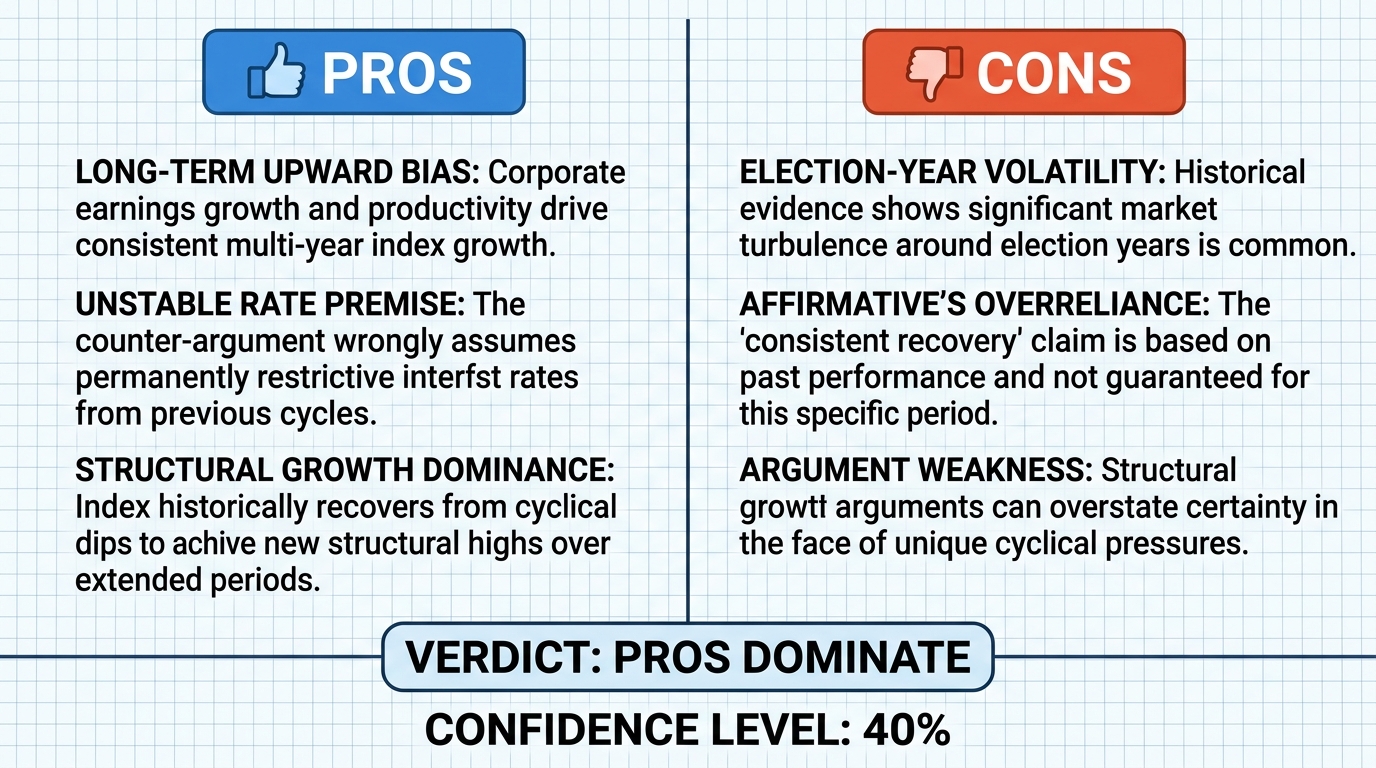
Verdict
Verdict: likely TRUE (40%)
Web Report: https://solsice.com/public/debates/the-s-p-500-index-will-be-higher-on-november-8th-2027-than-i-793fa89bb9f8
This section provides a brief overview of the key arguments. You do not need to read the full detailed report below.
✅ Key PRO arguments:
- ■The S&P 500 will exceed its election-day value by November 2027 due to a robust long-term upward bias driven by corporate earnings growth and productivity gains. Over extended periods, the index has consistently recovered from cyclical volatility and reached new structural highs, and the three-year window between the 2024 elections and November 2027 allows these structural growth drivers to compound, historically outweighing short-term political or macroeconomic fluctuations.
- ■The opposing argument relies on an unstable parameter: it claims interest rates are at restrictive levels due to the 2022-2023 tightening cycle , but then projects late-2027 volatility and lingering inflation pressures without explaining the transition between these two states. This silent reversal fails to establish a consistent baseline for the interest-rate environment, weakening the negative's valuation-compression claim.
❌ Key ANTI arguments:
- ■The S&P 500 is not guaranteed to be higher on November 8, 2027 than on election day; historical evidence shows substantial election-year volatility and repeated outcomes where the three-year period following an election did not produce higher index levels. Research on political uncertainty documents that markets become significantly more volatile during presidential elections and periods of policy uncertainty .
- ■The affirmative's claim that the S&P 500 has consistently recovered from cyclical volatility and reached new structural highs over extended periods generalizes long-term trends to a short, policy-constrained three-year window. This ignores historical instances where post-election periods saw the index decline, and research shows elections generate heightened volatility with multiple historical instances of decline in the three-year window following elections.
💭 Conclusion: True: The S&P 500 is more likely than not to be higher on November 8, 2027 than on election day, because the affirmative's structural-growth case prevailed. The winning argument relies on the index's long-term upward bias from corporate earnings growth and productivity gains, which has historically allowed it to recover from cyclical volatility and reach new highs. The affirmative also exposed a flaw in the negative's case: the interest-rate argument shifts from a fixed restrictive level to a volatile late-2027 environment without explaining the transition, undermining its consistency. The negative's evidence of election-year volatility and historical three-year declines shows risk, but it does not establish a guaranteed decline or outweigh the compounding growth drivers over the three-year window. The judge assigned only 40% confidence to this verdict, reflecting a single debate with limited direct evidence, so the outcome is probable but not highly certain.
🔬 DeepResearch Result: likely TRUE ✅ (40%)
Assertion: The S&P 500 index will be higher on November 8th 2027 than it was on the day of those elections.
Participating models: gemma-4-26b-a4b-it 💬👁️, glm-4.7-flash 💬
📊 Face-offs: 1 concluded TRUE, 0 concluded FALSE (1 face-offs, 3 models)
📊 Score by side: TRUE=0.40, FALSE=0.00
🏅 Model score changes:
deepseek-v4-flash-0731 💬: +4
✅ PRO Arguments:
- ■The S&P 500 will exceed its election-day value by November 2027 due to a robust long-term upward bias driven by corporate earnings growth and productivity gains. Over extended periods, the index has consistently recovered from cyclical volatility and reached new structural highs, and the three-year window between the 2024 elections and November 2027 allows these structural growth drivers to compound, historically outweighing short-term political or macroeconomic fluctuations. gemma-4-26b-a4b-it 💬👁️
- ■The opposing argument relies on an unstable parameter: it claims interest rates are at restrictive levels due to the 2022-2023 tightening cycle , but then projects late-2027 volatility and lingering inflation pressures without explaining the transition between these two states. This silent reversal fails to establish a consistent baseline for the interest-rate environment, weakening the negative's valuation-compression claim. gemma-4-26b-a4b-it 💬👁️
❌ ANTI Arguments:
- ■The S&P 500 is not guaranteed to be higher on November 8, 2027 than on election day; historical evidence shows substantial election-year volatility and repeated outcomes where the three-year period following an election did not produce higher index levels. Research on political uncertainty documents that markets become significantly more volatile during presidential elections and periods of policy uncertainty . glm-4.7-flash 💬
- ■The affirmative's claim that the S&P 500 has consistently recovered from cyclical volatility and reached new structural highs over extended periods generalizes long-term trends to a short, policy-constrained three-year window. This ignores historical instances where post-election periods saw the index decline, and research shows elections generate heightened volatility with multiple historical instances of decline in the three-year window following elections. glm-4.7-flash 💬
💭 Reasoning: True: The S&P 500 is more likely than not to be higher on November 8, 2027 than on election day, because the affirmative's structural-growth case prevailed. The winning argument relies on the index's long-term upward bias from corporate earnings growth and productivity gains, which has historically allowed it to recover from cyclical volatility and reach new highs. The affirmative also exposed a flaw in the negative's case: the interest-rate argument shifts from a fixed restrictive level to a volatile late-2027 environment without explaining the transition, undermining its consistency. The negative's evidence of election-year volatility and historical three-year declines shows risk, but it does not establish a guaranteed decline or outweigh the compounding growth drivers over the three-year window. The judge assigned only 40% confidence to this verdict, reflecting a single debate with limited direct evidence, so the outcome is probable but not highly certain.
📋 PRO Facts:
• The S&P 500 has a robust long-term upward bias driven by corporate earnings growth and productivity gains.
• Over extended periods, the index has consistently recovered from cyclical volatility and reached new structural highs.
• The three-year window between the 2024 elections and November 2027 allows compounding of structural growth drivers.
• The affirmative argues that historical upward bias outweighs short-term political or macroeconomic fluctuations.
• The negative's interest-rate argument shifts from a fixed restrictive level to an uncertain volatile late-2027 environment without a transition mechanism.
📋 ANTI Facts:
• Historical evidence shows substantial election-year volatility and repeated outcomes where the three-year period following an election did not produce higher index levels.
• Research on political uncertainty documents that markets become significantly more volatile during presidential elections and policy uncertainty.
• The S&P 500 has experienced substantial drawdowns during the year surrounding elections.
• There are multiple historical instances where post-election three-year windows saw the index decline.
• The affirmative's claim generalizes long-term trends to a short, policy-constrained three-year window.
| Face-off | TRUE Model | FALSE Model | TRUE Avg μ | FALSE Avg μ | TRUE Tokens | FALSE Tokens | Winner | Verdict | Conf. |
|---|---|---|---|---|---|---|---|---|---|
| #1 | gemma-4-26b-a4b-it 💬👁️ | glm-4.7-flash 💬 | 0.161 | 0.218 | 2 | 4 | FALSE | TRUE | 40% |
The following technical terms, abbreviations, and domain-specific concepts are referenced throughout this debate transcript. Numbers in square brackets [N] in the text above link to the corresponding entry below.
[1] Compounding — The process by which an investment's returns generate additional returns over time, cited as a driver of long-term index growth.
[2] Corporate earnings — The profits of companies, cited as a fundamental driver of the S&P 500's upward bias.
[3] Cyclical volatility — Fluctuations in market prices that follow economic cycles, mentioned as a historical pattern the index recovers from.
[4] Drawdown — A decline in an investment's value from a peak, mentioned as a risk during election periods.
[5] Earnings growth — The increase in corporate profits over time, cited as a key factor in index appreciation.
[6] Economies of scale — Cost advantages gained from larger scale of operations, mentioned as a factor in constituent companies' expansion.
[7] Election-year volatility — Increased market fluctuations during presidential election years, cited as a historical pattern.
[8] Equity valuation — The process of determining the worth of stocks, mentioned as being compressed by restrictive interest rates.
[9] Federal funds rate — The interest rate at which banks lend reserves to each other overnight, referenced as being at restrictive levels.
[10] Inflation — The rate at which the general level of prices rises, mentioned as a lingering pressure.
[11] Margin expansion — An increase in profit margins, attributed in the debate to technological advancements.
[12] Neutral policy stance — A monetary policy position that neither stimulates nor restricts the economy, mentioned as a transition from restrictive rates.
[13] Policy uncertainty — The risk that future government policies are unclear, mentioned as a constraint on market performance.
[14] Political uncertainty — The risk that political events or policy changes affect market conditions, cited as a source of volatility.
[15] Productivity — The efficiency of production, cited as a driver of long-term index growth.
[16] Restrictive interest rates — Interest rates set at levels that slow economic activity, mentioned as a factor compressing valuations.
[17] S&P 500 — Standard & Poor's 500 — A stock market index tracking 500 large-cap US companies, used as the benchmark in this debate.
[18] Structural constraints — Limitations on growth due to underlying economic or institutional factors, mentioned as dominating in short periods.
[19] Structural high — A new peak in the index level that is sustained by fundamental economic changes, mentioned as a historical outcome.
[20] Tightening cycle — A period of rising interest rates intended to reduce money supply, referenced as the 2022-2023 cycle.
[21] Volatility — The degree of variation in a financial instrument's price over time, mentioned as heightened during elections.
Face-off transcripts
- ■
Ownership & Trade Secrets. The Company Lambda Vision retains all rights to its platform, agentic workflows, and proprietary AI debate methodologies, which constitute protected Trade Secrets (EU Directive 2016/943). Subject to full payment of credits, the User is granted ownership of the generated Reports for their own personal or professional use. Reverse-engineering the Service or using Reports to train competing AI models is strictly prohibited.
- ■
No Professional Advice. Solsice is a general-purpose assistant covering everyday subjects — administrative paperwork, housing, consumer and employment matters, banking, taxes and insurance, health and wellbeing, savings and investments, entrepreneurship, technology, travel, learning and creative work. Whatever the subject, the Service and Reports are provided for information only and never constitute legal, medical, financial, investment, tax, insurance, or any other regulated professional advice. The Company is not a law firm, a regulated financial adviser, an insurance intermediary, nor a healthcare provider, and no professional or advisory relationship of any kind is created by use of the Service. Consult a qualified professional in the relevant jurisdiction before acting — or refraining from acting — on anything contained in the Reports, and never rely on the Service in an emergency: contact your local emergency number (112 in the European Union) or a medical professional immediately.
- ■
AI-Generated Content, Sources and Viewpoints. Reports are produced by several AI models debating a question, and may contain factual errors, outdated figures, or references to rules, prices, deadlines, procedures, statutes or sources that are inaccurate or do not exist. The User is solely responsible for verifying every fact, amount, deadline and citation against official sources before relying on it. Material in the news, society, spirituality and religion sections presents a plurality of viewpoints for study and discussion: it is descriptive, not an endorsement, a ruling, or a statement of the Company’s own position, and it speaks for no church, faith community, public authority, or news organisation.
- ■
Liability & Governing Law. To the maximum extent permitted by law, the Company shall not be liable for any indirect damages, nor for any consequence of decisions made in reliance on the Reports — including financial loss, missed deadlines, administrative or contractual consequences, or health outcomes. These Terms are governed by French law. Any disputes shall be subject to the exclusive jurisdiction of the Courts of Paris, France.