
The 'Sagas of Sunundry Darkling Gate' series will deliver horrors that linger with the audience long after the story concludes.
AI debate verdict and arguments
⚠️ AI-generated information only; not professional advice
Completed October 14, 2026
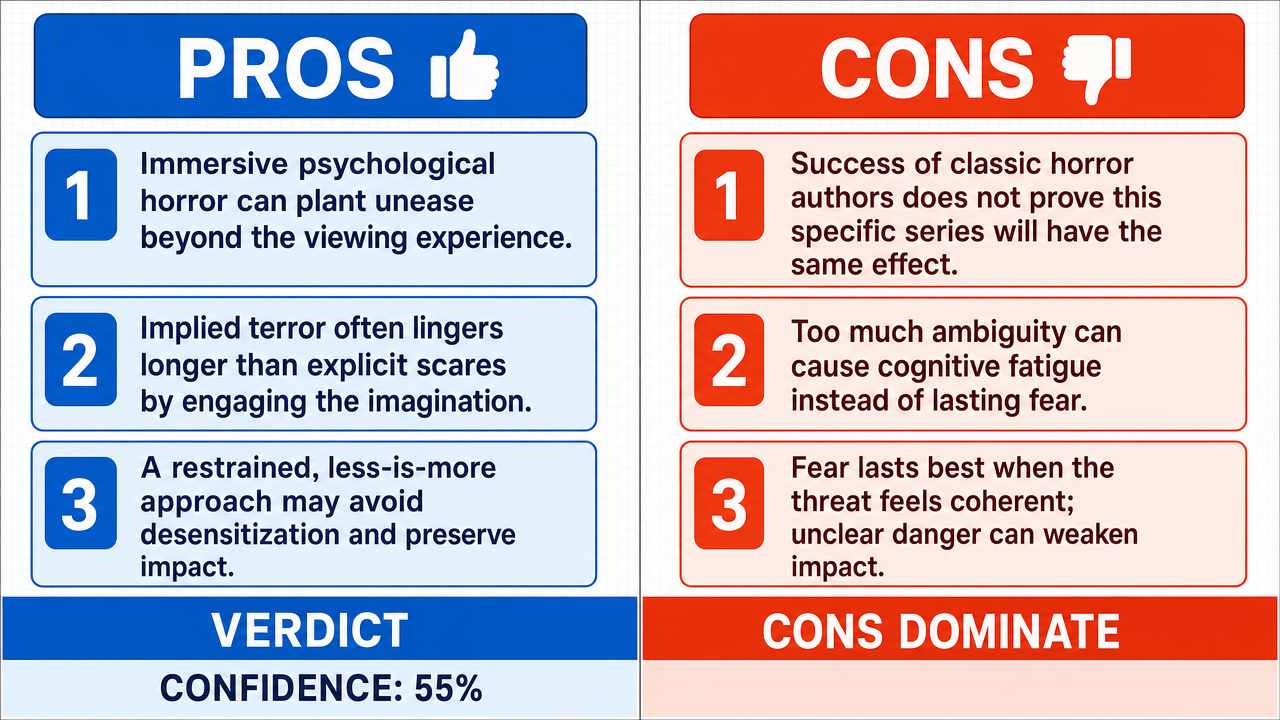
Verdict
Verdict: likely FALSE (55%)
Web Report: https://solsice.com/public/debates/the-sagas-of-sunundry-darkling-gate-series-will-deliver-horr-1dcbfd1cf477
This section provides a brief overview of the key arguments. You do not need to read the full detailed report below.
✅ Key PRO arguments:
- ■The series employs deeply immersive psychological horror techniques that bypass short-term narrative engagement to embed unease directly into the audience's subconscious, leveraging the 'less-is-more' principle where the unseen and implied are far more potent than explicit gore.
- ■Narratives which leave key horrors to the imagination, such as Shirley Jackson's The Haunting of Hill House or Lovecraft's slow-burn cosmic dread , generate persistent cognitive residue as the audience's mind continues to 'fill in the blanks' long after the story ends.
- ■The series deliberately avoids triggers of rapid desensitization (repetitive shock, saturated horror market tropes) by employing a 'less-is-more' approach and existential themes that are not subject to the same rapid desensitization as visceral gore .
❌ Key ANTI arguments:
- ■The affirmative commits a logical error of proxy substitution: citing the historical success of authors like Jackson or Lovecraft cannot validate the specific impact of 'Sunundry Darkling Gate' without a demonstrated transfer operator —such as a proven structural correlation or stylistic mapping —between the two works.
- ■Cognitive fatigue and the 'uncanny valley ' of narrative ambiguity mean that when a narrative relies too heavily on leaving blanks for the audience to fill, it frequently produces frustration or boredom rather than dread due to a lack of narrative coherence .
- ■Research in cognitive psychology suggests that for an affect like fear to be sustained, the stimulus must be perceived as a coherent threat; if the narrative lacks coherence, the audience disengages rather than experiences lingering horror.
💭 Conclusion: False. The negative side successfully demonstrated that the affirmative's argument relied on a flawed logical substitution, using the proven impact of canonical horror works like Jackson's and Lovecraft's to claim similar effects for an unproven new series without establishing any transfer mechanism. The negative further undermined the 'less-is-more' principle by citing cognitive psychology research showing that excessive narrative ambiguity often produces disengagement, frustration, or boredom rather than sustained dread, because fear requires a coherent threat stimulus. The affirmative's counter that the series avoids desensitization triggers remained speculative without concrete evidence of the series' actual techniques. The judge assigned only moderate confidence (55%) to this verdict, reflecting that while the negative's logical critique was stronger, the debate centered on a future prediction about an unspecified work, limiting certainty in either direction.
🔬 DeepResearch Result: likely FALSE ❌ (55%)
Assertion: The 'Sagas of Sunundry Darkling Gate' series will deliver horrors that linger with the audience long after the story concludes.
Participating models: deepseek-v3.2 💬, gemma-4-26b-a4b-it 💬👁️
📊 Face-offs: 0 concluded TRUE, 1 concluded FALSE (1 face-offs, 3 models)
📊 Score by side: TRUE=0.00, FALSE=0.55
🏅 Model score changes:
minimax-m3 💬👁️: +6
✅ PRO Arguments:
- ■The series employs deeply immersive psychological horror techniques that bypass short-term narrative engagement to embed unease directly into the audience's subconscious, leveraging the 'less-is-more' principle where the unseen and implied are far more potent than explicit gore. deepseek-v3.2 💬
- ■Narratives which leave key horrors to the imagination, such as Shirley Jackson's The Haunting of Hill House or Lovecraft's slow-burn cosmic dread , generate persistent cognitive residue as the audience's mind continues to 'fill in the blanks' long after the story ends. deepseek-v3.2 💬
- ■The series deliberately avoids triggers of rapid desensitization (repetitive shock, saturated horror market tropes) by employing a 'less-is-more' approach and existential themes that are not subject to the same rapid desensitization as visceral gore . deepseek-v3.2 💬
❌ ANTI Arguments:
- ■The affirmative commits a logical error of proxy substitution: citing the historical success of authors like Jackson or Lovecraft cannot validate the specific impact of 'Sunundry Darkling Gate' without a demonstrated transfer operator —such as a proven structural correlation or stylistic mapping —between the two works. gemma-4-26b-a4b-it 💬👁️
- ■Cognitive fatigue and the 'uncanny valley ' of narrative ambiguity mean that when a narrative relies too heavily on leaving blanks for the audience to fill, it frequently produces frustration or boredom rather than dread due to a lack of narrative coherence . gemma-4-26b-a4b-it 💬👁️
- ■Research in cognitive psychology suggests that for an affect like fear to be sustained, the stimulus must be perceived as a coherent threat; if the narrative lacks coherence, the audience disengages rather than experiences lingering horror. gemma-4-26b-a4b-it 💬👁️
- ■Psychological desensitization and narrative instability prevent lasting horror, as audiences in a saturated horror market become habituated to standard techniques, undermining any claim of persistent cognitive residue. gemma-4-26b-a4b-it 💬👁️
💭 Reasoning: False. The negative side successfully demonstrated that the affirmative's argument relied on a flawed logical substitution, using the proven impact of canonical horror works like Jackson's and Lovecraft's to claim similar effects for an unproven new series without establishing any transfer mechanism. The negative further undermined the 'less-is-more' principle by citing cognitive psychology research showing that excessive narrative ambiguity often produces disengagement, frustration, or boredom rather than sustained dread, because fear requires a coherent threat stimulus. The affirmative's counter that the series avoids desensitization triggers remained speculative without concrete evidence of the series' actual techniques. The judge assigned only moderate confidence (55%) to this verdict, reflecting that while the negative's logical critique was stronger, the debate centered on a future prediction about an unspecified work, limiting certainty in either direction.
📋 PRO Facts:
• The 'less-is-more' principle in horror suggests that implied or unseen threats are often more psychologically potent than explicit gore.
• Shirley Jackson's The Haunting of Hill House and H.P. Lovecraft's cosmic dread works are cited as examples of narratives that generate persistent cognitive residue in audiences.
• Visceral gore and repetitive shock tactics are subject to more rapid psychological desensitization than existential or implied horror themes.
📋 ANTI Facts:
• Historical success of canonical horror authors does not automatically transfer to new works without a demonstrated structural or stylistic correlation.
• Cognitive psychology research indicates that sustained fear requires the stimulus to be perceived as a coherent threat; excessive ambiguity can produce disengagement.
• Audiences in a saturated horror market can become habituated to standard techniques, undermining claims of persistent cognitive impact.
• The 'uncanny valley' of narrative ambiguity can cause audiences to experience frustration or boredom rather than dread when blanks are left unfilled.
| Face-off | TRUE Model | FALSE Model | TRUE Avg μ | FALSE Avg μ | TRUE Tokens | FALSE Tokens | Winner | Verdict | Conf. |
|---|---|---|---|---|---|---|---|---|---|
| #1 | deepseek-v3.2 💬 | gemma-4-26b-a4b-it 💬👁️ | 0.275 | 0.269 | 8 | 2 | TRUE | FALSE | 55% |
The following technical terms, abbreviations, and domain-specific concepts are referenced throughout this debate transcript. Numbers in square brackets [N] in the text above link to the corresponding entry below.
[1] affect — affect (psychological) — In psychology, an observable expression of emotion or feeling; in the debate, used to describe the sustained emotional response (fear) that the series is claimed to produce.
[2] cognitive fatigue — A state of mental exhaustion that reduces the brain's ability to process stimuli, cited in the debate as a reason why sustained ambiguity may fail to produce dread.
[3] cognitive immersion — A state of deep mental engagement with a narrative in which fictional events are processed as if they were experientially real.
[4] cognitive psychology — The branch of psychology that studies internal mental processes such as perception, attention, memory, and language comprehension.
[5] cognitive residue — The lingering mental aftereffect of a narrative or stimulus that persists in the audience's mind after consumption has ended.
[6] cosmic dread — A subgenre of horror associated with H.P. Lovecraft, characterized by fear of vast, incomprehensible, indifferent cosmic forces beyond human understanding.
[7] domain hermeticity — In argumentation, the principle that variables or evidence should remain within the boundaries of the relevant domain; importing concepts from an unrelated domain is considered a violation.
[8] empathetic characters — Fictional characters designed so that audiences emotionally identify with them, a technique used to deepen narrative transportation.
[9] existential fear — Fear arising from contemplation of human existence, mortality, and meaninglessness, as opposed to fear of concrete physical threats.
[10] existential themes — Narrative themes dealing with the nature of human existence, freedom, and absurdity, cited in the debate as more resistant to desensitization than visceral content.
[11] experiential reality — The subjective sense that events encountered in a narrative feel personally real to the audience, produced by deep narrative transportation.
[12] flawed substitution of proxy — A logical error in which evidence about one entity is used to support a claim about a different entity without establishing a valid mapping between them.
[13] hidden premise — An unstated assumption underlying an argument that, if false, undermines the conclusion; identified in the debate as a weakness in the opposing case.
[14] less-is-more (principle) — less-is-more principle — A horror narrative technique in which restraint, implication, and the unseen are considered more effective at producing dread than explicit depiction.
[15] literary canon — The body of works considered established and authoritative within a literary tradition, cited in the debate as the source of comparative examples.
[16] narrative ambiguity — Deliberate openness or uncertainty in a story's meaning or events, used to engage the audience's imagination but argued in the debate to risk producing incoherence.
[17] narrative architecture — The structural design of a story, including its plot mechanics, pacing, and the arrangement of its narrative elements.
[18] narrative coherence — The degree to which a story's events and elements form a logically consistent and comprehensible whole.
[19] narrative instability — A lack of stable structure or coherent progression in a story, cited by the negative as a reason the series may fail to produce lasting impact.
[20] narrative noise — Incoherent or unmotivated narrative elements that the audience's cognition filters out as irrelevant rather than interpreting as threatening.
[21] narrative persistence — The duration for which a narrative's effects continue to influence the audience after consumption.
[22] narrative transportation — A psychological state in which a reader or viewer becomes deeply absorbed in a story, experiencing its events as if personally present.
[23] neurological encoding — The process by which experiences are converted into neural memory traces; cited in the debate as the mechanism underlying lasting narrative impact.
[24] non sequitur — A logical fallacy in which a conclusion does not follow from its premises.
[25] predictive immunity — In media psychology, the audience's learned ability to anticipate and become numb to expected narrative patterns, reducing emotional impact.
[26] psychological desensitization — The reduction of emotional responsiveness to a stimulus following repeated exposure, cited as a central objection to the affirmative's claim.
[27] psychological horror — A horror subgenre focused on mental, emotional, and psychological disturbance rather than physical monsters or gore.
[28] psychological triggers — Specific narrative or stylistic elements designed to provoke a psychological response such as fear or dread.
[29] saturated horror market — A media environment in which horror content is so abundant that audiences are presumed to have developed resistance to its effects.
[30] slow-burn — A pacing technique in horror in which tension and dread are built gradually over an extended narrative rather than delivered through sudden shocks.
[31] stimulus (psychological) — stimulus — Any event or element perceived by an organism that elicits a cognitive or emotional response; in the debate, narrative elements that must be categorized as threats to produce fear.
[32] structural tension — Narrative suspense arising from the arrangement and withholding of plot elements, argued in the debate to be necessary for ambiguity to produce dread.
[33] stylistic mapping — The identification of correspondences between the narrative techniques of different works, which the negative argues is required before one work's impact can be cited as evidence for another's.
[34] transfer operator — In argumentation, a demonstrated mechanism or mapping that justifies applying evidence or conclusions from one case to another.
[35] uncanny valley — Originally a robotics concept describing revulsion toward near-human replicas; in the debate, applied to narrative ambiguity that is close to coherence but fails to achieve it, producing discomfort or dismissal.
[36] visceral gore — Explicit, graphic depictions of physical violence and bodily harm, contrasted in the debate with ambiguity-based dread as more subject to rapid desensitization.
Face-off transcripts
- ■
Ownership & Trade Secrets. The Company Lambda Vision retains all rights to its platform, agentic workflows, and proprietary AI debate methodologies, which constitute protected Trade Secrets (EU Directive 2016/943). Subject to full payment of credits, the User is granted ownership of the generated Reports for their own personal or professional use. Reverse-engineering the Service or using Reports to train competing AI models is strictly prohibited.
- ■
No Professional Advice. Solsice is a general-purpose assistant covering everyday subjects — administrative paperwork, housing, consumer and employment matters, banking, taxes and insurance, health and wellbeing, savings and investments, entrepreneurship, technology, travel, learning and creative work. Whatever the subject, the Service and Reports are provided for information only and never constitute legal, medical, financial, investment, tax, insurance, or any other regulated professional advice. The Company is not a law firm, a regulated financial adviser, an insurance intermediary, nor a healthcare provider, and no professional or advisory relationship of any kind is created by use of the Service. Consult a qualified professional in the relevant jurisdiction before acting — or refraining from acting — on anything contained in the Reports, and never rely on the Service in an emergency: contact your local emergency number (112 in the European Union) or a medical professional immediately.
- ■
AI-Generated Content, Sources and Viewpoints. Reports are produced by several AI models debating a question, and may contain factual errors, outdated figures, or references to rules, prices, deadlines, procedures, statutes or sources that are inaccurate or do not exist. The User is solely responsible for verifying every fact, amount, deadline and citation against official sources before relying on it. Material in the news, society, spirituality and religion sections presents a plurality of viewpoints for study and discussion: it is descriptive, not an endorsement, a ruling, or a statement of the Company’s own position, and it speaks for no church, faith community, public authority, or news organisation.
- ■
Liability & Governing Law. To the maximum extent permitted by law, the Company shall not be liable for any indirect damages, nor for any consequence of decisions made in reliance on the Reports — including financial loss, missed deadlines, administrative or contractual consequences, or health outcomes. These Terms are governed by French law. Any disputes shall be subject to the exclusive jurisdiction of the Courts of Paris, France.