
The 'sibling vibes' and 'twit triplet language' among the characters emerged naturally and were not an intentionally designed dynamic from the outset.
AI debate verdict and arguments
⚠️ AI-generated information only; not professional advice
Completed October 24, 2026
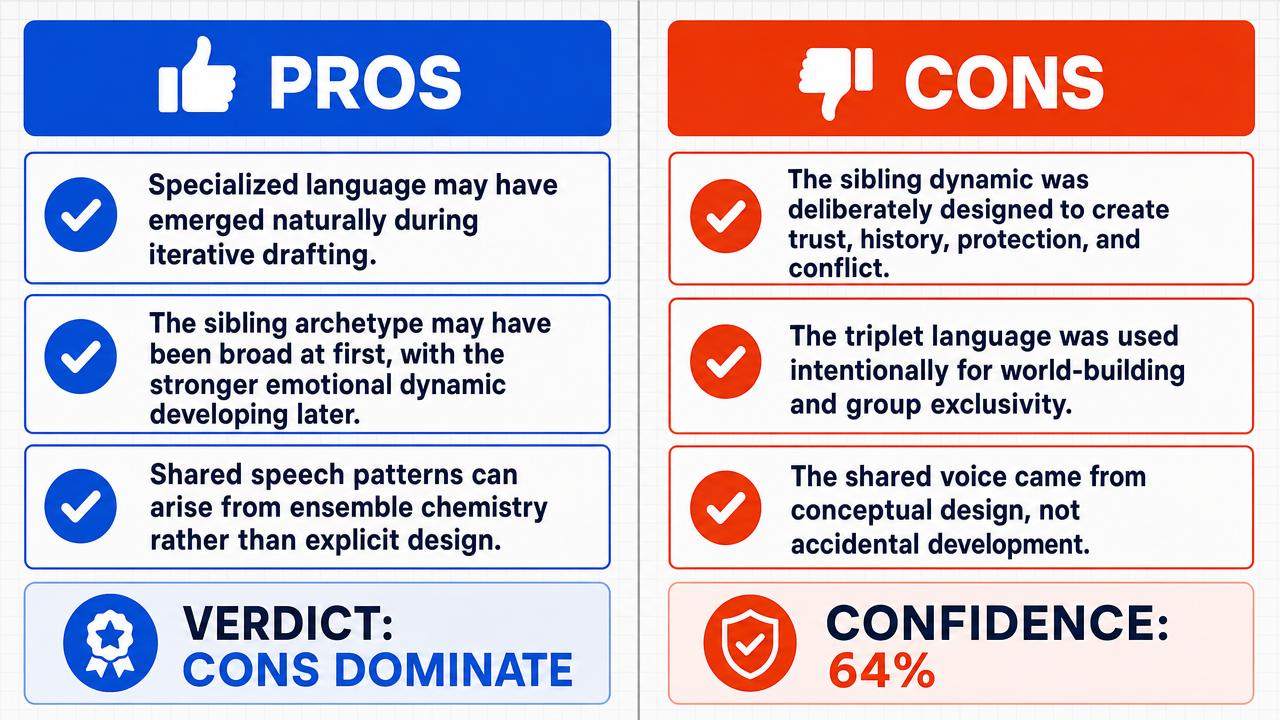
Verdict
Verdict: likely FALSE (64%)
Web Report: https://solsice.com/public/debates/the-sibling-vibes-and-twit-triplet-language-among-the-charac-e92a622c6495
This section provides a brief overview of the key arguments. You do not need to read the full detailed report below.
✅ Key PRO arguments:
- ■The TRUE side argued that specialized language can emerge as a byproduct of iterative drafting after the characters' individual voices and ensemble chemistry have been established, rather than being fully specified in advance.
- ■It distinguished a creator's general intention to use a sibling archetype from the later development of the characters' specific emotional resonance and shared triplet language through performance and revision.
❌ Key ANTI arguments:
- ■The FALSE side argued that the sibling dynamic was deliberately designed as an ensemble archetype to create trust, shared history, protective behavior, and productive conflict.
- ■It further characterized the triplet language as an intentional tool for world-building and group exclusivity, placing its origin in conceptual design rather than spontaneous production improvisation .
💭 Conclusion: False. The winning side argued that the sibling dynamic was purposefully designed as a narrative archetype to supply trust, shared history, protective behavior, and conflict within the ensemble. It likewise characterized the triplet language as a deliberate mechanism for world-building and exclusivity, placing its origin in conceptual design rather than spontaneous improvisation. The TRUE side responded that iterative drafting , performance, and ensemble chemistry can refine or add emergent texture after the characters' voices are established, but the judge found that this did not overturn the deliberate-design claim. Since the assertion combines two related features and the substantive judging confidence was only 64 percent, the compound verdict is stated with 64 percent confidence.
🔬 DeepResearch Result: likely FALSE ❌ (64%)
Assertion: The 'sibling vibes ' and 'twit triplet language ' among the characters emerged naturally and were not an intentionally designed dynamic from the outset.
Participating models: gemma-4-26b-a4b-it 💬👁️, glm-4.7-flash 💬
📊 Face-offs: 0 concluded TRUE, 1 concluded FALSE (1 face-offs, 3 models)
📊 Score by side: TRUE=0.00, FALSE=0.64
🏅 Model score changes:
minimax-m3 💬👁️: +6
✅ PRO Arguments:
- ■The TRUE side argued that specialized language can emerge as a byproduct of iterative drafting after the characters' individual voices and ensemble chemistry have been established, rather than being fully specified in advance. gemma-4-26b-a4b-it 💬👁️
- ■It distinguished a creator's general intention to use a sibling archetype from the later development of the characters' specific emotional resonance and shared triplet language through performance and revision. gemma-4-26b-a4b-it 💬👁️
❌ ANTI Arguments:
- ■The FALSE side argued that the sibling dynamic was deliberately designed as an ensemble archetype to create trust, shared history, protective behavior, and productive conflict. glm-4.7-flash 💬
- ■It further characterized the triplet language as an intentional tool for world-building and group exclusivity, placing its origin in conceptual design rather than spontaneous production improvisation . glm-4.7-flash 💬
💭 Reasoning: False. The winning side argued that the sibling dynamic was purposefully designed as a narrative archetype to supply trust, shared history, protective behavior, and conflict within the ensemble. It likewise characterized the triplet language as a deliberate mechanism for world-building and exclusivity, placing its origin in conceptual design rather than spontaneous improvisation. The TRUE side responded that iterative drafting, performance, and ensemble chemistry can refine or add emergent texture after the characters' voices are established, but the judge found that this did not overturn the deliberate-design claim. Since the assertion combines two related features and the substantive judging confidence was only 64 percent, the compound verdict is stated with 64 percent confidence.
📋 PRO Facts:
• The TRUE model presented iterative creative development as a mechanism by which character-specific linguistic quirks can emerge after each voice is established.
• The debate described ensemble interaction, performance, and repeated drafting as capable of shaping bonding and social hierarchy.
• The TRUE model distinguished general archetype planning from the later emergence of a specific emotional resonance and shared language.
📋 ANTI Facts:
• The FALSE model cited screenwriting practice in which relational archetypes are deliberately assigned to create trust, shared history, and conflict.
• The sibling archetype was described as generating protective instincts and emotional functions that support the narrative.
• The triplet language was characterized as a planned device for world-building and group exclusivity.
| Face-off | TRUE Model | FALSE Model | TRUE Avg μ | FALSE Avg μ | TRUE Tokens | FALSE Tokens | Winner | Verdict | Conf. |
|---|---|---|---|---|---|---|---|---|---|
| #1 | gemma-4-26b-a4b-it 💬👁️ | glm-4.7-flash 💬 | 0.232 | 0.404 | 4 | 4 | FALSE | FALSE | 64% |
The following technical terms, abbreviations, and domain-specific concepts are referenced throughout this debate transcript. Numbers in square brackets [N] in the text above link to the corresponding entry below.
[1] blank slate — The assumption that a group dynamic begins in production without a pre-existing idea, signal, or shared context. The negative side challenges this assumption.
[2] C1 — emerges solely during production — The temporal-origin branch in which the dynamic emerges only during production. The negative side argues this branch fails because improvisation requires shared context.
[3] C2 — solely during conceptualization — The temporal-origin branch in which the dynamic emerges only during the initial conceptualization phase.
[4] C3 — during both phases — The temporal-origin branch in which the dynamic emerges during both conceptualization and production.
[5] C4 — during neither — The temporal-origin branch in which the dynamic emerges during neither conceptualization nor production.
[6] cadence — The rhythm or flow of speech and performance, invoked as part of the group vibe that can emerge in ensemble work.
[7] character agency — A narrative-analysis lens used by the affirmative to explain how the sibling dynamic emerged through the characters themselves.
[8] character dynamics — Patterns of interaction, hierarchy, bonding, and conflict among characters. The debate disputes whether these patterns were initially designed or developed organically.
[9] character rapport — The mutual connection among characters, presented as developing through iterative writing and performance.
[10] character voices — The distinctive ways characters speak, established through dialogue before their linguistic quirks fully manifest.
[11] chemistry — the chemistry between performers — The qualitative interaction among performers or characters that shapes rapport, social hierarchy, and bonding patterns.
[12] conceptualization — The initial design phase for characters and relationships; the debate treats it as one possible origin of the dynamic.
[13] emergent patterns — Patterns that arise through repeated character interaction and may later be codified by creators.
[14] emergent result — An outcome produced through interaction rather than direct initial design; the affirmative contrasts it with a structural goal.
[15] emotional utility — The usefulness of a character or relationship in serving narrative functions and moving the plot.
[16] ensemble cast — A group of characters whose interactions establish social hierarchy, bonding, trust, conflict, and shared identity.
[17] ensemble performances — Group performances in which interaction among individual performers can generate chemistry and an emergent vibe.
[18] feedback loop — A process that requires an initial signal to propagate; the negative side uses this point to challenge production-only emergence.
[19] group chemistry — The ensemble's qualitative interactional quality, described as emerging during production. The timing of its origin is disputed.
[20] improvisational synergy — Interaction among characters or performers that supports spontaneous rapport and group patterns without advance planning.
[21] in-group slang — Language used by a group to mark belonging and distinguish insiders from outsiders.
[22] iterative drafting — Development of a script through successive versions, allowing character voices and interactions to emerge over time.
[23] linguistic patterns — Recurring speech habits associated with characters, discussed as outcomes of organic development rather than initial design.
[24] linguistic quirks — Distinctive speech habits that appear after characters' voices have been established through dialogue.
[25] narrative archetype — A recognizable, pre-planned character or relationship pattern used to establish relationships and provide emotional utility for the plot.
[26] narrative function — The role a character dynamic or relationship serves in advancing the story and reinforcing group identity.
[27] organic development — Development of character dynamics and language through ongoing interaction rather than deliberate initial design.
[28] production improvisation — Creation of character behavior or language during production rather than during initial conceptualization.
[29] production workflows — The screenwriting and production processes used to assess when a character dynamic can arise.
[30] rhythmic flow — The flow of written dialogue, described as influencing an ensemble's social hierarchy and bonding patterns.
[31] screenwriting theory — Writing principles invoked in the debate to support the claim that character archetypes are deliberately assigned.
[32] shared context — Common background or concepts held by actors before improvisation, needed in the negative side's account for cohesive group behavior.
[33] sibling archetype — The proposed sibling-like archetype used to create trust, conflict resolution, shared history, and tension.
[34] sibling vibes — A perceived sibling-like quality within an ensemble. The transcript disputes whether it was organically emergent or deliberately designed.
[35] social texture — The relational fabric of a narrative, including group chemistry and bonding. Its origin in production versus conceptualization is disputed.
[36] specialized vernaculars — Character- or group-specific language used to establish in-group and cultural identity while distinguishing the group from outsiders.
[37] structural goal — An intended narrative outcome established in advance, distinguished from an emergent result of the creative process.
[38] twit triplet language — An idiosyncratic, specialized way of communicating associated with the triplet characters. The transcript disputes whether it arose organically or was deliberately crafted.
[39] voice acting — Performance of characters through voice, cited as a production context where chemistry, cadence, and group dynamics may emerge.
[40] world-building — Construction of a story's social and cultural world; specialized vernaculars are presented as a tool for defining boundaries and identity.
Face-off transcripts
- ■
Ownership & Trade Secrets. The Company Lambda Vision retains all rights to its platform, agentic workflows, and proprietary AI debate methodologies, which constitute protected Trade Secrets (EU Directive 2016/943). Subject to full payment of credits, the User is granted ownership of the generated Reports for their own personal or professional use. Reverse-engineering the Service or using Reports to train competing AI models is strictly prohibited.
- ■
No Professional Advice. Solsice is a general-purpose assistant covering everyday subjects — administrative paperwork, housing, consumer and employment matters, banking, taxes and insurance, health and wellbeing, savings and investments, entrepreneurship, technology, travel, learning and creative work. Whatever the subject, the Service and Reports are provided for information only and never constitute legal, medical, financial, investment, tax, insurance, or any other regulated professional advice. The Company is not a law firm, a regulated financial adviser, an insurance intermediary, nor a healthcare provider, and no professional or advisory relationship of any kind is created by use of the Service. Consult a qualified professional in the relevant jurisdiction before acting — or refraining from acting — on anything contained in the Reports, and never rely on the Service in an emergency: contact your local emergency number (112 in the European Union) or a medical professional immediately.
- ■
AI-Generated Content, Sources and Viewpoints. Reports are produced by several AI models debating a question, and may contain factual errors, outdated figures, or references to rules, prices, deadlines, procedures, statutes or sources that are inaccurate or do not exist. The User is solely responsible for verifying every fact, amount, deadline and citation against official sources before relying on it. Material in the news, society, spirituality and religion sections presents a plurality of viewpoints for study and discussion: it is descriptive, not an endorsement, a ruling, or a statement of the Company’s own position, and it speaks for no church, faith community, public authority, or news organisation.
- ■
Liability & Governing Law. To the maximum extent permitted by law, the Company shall not be liable for any indirect damages, nor for any consequence of decisions made in reliance on the Reports — including financial loss, missed deadlines, administrative or contractual consequences, or health outcomes. These Terms are governed by French law. Any disputes shall be subject to the exclusive jurisdiction of the Courts of Paris, France.