
The slang term 'gat' (G-A-T) means 'looking good'.
AI debate verdict and arguments
⚠️ AI-generated information only; not professional advice
Completed October 25, 2026
Verdict
Verdict: likely FALSE (87%)
Web Report: https://solsice.com/public/debates/the-slang-term-gat-g-a-t-means-looking-good-1c27d38f0e51
This section provides a brief overview of the key arguments. You do not need to read the full detailed report below.
✅ Key PRO arguments:
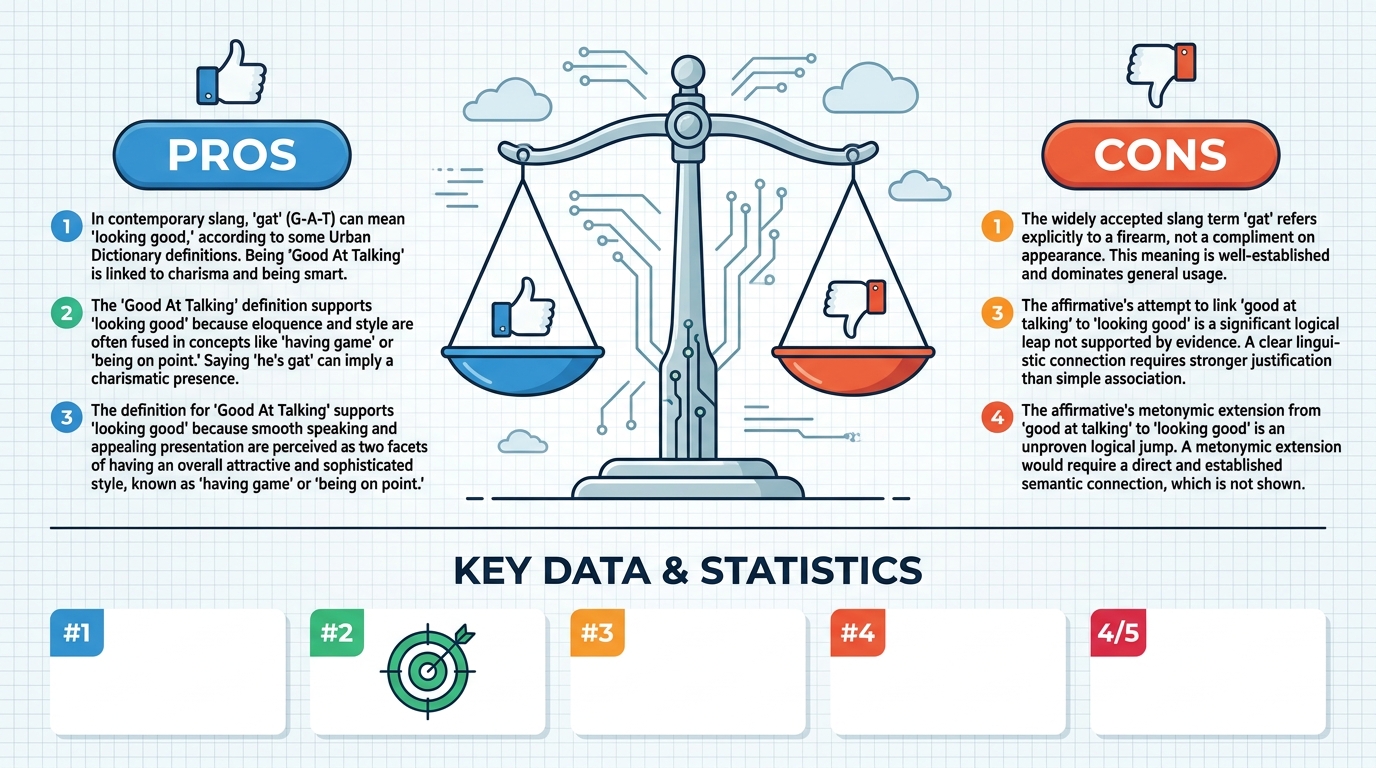
- ■In contemporary slang , 'gat ' (G-A-T) means 'looking good.' Urban Dictionary defines GAT as 'Good At Talking,' and being verbally adept is equated with being 'smooth' or 'sharp,' so the term carries the semantic weight of 'looking good' through metonymic extension .
- ■The 'Good At Talking' definition supports 'looking good' because eloquence and style are fused in the concept of 'having game ' or 'being on point'; saying 'he's got that GAT ' means both speaking well and carrying oneself in a way that looks good.
❌ Key ANTI arguments:
- ■The slang term 'gat ' refers to a firearm, not a compliment on appearance. The affirmative relies on crowdsourced , unverified Urban Dictionary entries, which are not authoritative sources for semantic definitions; a single user's definition does not constitute a linguistic fact .
- ■The affirmative's metonymic extension from 'good at talking' to 'looking good' is a logical leap unsupported by the source. A metonymic extension requires a consistent and widespread shift in meaning, not a single unverified entry.
💭 Conclusion: False — the debate evidence does not support the claim that 'gat ' means 'looking good.' The winning side established that the common slang meaning of 'gat' is a firearm, not a compliment on appearance. The affirmative's case rested entirely on a crowdsourced Urban Dictionary entry for 'Good At Talking,' which the negative correctly identified as non-authoritative and unverified. The negative also exposed the affirmative's metonymic leap from verbal skill to visual attractiveness as an unsupported logical extension. Therefore, the verdict is FALSE, consistent with the judge's decision and the strongest arguments from the negative side.
🔬 DeepResearch Result: likely FALSE ❌ (87%)
Assertion: The slang term 'gat ' (G-A-T) means 'looking good'.
Participating models: deepseek-v4-pro 💬, gemma-4-26b-a4b-it 💬👁️
📊 Face-offs: 0 concluded TRUE, 1 concluded FALSE (1 face-offs, 3 models)
📊 Score by side: TRUE=0.00, FALSE=0.87
🏅 Model score changes:
deepseek-v4-flash-0731 💬: +9
✅ PRO Arguments:
- ■In contemporary slang, 'gat' (G-A-T) means 'looking good.' Urban Dictionary defines GAT as 'Good At Talking,' and being verbally adept is equated with being 'smooth' or 'sharp,' so the term carries the semantic weight of 'looking good' through metonymic extension . deepseek-v4-pro 💬
- ■The 'Good At Talking' definition supports 'looking good' because eloquence and style are fused in the concept of 'having game ' or 'being on point'; saying 'he's got that GAT' means both speaking well and carrying oneself in a way that looks good. deepseek-v4-pro 💬
❌ ANTI Arguments:
- ■The slang term 'gat' refers to a firearm, not a compliment on appearance. The affirmative relies on crowdsourced , unverified Urban Dictionary entries, which are not authoritative sources for semantic definitions; a single user's definition does not constitute a linguistic fact . gemma-4-26b-a4b-it 💬👁️
- ■The affirmative's metonymic extension from 'good at talking' to 'looking good' is a logical leap unsupported by the source. A metonymic extension requires a consistent and widespread shift in meaning, not a single unverified entry. gemma-4-26b-a4b-it 💬👁️
💭 Reasoning: False — the debate evidence does not support the claim that 'gat' means 'looking good.' The winning side established that the common slang meaning of 'gat' is a firearm, not a compliment on appearance. The affirmative's case rested entirely on a crowdsourced Urban Dictionary entry for 'Good At Talking,' which the negative correctly identified as non-authoritative and unverified. The negative also exposed the affirmative's metonymic leap from verbal skill to visual attractiveness as an unsupported logical extension. Therefore, the verdict is FALSE, consistent with the judge's decision and the strongest arguments from the negative side.
📋 PRO Facts:
• Urban Dictionary contains a crowdsourced entry defining GAT as 'Good At Talking.'
• The affirmative argued that being 'good at talking' implies being 'smooth' or 'sharp,' which they equated with looking good.
📋 ANTI Facts:
• The slang term 'gat' commonly refers to a firearm.
• Urban Dictionary is a crowdsourced, unverified platform and is not an authoritative source for semantic definitions.
• A metonymic extension requires a consistent and widespread shift in meaning, not a single user entry.
| Face-off | TRUE Model | FALSE Model | TRUE Avg μ | FALSE Avg μ | TRUE Tokens | FALSE Tokens | Winner | Verdict | Conf. |
|---|---|---|---|---|---|---|---|---|---|
| #1 | deepseek-v4-pro 💬 | gemma-4-26b-a4b-it 💬👁️ | 0.308 | 0.296 | 6 | 2 | TRUE | FALSE | 87% |
The following technical terms, abbreviations, and domain-specific concepts are referenced throughout this debate transcript. Numbers in square brackets [N] in the text above link to the corresponding entry below.
[1] algorithm — A computational process used by a social media platform to select and display content; the affirmative mentions the platform's algorithm surfacing videos tagged #GAT.
[2] anecdotal input — User-submitted personal observations rather than systematic evidence; the negative argues Urban Dictionary is designed for anecdotal input and cannot support a semantic claim.
[3] behavioral attribute — A characteristic related to a person's actions or conduct; the negative argues that being a 'smooth talker' is a behavioral attribute, not a visual one.
[4] crowdsourced — Obtained from contributions by a large group of users rather than from a single authoritative source; used in the debate to describe Urban Dictionary entries and platforms.
[5] gat — Good At Talking — A slang term whose meaning is disputed in the debate: the affirmative argues it means 'looking good' via the phrase 'Good At Talking', while the negative argues it refers to a firearm.
[6] hashtag — A word or phrase preceded by '#' used to categorize content on social media; the affirmative cites #GAT as evidence of the term's usage.
[7] having game — A slang expression meaning social or romantic skill and confidence; the affirmative equates being 'good at talking' with 'having game' and an appealing presentation.
[8] lexicographic record — The body of dictionaries and lexical references that document word meanings; the affirmative cites it as evidence for the slang meaning of 'gat'.
[9] linguistic fact — A verifiable and generally accepted statement about language usage; the negative argues that a single unverified user entry is not a linguistic fact.
[10] linguistic norm — A standard or conventional usage accepted by a language community; the negative argues that crowdsourced entries do not establish a linguistic norm.
[11] logical fallacy — An error in reasoning that undermines an argument; the negative claims the affirmative's metonymic extension is a logical fallacy.
[12] metonymic extension — A semantic change in which a related attribute or associated term comes to stand for the thing itself; the affirmative uses it to link 'good at talking' to 'looking good', while the negative disputes that the link is valid.
[13] referent — The entity or concept that a word or expression denotes; the negative argues the affirmative substitutes one referent (verbal charisma) for another (visual appearance).
[14] semantic foundation — The underlying basis for a word's meaning; the negative contests the semantic foundation of the affirmative's claim.
[15] semantic meaning — The meaning that a word or expression conveys; the negative argues a hashtag alone does not establish the semantic meaning of 'gat'.
[16] semantic pathway — A chain of reasoning connecting one meaning to another; the affirmative claims a semantic pathway links verbal skill to visual appeal.
[17] semantic weight — The significance or meaning carried by a term; the affirmative claims 'gat' carries the semantic weight of 'looking good'.
[18] slang — Informal, nonstandard vocabulary used by a particular group; the debate concerns whether 'gat' is slang for 'looking good' or for a firearm.
[19] source genus — A category or class of sources; the negative argues that crowdsourced entries and authoritative dictionaries belong to different source genera, so the former cannot support a semantic claim.
[20] substitution of the referent — A rhetorical error in which an argument replaces the thing being discussed with a different but related thing; the negative accuses the affirmative of this.
[21] transfer operator — In the debate, a hypothetical mechanism or justification that would link a hashtag or attribute to a specific semantic meaning; the negative claims the affirmative fails to provide it.
[22] upvotes — User votes indicating approval on crowdsourced platforms; the affirmative cites hundreds of upvotes as evidence of a definition's popularity.
[23] vernacular — The everyday language spoken by a particular group; the affirmative claims 'gat' is used in youth vernacular.
[24] visual attribute — A characteristic relating to appearance; the negative contrasts visual attributes with behavioral attributes.
[25] youth vernacular — The informal language variety used by young people; the affirmative claims 'gat' is part of youth vernacular.
Face-off transcripts
- ■
Ownership & Trade Secrets. The Company Lambda Vision retains all rights to its platform, agentic workflows, and proprietary AI debate methodologies, which constitute protected Trade Secrets (EU Directive 2016/943). Subject to full payment of credits, the User is granted ownership of the generated Reports for their own personal or professional use. Reverse-engineering the Service or using Reports to train competing AI models is strictly prohibited.
- ■
No Professional Advice. Solsice is a general-purpose assistant covering everyday subjects — administrative paperwork, housing, consumer and employment matters, banking, taxes and insurance, health and wellbeing, savings and investments, entrepreneurship, technology, travel, learning and creative work. Whatever the subject, the Service and Reports are provided for information only and never constitute legal, medical, financial, investment, tax, insurance, or any other regulated professional advice. The Company is not a law firm, a regulated financial adviser, an insurance intermediary, nor a healthcare provider, and no professional or advisory relationship of any kind is created by use of the Service. Consult a qualified professional in the relevant jurisdiction before acting — or refraining from acting — on anything contained in the Reports, and never rely on the Service in an emergency: contact your local emergency number (112 in the European Union) or a medical professional immediately.
- ■
AI-Generated Content, Sources and Viewpoints. Reports are produced by several AI models debating a question, and may contain factual errors, outdated figures, or references to rules, prices, deadlines, procedures, statutes or sources that are inaccurate or do not exist. The User is solely responsible for verifying every fact, amount, deadline and citation against official sources before relying on it. Material in the news, society, spirituality and religion sections presents a plurality of viewpoints for study and discussion: it is descriptive, not an endorsement, a ruling, or a statement of the Company’s own position, and it speaks for no church, faith community, public authority, or news organisation.
- ■
Liability & Governing Law. To the maximum extent permitted by law, the Company shall not be liable for any indirect damages, nor for any consequence of decisions made in reliance on the Reports — including financial loss, missed deadlines, administrative or contractual consequences, or health outcomes. These Terms are governed by French law. Any disputes shall be subject to the exclusive jurisdiction of the Courts of Paris, France.