
The societal expectations of the Regency era, while sometimes disagreeable from a modern perspective, primarily provide interesting obstacles and depth to the story in Regency Cthulhu, rather than being a hindrance.
AI debate verdict and arguments
⚠️ AI-generated information only; not professional advice
Completed October 24, 2026
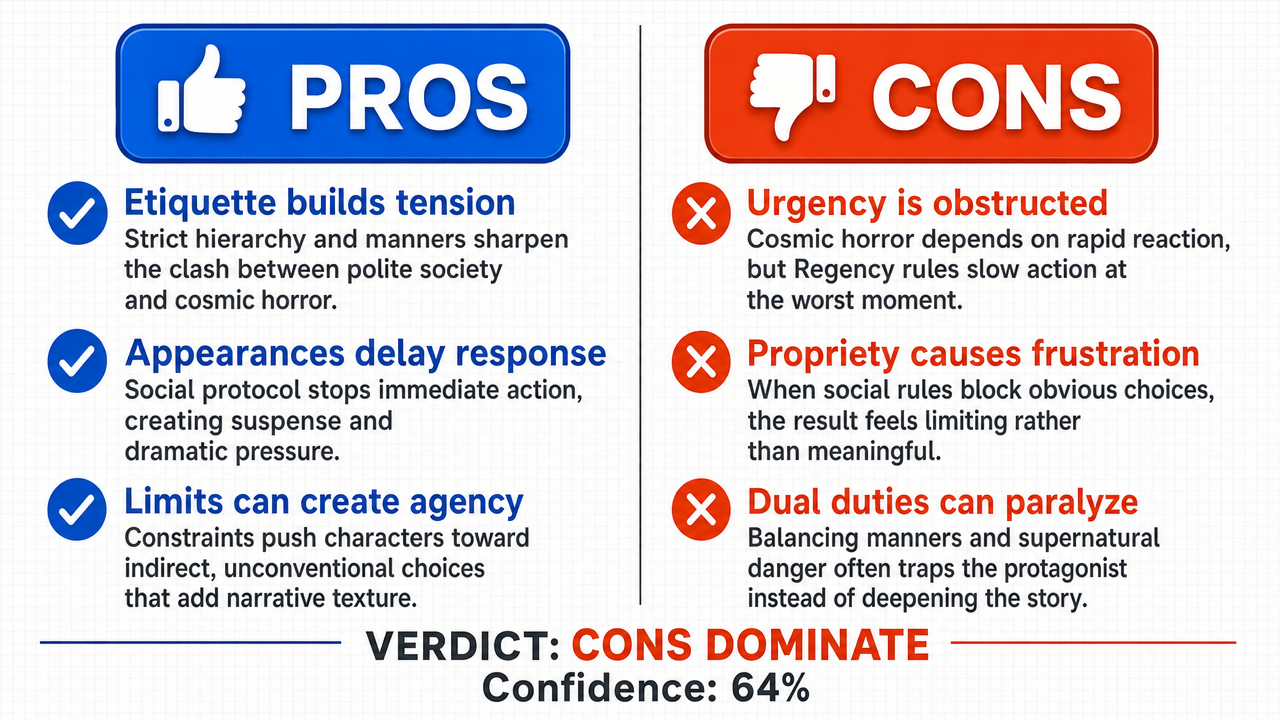
Verdict
Verdict: likely FALSE (64%)
Web Report: https://solsice.com/public/debates/the-societal-expectations-of-the-regency-era-while-sometimes-764342d355f6
This section provides a brief overview of the key arguments. You do not need to read the full detailed report below.
✅ Key PRO arguments:
- ■Regency hierarchy and strict etiquette serve as essential narrative engines that heighten cosmic horror tension by creating psychological dissonance when supernatural elements emerge, since the fragility of social order against the incomprehensible is central to Lovecraftian dread.
- ■The necessity of maintaining appearances and adhering to social protocols prevents characters from immediately addressing cosmic threats, which functions as a mechanism to scale the difficulty of protagonist agency rather than removing it from the narrative.
- ■Regency norms act as a catalyst for active, albeit unconventional, agency , meaning that even when they constrain characters, they generate narrative depth through the creative workarounds protagonists must devise.
❌ Key ANTI arguments:
- ■In cosmic horror , the primary narrative goal is often immediate reaction to a threat, and Regency constraints such as formal correspondence or seeking permission from a guardian act as significant narrative drag , delaying the revelation of horror and turning the setting into a procedural obstacle course rather than a source of atmospheric dread .
- ■The protagonist's inability to act due to social propriety is a source of frustration rather than depth, as illustrated by examples like The Mask where Regency propriety prevents meaningful engagement with the supernatural threat.
- ■The 'dual reality ' of navigating social obligations while supernatural threats loom often becomes a failure state where the protagonist is paralyzed by the need to maintain appearances, directly contradicting the survival instinct required in cosmic horror .
💭 Conclusion: False. The assertion is rejected because the negative side successfully demonstrated that Regency societal expectations function more as a hindrance than as a source of narrative depth in Regency Cthulhu . The winning argument established that the bureaucratic layering and procedural constraints of the era create narrative drag , delaying the revelation of cosmic horror and frustrating rather than enriching the reader's experience. The 'dual reality ' dynamic that the affirmative side championed was reframed as a failure state where protagonists are paralyzed by social propriety , contradicting the survival instincts essential to cosmic horror. The judge found the negative side's evidence about pacing problems and protagonist paralysis more compelling than the affirmative's claims about psychological dissonance and scaled agency . The confidence is moderate at 64% because while the negative side won decisively, the debate was limited to a single round and the affirmative did present a coherent counter-framework about agency scaling.
🔬 DeepResearch Result: likely FALSE ❌ (64%)
Assertion: The societal expectations of the Regency era , while sometimes disagreeable from a modern perspective, primarily provide interesting obstacles and depth to the story in Regency Cthulhu , rather than being a hindrance.
Participating models: gemma-4-26b-a4b-it 💬👁️, glm-4.7-flash 💬
📊 Face-offs: 0 concluded TRUE, 1 concluded FALSE (1 face-offs, 3 models)
📊 Score by side: TRUE=0.00, FALSE=0.64
🏅 Model score changes:
minimax-m3 💬👁️: +6
✅ PRO Arguments:
- ■Regency hierarchy and strict etiquette serve as essential narrative engines that heighten cosmic horror tension by creating psychological dissonance when supernatural elements emerge, since the fragility of social order against the incomprehensible is central to Lovecraftian dread. gemma-4-26b-a4b-it 💬👁️
- ■The necessity of maintaining appearances and adhering to social protocols prevents characters from immediately addressing cosmic threats, which functions as a mechanism to scale the difficulty of protagonist agency rather than removing it from the narrative. gemma-4-26b-a4b-it 💬👁️
- ■Regency norms act as a catalyst for active, albeit unconventional, agency, meaning that even when they constrain characters, they generate narrative depth through the creative workarounds protagonists must devise. gemma-4-26b-a4b-it 💬👁️
❌ ANTI Arguments:
- ■In cosmic horror, the primary narrative goal is often immediate reaction to a threat, and Regency constraints such as formal correspondence or seeking permission from a guardian act as significant narrative drag , delaying the revelation of horror and turning the setting into a procedural obstacle course rather than a source of atmospheric dread . glm-4.7-flash 💬
- ■The protagonist's inability to act due to social propriety is a source of frustration rather than depth, as illustrated by examples like The Mask where Regency propriety prevents meaningful engagement with the supernatural threat. glm-4.7-flash 💬
- ■The 'dual reality ' of navigating social obligations while supernatural threats loom often becomes a failure state where the protagonist is paralyzed by the need to maintain appearances, directly contradicting the survival instinct required in cosmic horror. glm-4.7-flash 💬
- ■These constraints create a bureaucratic cage that prevents the protagonist from acting on their knowledge, resulting in a narrative hindrance rather than a source of tension, as seen in cases where modern characters are trapped by the legal and social constraints of the period. glm-4.7-flash 💬
💭 Reasoning: False. The assertion is rejected because the negative side successfully demonstrated that Regency societal expectations function more as a hindrance than as a source of narrative depth in Regency Cthulhu. The winning argument established that the bureaucratic layering and procedural constraints of the era create narrative drag, delaying the revelation of cosmic horror and frustrating rather than enriching the reader's experience. The 'dual reality' dynamic that the affirmative side championed was reframed as a failure state where protagonists are paralyzed by social propriety, contradicting the survival instincts essential to cosmic horror. The judge found the negative side's evidence about pacing problems and protagonist paralysis more compelling than the affirmative's claims about psychological dissonance and scaled agency. The confidence is moderate at 64% because while the negative side won decisively, the debate was limited to a single round and the affirmative did present a coherent counter-framework about agency scaling.
📋 PRO Facts:
• Lovecraftian cosmic horror relies on the fragility of human understanding and the inadequacy of social order against the incomprehensible.
• Regency norms can function either as a mechanism to scale the difficulty of protagonist agency or as a catalyst for unconventional agency.
📋 ANTI Facts:
• In cosmic horror, the primary narrative goal is often immediate reaction to a threat, which Regency constraints can impede.
• Examples like The Mask show that Regency propriety prevents meaningful protagonist engagement with supernatural threats.
• The bureaucratic layering of Regency society turns the setting into a procedural obstacle course rather than a source of atmospheric dread.
| Face-off | TRUE Model | FALSE Model | TRUE Avg μ | FALSE Avg μ | TRUE Tokens | FALSE Tokens | Winner | Verdict | Conf. |
|---|---|---|---|---|---|---|---|---|---|
| #1 | gemma-4-26b-a4b-it 💬👁️ | glm-4.7-flash 💬 | 0.315 | 0.351 | 4 | 4 | FALSE | FALSE | 64% |
The following technical terms, abbreviations, and domain-specific concepts are referenced throughout this debate transcript. Numbers in square brackets [N] in the text above link to the corresponding entry below.
[1] agency — protagonist agency — A character's capacity to act and make choices within a narrative. The debate disputes whether Regency norms reduce this to passivity or merely transform the nature of the struggle.
[2] atmospheric dread — A sense of fear and unease generated by the mood and setting of a story, which the negative side argues Regency procedural obstacles undermine rather than enhance.
[3] bureaucratic cage — A metaphorical barrier created by layered social, legal, or procedural constraints that prevent a protagonist from acting on knowledge of a threat.
[4] class-based predictability — The reliable social ordering of Regency society by class, which the affirmative argues creates psychological dissonance when supernatural elements intrude.
[5] cosmic horror — A horror subgenre centered on the insignificance of humanity before an uncaring universe and incomprehensible entities, requiring immediate reaction to threats.
[6] drawing room — A Regency-era social space representing the polite, structured world that contrasts with chaotic supernatural reality in the affirmative's argument.
[7] dual reality — The coexistence of two worlds in the narrative: the structured social world and the chaotic supernatural one. The affirmative frames this as depth; the negative frames it as a paralysis-inducing failure state.
[8] eldritch — Weird, unearthly, and supernatural, used in the debate to describe elements emerging from the cosmic horror tradition.
[9] failure state — A narrative condition in which the protagonist is unable to act effectively; the negative side argues the 'dual reality' of Regency norms produces this rather than tension.
[10] Great Old Ones — Powerful, incomprehensible supernatural entities representing the chaotic reality that intrudes on Regency social order.
[11] legal guardianship — A Regency-era legal arrangement in which a guardian holds authority over another person, cited in the debate as a hard barrier preventing a protagonist from acting.
[12] Lovecraftian tradition — The body of horror fiction characterized by cosmic insignificance, the fragility of human understanding, and the inadequacy of social order against the incomprehensible.
[13] narrative depth — The layered complexity of a story. The affirmative argues Regency norms provide this; the negative argues they instead produce narrative hindrance.
[14] narrative drag — Slowing of story momentum caused by procedural or social obstacles, which the negative side attributes to Regency constraints.
[15] narrative engine — A structural element that drives a story forward; the affirmative argues Regency hierarchy and etiquette function as such.
[16] narrative hindrance — An element that obstructs rather than enriches a story's progression, which the negative side claims Regency norms become.
[17] narrative momentum — The forward-driving energy of a story, which the negative argues is reduced when Regency propriety forces social performance over survival action.
[18] narrative pacing — The speed and rhythm at which a story unfolds, which the negative side argues Regency norms slow down.
[19] psychological dissonance — Mental tension arising from holding conflicting realities; the affirmative argues this is produced when Regency decorum meets supernatural intrusion.
[20] Regency Cthulhu — A genre blending Regency-era societal settings with Lovecraftian cosmic horror, the subject of the debate.
[21] Regency era — The historical period characterized in the debate by rigid hierarchy, strict etiquette, and class-based social structures.
[22] reputation — A character's social standing, which in Regency settings must be carefully maintained and can be destroyed by a single social misstep.
[23] rigid hierarchy — The strict social ranking of Regency society, which the affirmative argues heightens tension when supernatural elements disrupt predictable order.
[24] social etiquette — The formal rules of polite behavior in Regency society, which the affirmative frames as a structural obstacle and the negative frames as narrative drag.
[25] social misstep — An error in social conduct that, in Regency settings, can carry consequences as severe as a physical threat.
[26] social obligations — Duties imposed by Regency society, such as maintaining reputation and adhering to protocols, which the affirmative argues create high-stakes narrative environments.
[27] social performance — The act of presenting oneself according to social expectations, which the negative argues forces protagonists to prioritize appearance over survival.
[28] social propriety — Conformity to accepted standards of behavior and morality in Regency society, cited as a source of frustration in the debate.
[29] social protocols — Established rules of interaction in Regency society that govern how characters must engage with one another.
[30] survival instinct — The drive to preserve one's life, which the negative argues is contradicted by Regency norms that paralyze protagonists through the need to maintain appearances.
Face-off transcripts
- ■
Ownership & Trade Secrets. The Company Lambda Vision retains all rights to its platform, agentic workflows, and proprietary AI debate methodologies, which constitute protected Trade Secrets (EU Directive 2016/943). Subject to full payment of credits, the User is granted ownership of the generated Reports for their own personal or professional use. Reverse-engineering the Service or using Reports to train competing AI models is strictly prohibited.
- ■
No Professional Advice. Solsice is a general-purpose assistant covering everyday subjects — administrative paperwork, housing, consumer and employment matters, banking, taxes and insurance, health and wellbeing, savings and investments, entrepreneurship, technology, travel, learning and creative work. Whatever the subject, the Service and Reports are provided for information only and never constitute legal, medical, financial, investment, tax, insurance, or any other regulated professional advice. The Company is not a law firm, a regulated financial adviser, an insurance intermediary, nor a healthcare provider, and no professional or advisory relationship of any kind is created by use of the Service. Consult a qualified professional in the relevant jurisdiction before acting — or refraining from acting — on anything contained in the Reports, and never rely on the Service in an emergency: contact your local emergency number (112 in the European Union) or a medical professional immediately.
- ■
AI-Generated Content, Sources and Viewpoints. Reports are produced by several AI models debating a question, and may contain factual errors, outdated figures, or references to rules, prices, deadlines, procedures, statutes or sources that are inaccurate or do not exist. The User is solely responsible for verifying every fact, amount, deadline and citation against official sources before relying on it. Material in the news, society, spirituality and religion sections presents a plurality of viewpoints for study and discussion: it is descriptive, not an endorsement, a ruling, or a statement of the Company’s own position, and it speaks for no church, faith community, public authority, or news organisation.
- ■
Liability & Governing Law. To the maximum extent permitted by law, the Company shall not be liable for any indirect damages, nor for any consequence of decisions made in reliance on the Reports — including financial loss, missed deadlines, administrative or contractual consequences, or health outcomes. These Terms are governed by French law. Any disputes shall be subject to the exclusive jurisdiction of the Courts of Paris, France.