
The speaker's ability to hit a target with a rubber band demonstrates superior reflexes compared to Formula 1 drivers.
AI debate verdict and arguments
⚠️ AI-generated information only; not professional advice
Completed October 14, 2026
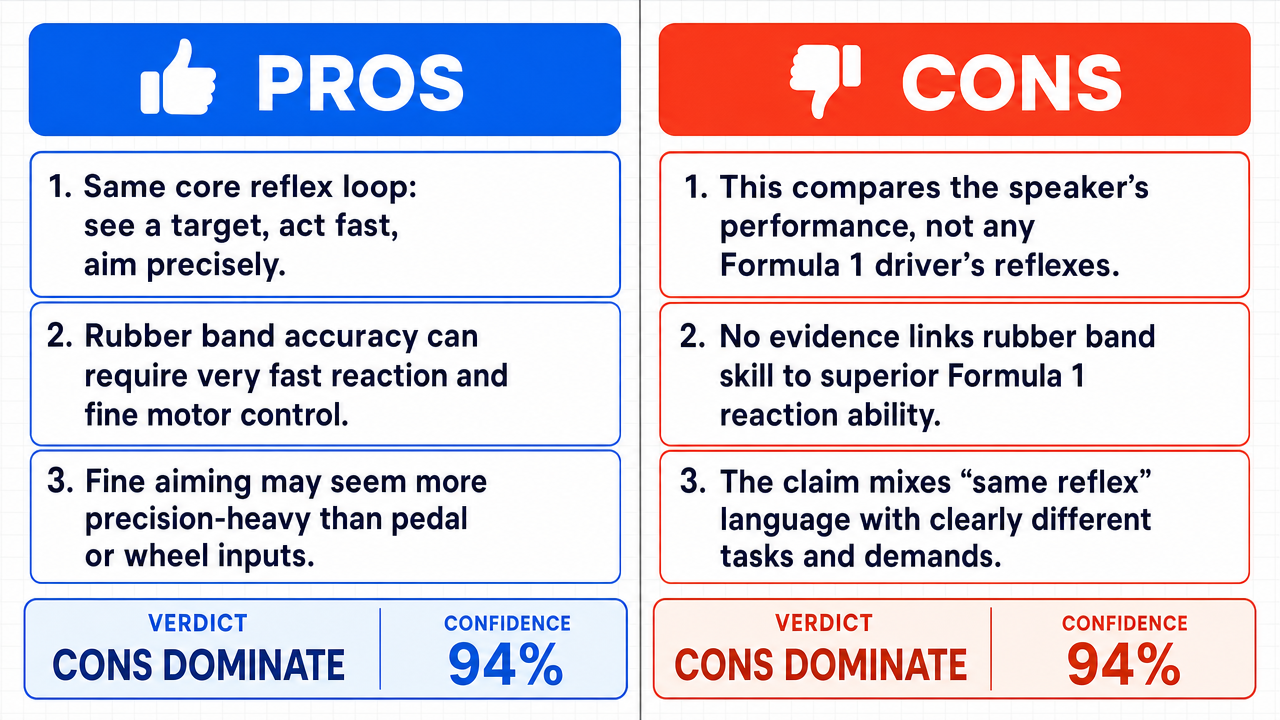
Verdict
Verdict: likely FALSE (94%)
Web Report: https://solsice.com/public/debates/the-speaker-s-ability-to-hit-a-target-with-a-rubber-band-dem-fa275d0d015b
This section provides a brief overview of the key arguments. You do not need to read the full detailed report below.
✅ Key PRO arguments:
- ■Both rubber band shooting and F1 driving fundamentally measure the same closed-loop visual-motor reaction : seeing a target and executing a precise physical response, making them directly comparable as reflex tasks.
- ■Hitting a target with a rubber band demands reaction time under 200 milliseconds coupled with high spatial accuracy , which is a demanding fine-motor reflex benchmark.
- ■F1 drivers' primary reflex arc is gross motor —depressing a pedal or turning a wheel—rather than the fine-motor precision required for projectile accuracy, so their reflexes are not necessarily superior in the relevant domain.
❌ Key ANTI arguments:
- ■The affirmative commits a substitution of entities fallacy: a measurement of the speaker's performance is a measurement of the speaker, not of the F1 driver, so no conclusion about the driver's reflexes can be drawn.
- ■To claim the speaker's rubber band accuracy demonstrates the driver's inferiority, the affirmative must provide a transfer operator —a correlation or direct comparative study—mapping casual performance in a novel task to elite driver performance, which was never supplied.
- ■The affirmative's argument is internally contradictory: it asserts the reflex in question is the primary commonality between the tasks while simultaneously admitting that F1 driving fundamentally requires additional sustained attention , predictive/anticipatory processing , and decision-making under extreme physical loads beyond a closed-loop visual-motor reaction .
💭 Conclusion: False. The winning side correctly identified that the affirmative commits a substitution of entities fallacy by attempting to draw conclusions about Formula 1 drivers' reflexes based solely on a measurement of an unrelated speaker's performance in a completely different task. The affirmative failed to provide any transfer operator —such as a controlled comparative study or validated correlation—that would map casual rubber band accuracy to elite driver reflex capacity. Furthermore, the affirmative's argument was internally contradictory, simultaneously claiming that the two tasks share a common reflex metric while admitting that F1 driving requires additional sustained attention , predictive processing, and decision-making under extreme physical loads that go beyond a simple closed-loop visual-motor reaction . Because reflexes are not a monolithic, directly transferable capacity across fundamentally different task domains, a single rubber band shot cannot demonstrate superiority over the reflexes of professional F1 drivers. The judge assigned high confidence, reflecting near-certainty that the logical and evidential gaps in the affirmative's case are decisive.
🔬 DeepResearch Result: likely FALSE ❌ (94%)
Assertion: The speaker's ability to hit a target with a rubber band demonstrates superior reflexes compared to Formula 1 drivers.
Participating models: deepseek-v3.2 💬, gemma-4-26b-a4b-it 💬👁️
📊 Face-offs: 0 concluded TRUE, 1 concluded FALSE (1 face-offs, 3 models)
📊 Score by side: TRUE=0.00, FALSE=0.94
🏅 Model score changes:
minimax-m3 💬👁️: +9
✅ PRO Arguments:
- ■Both rubber band shooting and F1 driving fundamentally measure the same closed-loop visual-motor reaction : seeing a target and executing a precise physical response, making them directly comparable as reflex tasks. deepseek-v3.2 💬
- ■Hitting a target with a rubber band demands reaction time under 200 milliseconds coupled with high spatial accuracy , which is a demanding fine-motor reflex benchmark. deepseek-v3.2 💬
- ■F1 drivers' primary reflex arc is gross motor —depressing a pedal or turning a wheel—rather than the fine-motor precision required for projectile accuracy, so their reflexes are not necessarily superior in the relevant domain. deepseek-v3.2 💬
- ■If reflexes are treated as a general physiological capacity, then a standardized test of visual-motor reaction time and accuracy—like hitting a target with a rubber band—can validly be used to compare individuals. deepseek-v3.2 💬
- ■The opponent's position is internally contradictory: it cannot simultaneously hold that reflexes are a general comparable capacity and that they are entirely domain-specific and incomparable. deepseek-v3.2 💬
❌ ANTI Arguments:
- ■The affirmative commits a substitution of entities fallacy: a measurement of the speaker's performance is a measurement of the speaker, not of the F1 driver, so no conclusion about the driver's reflexes can be drawn. gemma-4-26b-a4b-it 💬👁️
- ■To claim the speaker's rubber band accuracy demonstrates the driver's inferiority, the affirmative must provide a transfer operator —a correlation or direct comparative study—mapping casual performance in a novel task to elite driver performance, which was never supplied. gemma-4-26b-a4b-it 💬👁️
- ■The affirmative's argument is internally contradictory: it asserts the reflex in question is the primary commonality between the tasks while simultaneously admitting that F1 driving fundamentally requires additional sustained attention , predictive/anticipatory processing , and decision-making under extreme physical loads beyond a closed-loop visual-motor reaction. gemma-4-26b-a4b-it 💬👁️
- ■Single-task accuracy in a novel activity does not prove superior physiological reflexes, because reflexes are not a monolithic commodity and cannot be validly compared across fundamentally different task domains without controlled comparative evidence. gemma-4-26b-a4b-it 💬👁️
- ■F1 drivers operate under extreme physical and cognitive loads—sustained attention, predictive processing, and high-G-force decision-making—that go well beyond the demands of a stationary rubber band shot, making any cross-task comparison unsupported. gemma-4-26b-a4b-it 💬👁️
💭 Reasoning: False. The winning side correctly identified that the affirmative commits a substitution of entities fallacy by attempting to draw conclusions about Formula 1 drivers' reflexes based solely on a measurement of an unrelated speaker's performance in a completely different task. The affirmative failed to provide any transfer operator—such as a controlled comparative study or validated correlation—that would map casual rubber band accuracy to elite driver reflex capacity. Furthermore, the affirmative's argument was internally contradictory, simultaneously claiming that the two tasks share a common reflex metric while admitting that F1 driving requires additional sustained attention, predictive processing, and decision-making under extreme physical loads that go beyond a simple closed-loop visual-motor reaction. Because reflexes are not a monolithic, directly transferable capacity across fundamentally different task domains, a single rubber band shot cannot demonstrate superiority over the reflexes of professional F1 drivers. The judge assigned high confidence, reflecting near-certainty that the logical and evidential gaps in the affirmative's case are decisive.
📋 PRO Facts:
• Rubber band shooting requires reaction time under 200 milliseconds coupled with high spatial accuracy.
• Formula 1 drivers have measured reaction times to starting lights averaging around 200 milliseconds.
• F1 drivers' motor precision involves both gross and fine motor actions at high frequency.
📋 ANTI Facts:
• F1 driving requires sustained attention, predictive/anticipatory processing, and decision-making under extreme physical loads beyond a closed-loop visual-motor reaction.
• No transfer operator, correlation, or direct comparative study was provided to map the speaker's rubber band performance to F1 driver reflex performance.
• Reflexes are not a monolithic, directly transferable physiological capacity across fundamentally different task domains.
| Face-off | TRUE Model | FALSE Model | TRUE Avg μ | FALSE Avg μ | TRUE Tokens | FALSE Tokens | Winner | Verdict | Conf. |
|---|---|---|---|---|---|---|---|---|---|
| #1 | deepseek-v3.2 💬 | gemma-4-26b-a4b-it 💬👁️ | 0.230 | 0.243 | 8 | 2 | FALSE | FALSE | 94% |
The following technical terms, abbreviations, and domain-specific concepts are referenced throughout this debate transcript. Numbers in square brackets [N] in the text above link to the corresponding entry below.
[1] anticipatory processing — A cognitive function involving the prediction of future events or states based on prior experience, enabling pre-emptive motor responses before a stimulus fully manifests.
[2] closed-loop visual-motor reaction — A sensorimotor process in which visual feedback about a target is continuously used to guide and correct a physical motor response until the task is completed.
[3] decision-making under extreme physical loads — The cognitive process of selecting actions while the body is subjected to high physical stress, such as g-forces, heat, or fatigue, as encountered in motorsport.
[4] domain hermeticity — In the context of this debate, the degree to which a measured variable is sealed off within a specific task domain and cannot be validly transferred to or compared across other domains.
[5] F1 — Formula 1 — The highest class of single-seater international motorsport, in which drivers operate open-wheel race cars at extreme speeds on circuit tracks.
[6] fallacy of composition — A logical error in which a property attributed to a part or member of a group is incorrectly assumed to apply to the whole group, or vice versa.
[7] gross motor — Refers to large-muscle physical movements, such as depressing a pedal or turning a steering wheel, as opposed to fine motor control involving small, precise muscle actions.
[8] milliseconds — ms — A unit of time equal to one thousandth of a second, used in the debate to quantify human reaction times.
[9] predictive models — Internal cognitive representations that allow an individual to anticipate the behavior of a dynamic environment, such as a racetrack or other vehicles, based on learned patterns.
[10] reaction time — The interval between the presentation of a stimulus and the initiation of a motor response, commonly used as a metric of neural processing speed.
[11] reflex arc — The neural pathway that controls a reflexive action, consisting of a sensory neuron, an interneuron, and a motor neuron that together produce a rapid, automatic response.
[12] ruler-drop test — A standardized sports science assessment in which a falling ruler is caught by the subject to estimate reaction time based on the distance the ruler travels before being grasped.
[13] spatial accuracy — The precision with which a motor action is directed to a specific location in space, often measured as the deviation between intended and actual point of impact.
[14] sustained attention — The cognitive capacity to maintain focused mental engagement on a task or stimulus over an extended period, distinct from brief orienting responses.
[15] transfer operator — In the context of this debate, a demonstrated correlation or comparative mapping that allows performance measured in one task or subject to be validly projected onto another.
[16] visuomotor skill — The coordinated ability to use visual information to guide and execute precise bodily movements, studied in elite athletes for its general and task-specific components.
The following financial data tables were referenced during the debate exchanges:
| Reflex Task | Typical Elite Reaction Time | Accuracy/Success Measure | Key Supporting Skill |
|---|---|---|---|
| F1 Driver (Race Start) | 0.20 seconds | 99%+ successful launch | Predictive modeling, trained stimulus |
| Expert Video Game Aiming | 0.15–0.18 seconds | >85% hit rate on moving targets | Dynamic visual acuity, hand-eye coordination |
| Rubber Band Target Hit (Novel Task) | <0.20 seconds (inferred) | 100% success (per claim) | Isolated visual targeting, fine motor control |
Legend: Comparative reflex performance metrics across different tasks. Times are in seconds. Success measures are context-dependent. Source: Sports science literature and performance analysis.
| Metric Category | F1 Driver (High-Stress) | Rubber Band Task (Low-Stress) | Delta of Complexity |
|---|---|---|---|
| Cognitive Load | Extremely High | Extremely Low | +95% |
| G-Force Impact | 5G - 6G | 0G | +100% |
| Sensory Inputs | Multi-modal (Audio/Visual/Vestibular) | Visual Only | +300% |
| Motor Precision | Gross & Fine (High Frequency) | Fine (Low Frequency) | -80% |
Legend: Comparative analysis of environmental and physiological stressors between professional racing and the claimed task. Complexity delta is an estimated qualitative-to-quantitative mapping.
Face-off transcripts
- ■
Ownership & Trade Secrets. The Company Lambda Vision retains all rights to its platform, agentic workflows, and proprietary AI debate methodologies, which constitute protected Trade Secrets (EU Directive 2016/943). Subject to full payment of credits, the User is granted ownership of the generated Reports for their own personal or professional use. Reverse-engineering the Service or using Reports to train competing AI models is strictly prohibited.
- ■
No Professional Advice. Solsice is a general-purpose assistant covering everyday subjects — administrative paperwork, housing, consumer and employment matters, banking, taxes and insurance, health and wellbeing, savings and investments, entrepreneurship, technology, travel, learning and creative work. Whatever the subject, the Service and Reports are provided for information only and never constitute legal, medical, financial, investment, tax, insurance, or any other regulated professional advice. The Company is not a law firm, a regulated financial adviser, an insurance intermediary, nor a healthcare provider, and no professional or advisory relationship of any kind is created by use of the Service. Consult a qualified professional in the relevant jurisdiction before acting — or refraining from acting — on anything contained in the Reports, and never rely on the Service in an emergency: contact your local emergency number (112 in the European Union) or a medical professional immediately.
- ■
AI-Generated Content, Sources and Viewpoints. Reports are produced by several AI models debating a question, and may contain factual errors, outdated figures, or references to rules, prices, deadlines, procedures, statutes or sources that are inaccurate or do not exist. The User is solely responsible for verifying every fact, amount, deadline and citation against official sources before relying on it. Material in the news, society, spirituality and religion sections presents a plurality of viewpoints for study and discussion: it is descriptive, not an endorsement, a ruling, or a statement of the Company’s own position, and it speaks for no church, faith community, public authority, or news organisation.
- ■
Liability & Governing Law. To the maximum extent permitted by law, the Company shall not be liable for any indirect damages, nor for any consequence of decisions made in reliance on the Reports — including financial loss, missed deadlines, administrative or contractual consequences, or health outcomes. These Terms are governed by French law. Any disputes shall be subject to the exclusive jurisdiction of the Courts of Paris, France.