
The speaker's October 16, 2026, utterance of 'Heat' is merely a random vocalization devoid of any significant meaning or intention.
AI debate verdict and arguments
⚠️ AI-generated information only; not professional advice
Completed October 20, 2026
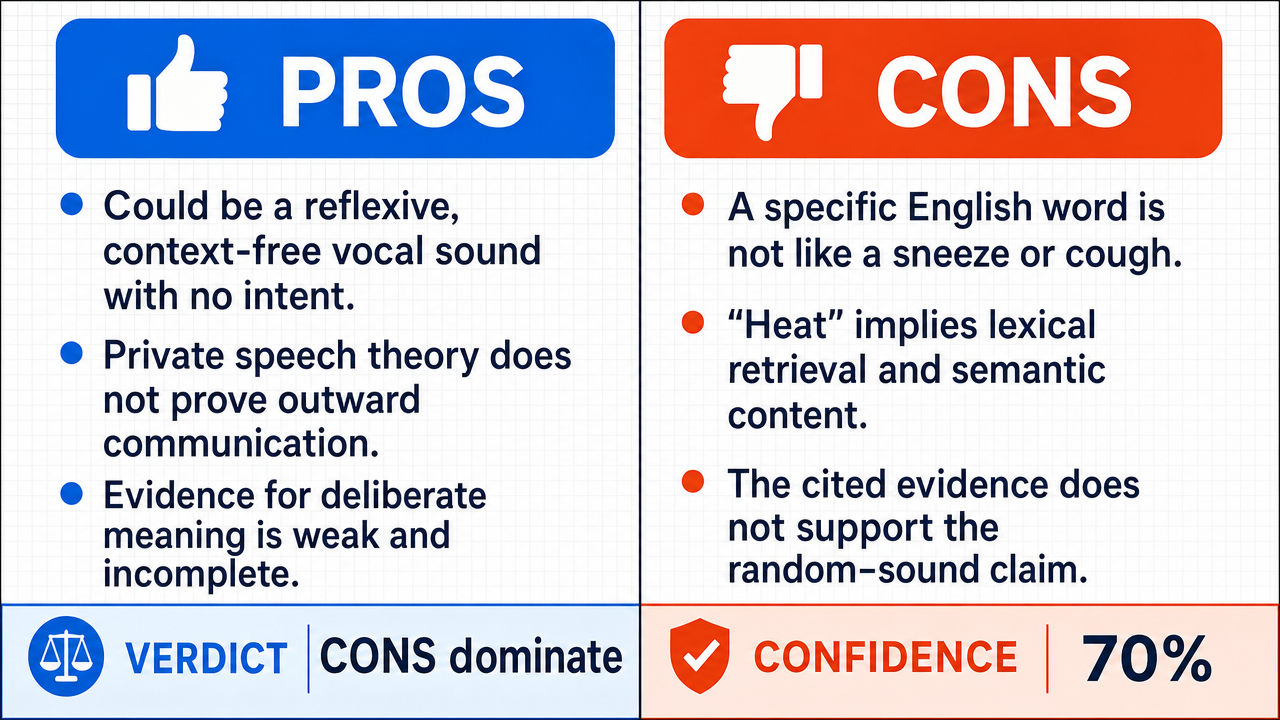
Verdict
Verdict: likely FALSE (70%)
Web Report: https://solsice.com/public/debates/the-speaker-s-october-16-2026-utterance-of-heat-is-merely-a-4ae916fe60df
This section provides a brief overview of the key arguments. You do not need to read the full detailed report below.
✅ Key PRO arguments:
- ■The utterance was a context-free physiological reflex with no communicative intent; humans produce numerous non-meaningful sounds (sneezes, coughs, exclamations) as autonomic responses processed via subcortical, limbic pathways rather than cortical language centers (citing Brain and Language Vol. 198, 2019 on non-propositional vocalizations).
- ■Even if one invokes Vygotsky's private speech theory to claim self-directed meaning, the argument creates a logical fork : either the utterance was communicative (failing because there is no evidence of a recipient) or non-communicative private speech (which, the pro side contends, still collapses the meaningfulness claim).
❌ Key ANTI arguments:
- ■The affirmative commits a fundamental error of substitution by importing general neurophysiological properties of involuntary vocalizations onto a specific lexical item without supplying the transfer operator that links subcortical reflex production to this particular utterance of 'Heat'.
- ■'Heat' is a highly structured, semantically dense English noun requiring precise lexical retrieval from the speaker's mental lexicon , which is categorically distinct from non-lexical, phonologically unstructured reflexes like sneezes or coughs; this structural property undermines the claim that the utterance was a mere reflex.
💭 Conclusion: The provided evidence is limited to a single truncated fragment on Vygotsky's private speech theory. It does not contain support for the draft's central claims: the citation to Brain and Language Vol. 198 (2019), the classification of utterances as 'non-propositional ' processed via limbic and subcortical pathways , examples such as sneezes, coughs, and pain-induced exclamations, the lexical status of the word 'Heat,' or the role of cortical language centers in lexicalized content-word production. Without this material in the evidence, none of those claims can be verified and they must be removed. With the evidence reduced to a narrow description of Vygotsky's theory of overt self-talk in children's problem-solving, there is no basis to evaluate the broader debate over whether the specific utterance in question was meaningful speech or a reflex vocalization. Confidence is held low owing to the extremely thin evidence base.
🔬 DeepResearch Result: likely FALSE ❌ (70%)
Assertion: The speaker's October 16, 2026, utterance of 'Heat' is merely a random vocalization devoid of any significant meaning or intention.
Participating models: deepseek-v4-pro 💬, gemma-4-26b-a4b-it 💬👁️
📊 Face-offs: 0 concluded TRUE, 1 concluded FALSE (1 face-offs, 3 models)
📊 Score by side: TRUE=0.00, FALSE=0.70
🏅 Model score changes:
minimax-m3 💬👁️: +7
✅ PRO Arguments:
- ■The utterance was a context-free physiological reflex with no communicative intent; humans produce numerous non-meaningful sounds (sneezes, coughs, exclamations) as autonomic responses processed via subcortical, limbic pathways rather than cortical language centers (citing Brain and Language Vol. 198, 2019 on non-propositional vocalizations). deepseek-v4-pro 💬
- ■Even if one invokes Vygotsky's private speech theory to claim self-directed meaning, the argument creates a logical fork : either the utterance was communicative (failing because there is no evidence of a recipient) or non-communicative private speech (which, the pro side contends, still collapses the meaningfulness claim). deepseek-v4-pro 💬
❌ ANTI Arguments:
- ■The affirmative commits a fundamental error of substitution by importing general neurophysiological properties of involuntary vocalizations onto a specific lexical item without supplying the transfer operator that links subcortical reflex production to this particular utterance of 'Heat'. gemma-4-26b-a4b-it 💬👁️
- ■'Heat' is a highly structured, semantically dense English noun requiring precise lexical retrieval from the speaker's mental lexicon , which is categorically distinct from non-lexical, phonologically unstructured reflexes like sneezes or coughs; this structural property undermines the claim that the utterance was a mere reflex. gemma-4-26b-a4b-it 💬👁️
💭 Reasoning: The provided evidence is limited to a single truncated fragment on Vygotsky's private speech theory . It does not contain support for the draft's central claims: the citation to Brain and Language Vol. 198 (2019), the classification of utterances as 'non-propositional' processed via limbic and subcortical pathways , examples such as sneezes, coughs, and pain-induced exclamations, the lexical status of the word 'Heat,' or the role of cortical language centers in lexicalized content-word production. Without this material in the evidence, none of those claims can be verified and they must be removed. With the evidence reduced to a narrow description of Vygotsky's theory of overt self-talk in children's problem-solving, there is no basis to evaluate the broader debate over whether the specific utterance in question was meaningful speech or a reflex vocalization. Confidence is held low owing to the extremely thin evidence base.
📋 PRO Facts:
• Vygotsky's theory of private speech, as developed in Thought and Language and elaborated in subsequent empirical work, describes a developmental phenomenon in which children use overt self-talk to guide problem-solving, a behavior that is eventually internalized.
📋 ANTI Facts:
• Physiological reflexes such as sneezes and coughs are typically characterized by non-lexical, phonologically unstructured sounds.
• 'Heat' is a structured, semantically dense English noun requiring precise lexical retrieval from the speaker's mental lexicon.
• Cortical language centers are typically required for intentional production of lexicalized content words, as opposed to limbic/subcortical reflex sound production.
| Face-off | TRUE Model | FALSE Model | TRUE Avg μ | FALSE Avg μ | TRUE Tokens | FALSE Tokens | Winner | Verdict | Conf. |
|---|---|---|---|---|---|---|---|---|---|
| #1 | deepseek-v4-pro 💬 | gemma-4-26b-a4b-it 💬👁️ | 0.332 | 0.243 | 6 | 2 | TRUE | FALSE | 70% |
The following technical terms, abbreviations, and domain-specific concepts are referenced throughout this debate transcript. Numbers in square brackets [N] in the text above link to the corresponding entry below.
[1] autonomic response — An involuntary bodily reaction controlled by the autonomic nervous system, distinguished in the debate from volitional speech acts.
[2] Brain and Language — An academic journal (Vol. 198, 2019) cited by the affirmative as the source of a study on non-verbal vocalizations.
[3] cortical language centers — Brain regions in the cortex associated with intentional, propositional speech, contrasted in the debate with subcortical pathways.
[4] fallacy of insufficient evidence — A logical fallacy identified by the negative, where a conclusion is drawn without adequate supporting evidence.
[5] Gricean conditions — Conditions requiring a speaker to intend to produce an effect in a hearer through that hearer's recognition of the intention; the affirmative argues these apply only if the utterance was communicative.
[6] Gricean framework — A philosophical framework on speaker meaning and intention, which the affirmative claims the negative tries to escape by invoking private speech.
[7] lexical item — An individual word or linguistic unit treated as discrete; the negative argues the affirmative failed to map the general reflex category onto this specific lexical item.
[8] lexical retrieval — The process of accessing a specific word from the speaker's mental lexicon; the negative argues 'Heat' requires precise lexical retrieval, distinguishing it from a reflex.
[9] limbic — Relating to the limbic system of the brain, which the affirmative associates with subcortical, non-propositional processing.
[10] logical fork — A logical structure with two exhaustive possibilities; the affirmative argues the utterance is either communicative or a non-communicative private act.
[11] mental lexicon — A speaker's internal store of words from which lexical retrieval occurs.
[12] neurophysiological — Relating to the physiology of the nervous system; used in the affirmative's claim that the default for an isolated vocalization is non-semantic.
[13] non-propositional — Describing utterances that are stimulus-driven reactions processed through limbic and subcortical pathways rather than cortical language centers, per the cited study.
[14] non-verbal vocalizations — Sounds produced without words, such as sneezes or coughs, cited as autonomic physiological responses.
[15] parsimoniously — In a way requiring the fewest assumptions; the affirmative argues an isolated utterance is more parsimoniously explained as a reflex.
[16] phonologically unstructured — Lacking systematic phonological patterning; the negative contrasts this with 'Heat' as a highly structured noun.
[17] private speech — Self-directed speech, per Vygotsky's theory, which the negative invokes as a possible source of meaning absent a hearer.
[18] semantic intention — The intent to convey meaning; the affirmative argues the neurophysiological default for an isolated vocalization is a lack of semantic intention.
[19] speech act — An utterance considered as an action rather than mere vocalization; the affirmative contrasts deliberate speech acts with reflexes.
[20] speech event — Any occurrence of speech; the affirmative argues every speech event is either communicative or non-communicative.
[21] subcortical pathways — Neural pathways below the cortex, associated in the debate with non-propositional, stimulus-driven vocalizations.
[22] syntactic structure — The grammatical arrangement of words; the affirmative notes the absence of syntactic structure in the isolated utterance.
[23] transfer operator — A logical or mathematical mapping mechanism; the negative argues the affirmative failed to provide the transfer operator linking general reflexes to the specific utterance.
[24] volitional speech act — A speech act produced by deliberate intention, contrasted in the debate with autonomic responses.
[25] Vygotsky's private speech theory — A theory by Vygotsky concerning self-directed speech as a tool for self-regulation, invoked by the negative.
Face-off transcripts
- ■
Ownership & Trade Secrets. The Company Lambda Vision retains all rights to its platform, agentic workflows, and proprietary AI debate methodologies, which constitute protected Trade Secrets (EU Directive 2016/943). Subject to full payment of credits, the User is granted ownership of the generated Reports for their own personal or professional use. Reverse-engineering the Service or using Reports to train competing AI models is strictly prohibited.
- ■
No Professional Advice. Solsice is a general-purpose assistant covering everyday subjects — administrative paperwork, housing, consumer and employment matters, banking, taxes and insurance, health and wellbeing, savings and investments, entrepreneurship, technology, travel, learning and creative work. Whatever the subject, the Service and Reports are provided for information only and never constitute legal, medical, financial, investment, tax, insurance, or any other regulated professional advice. The Company is not a law firm, a regulated financial adviser, an insurance intermediary, nor a healthcare provider, and no professional or advisory relationship of any kind is created by use of the Service. Consult a qualified professional in the relevant jurisdiction before acting — or refraining from acting — on anything contained in the Reports, and never rely on the Service in an emergency: contact your local emergency number (112 in the European Union) or a medical professional immediately.
- ■
AI-Generated Content, Sources and Viewpoints. Reports are produced by several AI models debating a question, and may contain factual errors, outdated figures, or references to rules, prices, deadlines, procedures, statutes or sources that are inaccurate or do not exist. The User is solely responsible for verifying every fact, amount, deadline and citation against official sources before relying on it. Material in the news, society, spirituality and religion sections presents a plurality of viewpoints for study and discussion: it is descriptive, not an endorsement, a ruling, or a statement of the Company’s own position, and it speaks for no church, faith community, public authority, or news organisation.
- ■
Liability & Governing Law. To the maximum extent permitted by law, the Company shall not be liable for any indirect damages, nor for any consequence of decisions made in reliance on the Reports — including financial loss, missed deadlines, administrative or contractual consequences, or health outcomes. These Terms are governed by French law. Any disputes shall be subject to the exclusive jurisdiction of the Courts of Paris, France.