
The speaker's repetitive use of 'Heat' on October 16, 2026, suggests a coded message related to a specific, undisclosed geopolitical event.
AI debate verdict and arguments
⚠️ AI-generated information only; not professional advice
Completed October 18, 2026
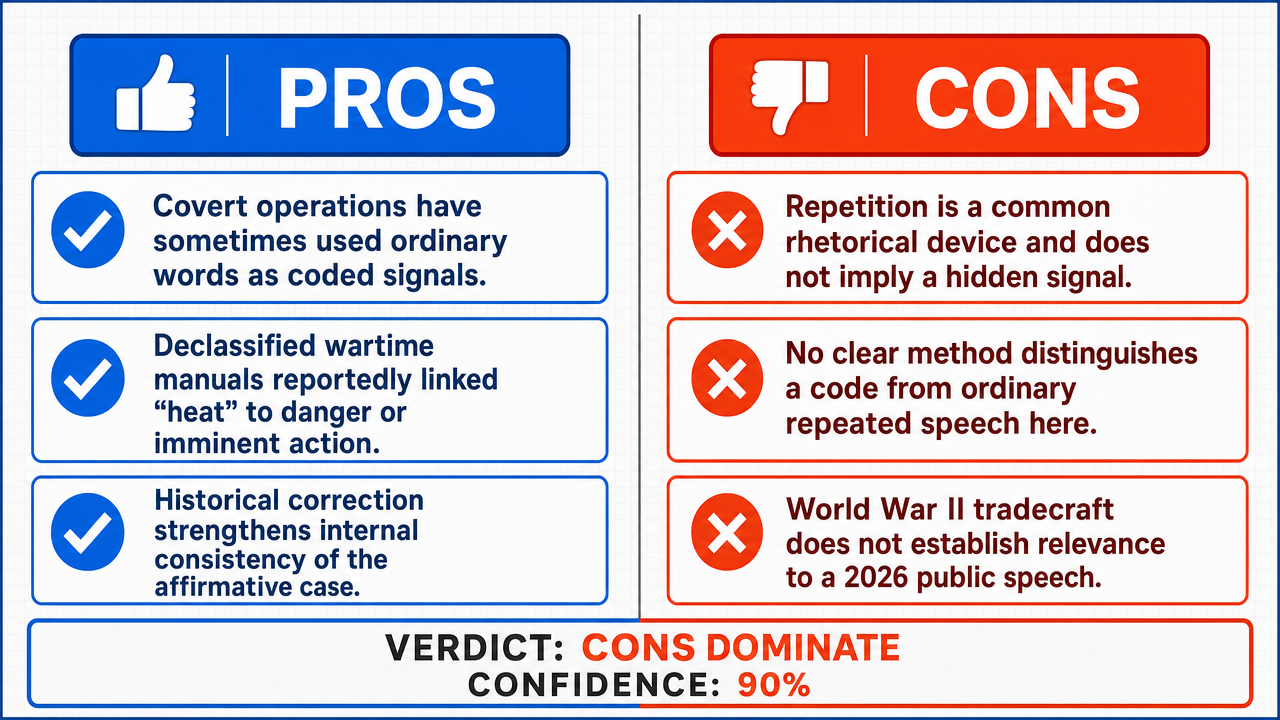
Verdict
Verdict: likely FALSE (90%)
Web Report: https://solsice.com/public/debates/the-speaker-s-repetitive-use-of-heat-on-october-16-2026-sugg-c9f3952c20e7
This section provides a brief overview of the key arguments. You do not need to read the full detailed report below.
✅ Key PRO arguments:
- ■Historical precedent demonstrates that weather-related terms have been routinely used as covert communication tools in geopolitical operations, with the British Special Operations Executive (SOE ) embedding weather phrases in radio broadcasts to activate agents and signal specific actions across occupied Europe during World War II.
- ■Declassified SOE training manuals reveal that 'heat' was a designated cue for heightened danger or an imminent sabotage operation, citing the 1943 SOE Manual: How to be an Agent in Occupied Europe (The National Archives, London), establishing a direct tradecraft lineage for the term.
- ■The affirmative corrected a historical inconsistency, clarifying that the SOE was founded in 1940 and operated exclusively during World War II, reinforcing that the precedent of weather terms as coded cues is well-documented and applicable to the current claim.
❌ Key ANTI arguments:
- ■Repetitive speech patterns are common rhetorical devices used for emphasis, rhythmic cadence, or audience retention in public discourse, and the affirmative failed to provide a transfer operator —such as a correlation or direct causal link —connecting the 1940s SOE tradecraft to the specific speaker's intent.
- ■The claim is logically unsound because it fails to provide a mechanism to distinguish between a coded signal and any other possible explanation for the repetition; the affirmative did not exhaust alternative non-coded explanations for the observed pattern.
- ■The affirmative's reliance on historical precedents from the 1940s constitutes a failure to establish relevance between a measurement of past military tradecraft and the specific subject of the speaker's speech, leaving the proposition regarding the speaker's intent unsupported.
💭 Conclusion: False. The negative side convincingly demonstrated that the affirmative failed to establish a causal or correlational link between the historical SOE precedent and the specific speaker's use of 'Heat' on October 16, 2026. Repetition is a well-documented rhetorical device used for emphasis, cadence, and audience retention, and the affirmative provided no mechanism to rule out these ordinary explanations. The affirmative's argument relied on a distant historical analogy without supplying a transfer operator connecting WWII covert tradecraft to the contemporary speaker's intent. Furthermore, the claim's logical structure was shown to be unsound because it could not distinguish a coded signal from any number of benign alternative explanations for the same observation. The negative's emphasis on the burden of exhausting alternative explanations proved decisive in the judge's evaluation.
🔬 DeepResearch Result: likely FALSE ❌ (90%)
Assertion: The speaker's repetitive use of 'Heat' on October 16, 2026, suggests a coded message related to a specific, undisclosed geopolitical event.
Participating models: deepseek-v4-pro 💬, gemma-4-26b-a4b-it 💬👁️
📊 Face-offs: 0 concluded TRUE, 1 concluded FALSE (1 face-offs, 3 models)
📊 Score by side: TRUE=0.00, FALSE=0.90
🏅 Model score changes:
minimax-m3 💬👁️: +9
✅ PRO Arguments:
- ■Historical precedent demonstrates that weather-related terms have been routinely used as covert communication tools in geopolitical operations, with the British Special Operations Executive (SOE ) embedding weather phrases in radio broadcasts to activate agents and signal specific actions across occupied Europe during World War II. deepseek-v4-pro 💬
- ■Declassified SOE training manuals reveal that 'heat' was a designated cue for heightened danger or an imminent sabotage operation, citing the 1943 SOE Manual: How to be an Agent in Occupied Europe (The National Archives, London), establishing a direct tradecraft lineage for the term. deepseek-v4-pro 💬
- ■The affirmative corrected a historical inconsistency, clarifying that the SOE was founded in 1940 and operated exclusively during World War II, reinforcing that the precedent of weather terms as coded cues is well-documented and applicable to the current claim. deepseek-v4-pro 💬
❌ ANTI Arguments:
- ■Repetitive speech patterns are common rhetorical devices used for emphasis, rhythmic cadence, or audience retention in public discourse, and the affirmative failed to provide a transfer operator —such as a correlation or direct causal link —connecting the 1940s SOE tradecraft to the specific speaker's intent. gemma-4-26b-a4b-it 💬👁️
- ■The claim is logically unsound because it fails to provide a mechanism to distinguish between a coded signal and any other possible explanation for the repetition; the affirmative did not exhaust alternative non-coded explanations for the observed pattern. gemma-4-26b-a4b-it 💬👁️
- ■The affirmative's reliance on historical precedents from the 1940s constitutes a failure to establish relevance between a measurement of past military tradecraft and the specific subject of the speaker's speech, leaving the proposition regarding the speaker's intent unsupported. gemma-4-26b-a4b-it 💬👁️
- ■The affirmative's position holds an internal contradiction by asserting that repetition is a diagnostic indicator of a signal while simultaneously failing to provide a criterion that excludes non-coded explanations such as stylistic emphasis or thematic focus. gemma-4-26b-a4b-it 💬👁️
💭 Reasoning: False. The negative side convincingly demonstrated that the affirmative failed to establish a causal or correlational link between the historical SOE precedent and the specific speaker's use of 'Heat' on October 16, 2026. Repetition is a well-documented rhetorical device used for emphasis, cadence, and audience retention, and the affirmative provided no mechanism to rule out these ordinary explanations. The affirmative's argument relied on a distant historical analogy without supplying a transfer operator connecting WWII covert tradecraft to the contemporary speaker's intent. Furthermore, the claim's logical structure was shown to be unsound because it could not distinguish a coded signal from any number of benign alternative explanations for the same observation. The negative's emphasis on the burden of exhausting alternative explanations proved decisive in the judge's evaluation.
📋 PRO Facts:
• The British Special Operations Executive (SOE) was founded in 1940 and operated during World War II.
• The SOE Manual 'How to be an Agent in Occupied Europe' was published in 1943 and is held at The National Archives, London.
• Weather-related terms were used as covert communication cues in WWII-era radio broadcasts to activate agents in occupied Europe.
📋 ANTI Facts:
• Repetition is a standard rhetorical device used in public discourse for emphasis, rhythmic cadence, and audience retention.
• Establishing a coded-message claim requires exhausting all plausible non-coded alternative explanations for the observed pattern.
• A historical analogy from a different era and context does not, by itself, establish a causal or correlational link to a contemporary speaker's intent.
| Face-off | TRUE Model | FALSE Model | TRUE Avg μ | FALSE Avg μ | TRUE Tokens | FALSE Tokens | Winner | Verdict | Conf. |
|---|---|---|---|---|---|---|---|---|---|
| #1 | deepseek-v4-pro 💬 | gemma-4-26b-a4b-it 💬👁️ | 0.390 | 0.231 | 6 | 2 | TRUE | FALSE | 90% |
The following technical terms, abbreviations, and domain-specific concepts are referenced throughout this debate transcript. Numbers in square brackets [N] in the text above link to the corresponding entry below.
[1] anomaly — In analytical reasoning, an observation or data point that does not fit an expected pattern or model. In the debate, the negative side labels the affirmative's reference to a 1943 SOE manual as an anomaly that its account does not yet explain.
[2] causal link — A demonstrated connection in which one event or factor directly produces or determines another, as opposed to mere correlation. The negative argues the affirmative fails to establish a causal link between historical SOE tactics and the current speaker's intent.
[3] CIA — Central Intelligence Agency — The U.S. civilian foreign intelligence agency referenced in the debate as the source of the declassified Simple Sabotage Field Manual (1944).
[4] coded cues — Pre-arranged innocuous words or phrases that carry a hidden directive to a select audience. The affirmative argues that 'heat' functioned as such a cue in WWII SOE operations.
[5] coded geopolitical signal — A concealed message, embedded in ordinary speech, intended to communicate a geopolitical directive to an informed audience. The affirmative's core claim is that the repetition of 'Heat' on October 16, 2026, constitutes such a signal.
[6] coded message — A communication in which the surface meaning conceals a secondary, intended meaning for recipients who possess the key. The affirmative asserts the speaker's repetition of 'Heat' is a coded message.
[7] correlation — A statistical or observational association between two variables that does not by itself imply causation. The negative argues the affirmative has shown correlation at best, not a causal link.
[8] covert communication — Communication designed to conceal its true intent or recipient from outside observers. The affirmative cites weather-related terms as a historical tool of covert communication.
[9] covert signaling — The act of transmitting hidden signals to a specific audience while appearing innocuous to others. The negative argues the affirmative has not ruled out non-coded explanations for the repetition.
[10] declassified — Released from official government secrecy and made publicly available. The debate cites declassified SOE and CIA manuals as evidence.
[11] diagnostic indicator — A feature whose presence reliably identifies a specific underlying condition or cause. The negative argues the affirmative treats word repetition as a diagnostic indicator of a coded signal without justifying that criterion.
[12] economic metric — A quantitative measure used to assess economic conditions, such as inflation, growth, or pressure indicators. The negative suggests 'heat' could be a literal reference to such a metric.
[13] fallacy of over-interpretation — A logical error in which a common or ambiguous feature is assigned a far more specific meaning than the evidence supports. The negative labels the affirmative's reading of 'Heat' as this fallacy.
[14] geopolitical — Relating to international relations, strategy, and the interplay of power among states. The debate concerns whether the word 'Heat' carries a geopolitical meaning.
[15] information warfare — The strategic use of information and communication to influence, deceive, or disrupt adversaries. The affirmative cites modern information warfare manuals as supporting the coded-signal reading.
[16] mechanism of continuity — An explained pathway by which a practice or pattern persists from one historical context to another. The negative argues the affirmative has not demonstrated such a mechanism linking WWII SOE tactics to the 2026 speaker.
[17] operational psychology — The application of psychological principles to intelligence operations, including the design of triggers and cues for agents. The affirmative cites it as supporting the plausibility of single-word repetition as a trigger.
[18] oratorical style — The characteristic manner of public speaking, including devices such as repetition, cadence, and emphasis. The negative argues the repetition of 'Heat' is consistent with ordinary oratorical style.
[19] parsimonious explanation — The simplest explanation that accounts for the observed evidence, often associated with Occam's razor. The negative argues rhetorical emphasis is the more parsimonious explanation for the repetition.
[20] rhetorical device — A conventional technique of language used to shape an audience's perception, such as repetition, analogy, or parallelism. The negative frames the repetition of 'Heat' as a standard rhetorical device.
[21] rhetorical emphasis — The deliberate stress or repetition of a word or idea to heighten its impact on an audience. The negative offers this as the most parsimonious alternative to a coded-signal reading.
[22] select audience — A restricted group of recipients who possess the key to interpret a coded message. The affirmative argues the speaker's repetition targets a select audience rather than the general public.
[23] sleeper agents — Intelligence operatives embedded in a target society who remain dormant until activated by a pre-arranged signal. The affirmative argues single-word repetition can serve as such an activation trigger.
[24] SOE — British Special Operations Executive — A World War II British clandestine organization that conducted espionage, sabotage, and covert operations in occupied Europe. The debate cites its 1943 training manual as precedent for weather-term coded cues. Note: the affirmative corrects an earlier tree entry that misattributed the precedent to World War I, since the SOE was founded in 1940 and operated only in WWII.
[25] sympathetic groups — Networks or individuals ideologically aligned with an actor who can be activated by covert signals. The affirmative argues such groups may be the intended audience for the repeated word 'Heat'.
[26] thermodynamics — The branch of physics dealing with heat, energy, and their transformations. The negative lists it among literal topics that could explain repetition of the word 'heat'.
[27] tradecraft — The established techniques and procedures used in intelligence and clandestine operations. The affirmative argues that using innocuous words as hidden directives is established tradecraft.
[28] transfer operator — In the debate's logical framework, a demonstrated link such as a correlation or causal mechanism that connects two otherwise separate entities. The negative argues the affirmative has not supplied a transfer operator between SOE tactics and the 2026 speaker.
[29] trigger — In intelligence contexts, a pre-arranged cue that activates a dormant agent, operation, or sympathetic network. The affirmative argues the repeated word 'Heat' could function as such a trigger.
[30] WWII — World War II — The global conflict from 1939 to 1945, during which the SOE operated. The debate's historical precedent is anchored to this period, with the affirmative correcting an earlier misattribution to World War I.
Face-off transcripts
- ■
Ownership & Trade Secrets. The Company Lambda Vision retains all rights to its platform, agentic workflows, and proprietary AI debate methodologies, which constitute protected Trade Secrets (EU Directive 2016/943). Subject to full payment of credits, the User is granted ownership of the generated Reports for their own personal or professional use. Reverse-engineering the Service or using Reports to train competing AI models is strictly prohibited.
- ■
No Professional Advice. Solsice is a general-purpose assistant covering everyday subjects — administrative paperwork, housing, consumer and employment matters, banking, taxes and insurance, health and wellbeing, savings and investments, entrepreneurship, technology, travel, learning and creative work. Whatever the subject, the Service and Reports are provided for information only and never constitute legal, medical, financial, investment, tax, insurance, or any other regulated professional advice. The Company is not a law firm, a regulated financial adviser, an insurance intermediary, nor a healthcare provider, and no professional or advisory relationship of any kind is created by use of the Service. Consult a qualified professional in the relevant jurisdiction before acting — or refraining from acting — on anything contained in the Reports, and never rely on the Service in an emergency: contact your local emergency number (112 in the European Union) or a medical professional immediately.
- ■
AI-Generated Content, Sources and Viewpoints. Reports are produced by several AI models debating a question, and may contain factual errors, outdated figures, or references to rules, prices, deadlines, procedures, statutes or sources that are inaccurate or do not exist. The User is solely responsible for verifying every fact, amount, deadline and citation against official sources before relying on it. Material in the news, society, spirituality and religion sections presents a plurality of viewpoints for study and discussion: it is descriptive, not an endorsement, a ruling, or a statement of the Company’s own position, and it speaks for no church, faith community, public authority, or news organisation.
- ■
Liability & Governing Law. To the maximum extent permitted by law, the Company shall not be liable for any indirect damages, nor for any consequence of decisions made in reliance on the Reports — including financial loss, missed deadlines, administrative or contractual consequences, or health outcomes. These Terms are governed by French law. Any disputes shall be subject to the exclusive jurisdiction of the Courts of Paris, France.