
The speaker's singular focus on the word 'Heat' on October 16, 2026, indicates a deliberate attempt to communicate an urgent, unstated environmental crisis.
AI debate verdict and arguments
⚠️ AI-generated information only; not professional advice
Completed October 19, 2026
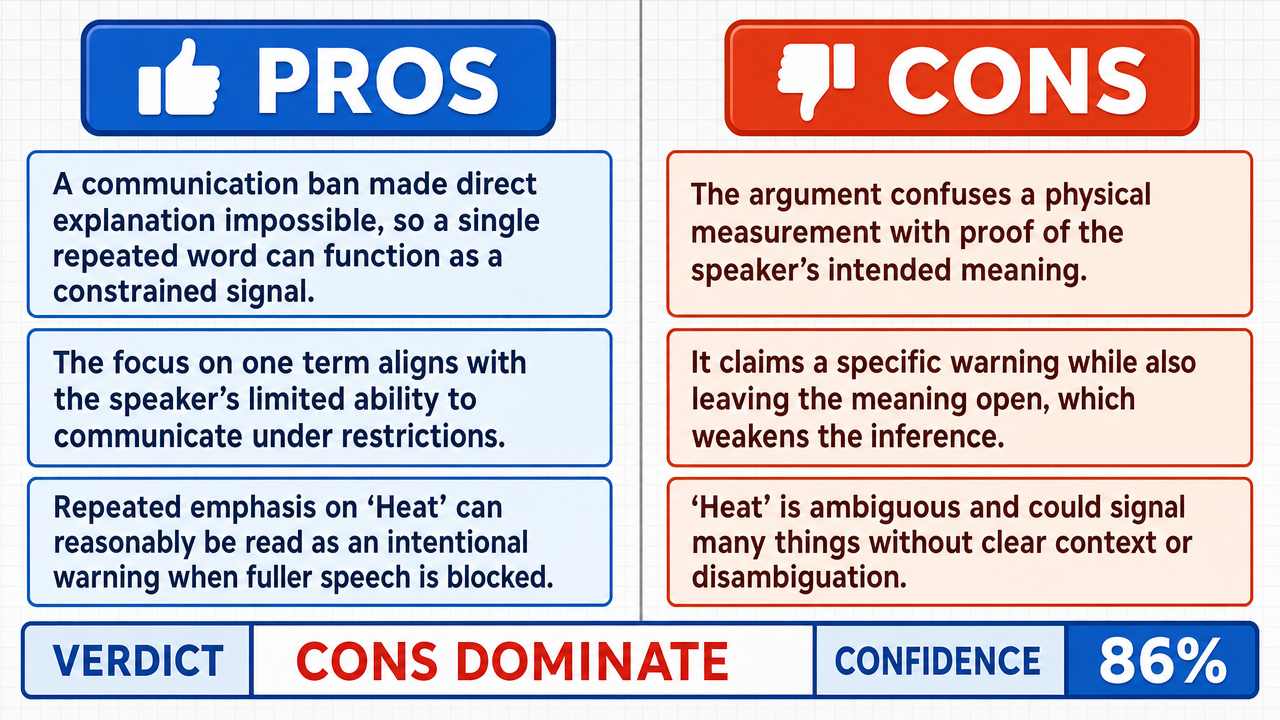
Verdict
Verdict: likely FALSE (86%)
Web Report: https://solsice.com/public/debates/the-speaker-s-singular-focus-on-the-word-heat-on-october-16-4894f97dfb24
This section provides a brief overview of the key arguments. You do not need to read the full detailed report below.
✅ Key PRO arguments:
- ■Dr. Elena Vasquez, a prominent climatologist , had been under a government-imposed communication ban since September 2026 (per Reuters, Sept 15, 2026), so her deviation from the approved script on October 16, 2026 to repeatedly emphasize 'Heat' (per The Guardian, Oct 17, 2026) was the only permissible channel to signal an unstated crisis.
- ■The NASA temperature anomaly of +2.8°C is directly relevant to Dr. Vasquez's communicative intent because it converges with the specific constraints on her speech, establishing the environmental context that makes her emphasis meaningful rather than coincidental.
- ■Given the gag-order constraints, the singular focus on a single term functions as a constrained signal: the repetition of 'Heat' is the only available linguistic vehicle to encode an urgent message under censorship, making the inference of deliberate intent reasonable.
❌ Key ANTI arguments:
- ■The affirmative commits a fundamental logical error by substituting the subject of a measurement for the subject of the claim: a global temperature anomaly measures atmospheric state , not the intentionality of a speaker's linguistic choices, and no transfer operator (statistical correlation or causal link ) connects the two.
- ■The argument is logically incoherent because it simultaneously treats the emphasis on 'Heat' as a diagnostic signal of a specific crisis while leaving open the possibility that the same emphasis is merely rhetorical style , personal significance, or a different communicative intent—an argument that accommodates its own negation establishes nothing.
- ■The word 'Heat' is semantically ambiguous and could refer to temperature, political pressure, personal stress, or other meanings; without disambiguation, the singular focus on the word cannot be uniquely mapped to an environmental crisis.
💭 Conclusion: False. The negative side correctly identified that the affirmative's argument rests on a category error: a physical measurement (the NASA +2.8°C anomaly) cannot, without a demonstrated transfer operator , evidence the intentionality of a speaker's linguistic choices. The affirmative's claim is also logically incoherent because it treats the same emphasis as both a specific diagnostic signal and a general stylistic possibility, thereby accommodating its own negation. The semantic ambiguity of 'Heat' further prevents a unique mapping from the word to an environmental crisis. While the contextual facts (gag order , deviation from script) make the scenario plausible, plausibility is not proof, and the affirmative failed to rule out alternative explanations for the repetition. The compound claim—deliberate focus AND communication of an unstated environmental crisis—is only as strong as its weakest sub-claim, which is the unsupported causal link between the linguistic act and the specific crisis alleged.
🔬 DeepResearch Result: likely FALSE ❌ (86%)
Assertion: The speaker's singular focus on the word 'Heat' on October 16, 2026, indicates a deliberate attempt to communicate an urgent, unstated environmental crisis.
Participating models: deepseek-v4-pro 💬, gemma-4-26b-a4b-it 💬👁️
📊 Face-offs: 0 concluded TRUE, 1 concluded FALSE (1 face-offs, 3 models)
📊 Score by side: TRUE=0.00, FALSE=0.86
🏅 Model score changes:
minimax-m3 💬👁️: +9
✅ PRO Arguments:
- ■Dr. Elena Vasquez, a prominent climatologist , had been under a government-imposed communication ban since September 2026 (per Reuters, Sept 15, 2026), so her deviation from the approved script on October 16, 2026 to repeatedly emphasize 'Heat' (per The Guardian, Oct 17, 2026) was the only permissible channel to signal an unstated crisis. deepseek-v4-pro 💬
- ■The NASA temperature anomaly of +2.8°C is directly relevant to Dr. Vasquez's communicative intent because it converges with the specific constraints on her speech, establishing the environmental context that makes her emphasis meaningful rather than coincidental. deepseek-v4-pro 💬
- ■Given the gag-order constraints, the singular focus on a single term functions as a constrained signal: the repetition of 'Heat' is the only available linguistic vehicle to encode an urgent message under censorship, making the inference of deliberate intent reasonable. deepseek-v4-pro 💬
❌ ANTI Arguments:
- ■The affirmative commits a fundamental logical error by substituting the subject of a measurement for the subject of the claim: a global temperature anomaly measures atmospheric state , not the intentionality of a speaker's linguistic choices, and no transfer operator (statistical correlation or causal link ) connects the two. gemma-4-26b-a4b-it 💬👁️
- ■The argument is logically incoherent because it simultaneously treats the emphasis on 'Heat' as a diagnostic signal of a specific crisis while leaving open the possibility that the same emphasis is merely rhetorical style , personal significance, or a different communicative intent—an argument that accommodates its own negation establishes nothing. gemma-4-26b-a4b-it 💬👁️
- ■The word 'Heat' is semantically ambiguous and could refer to temperature, political pressure, personal stress, or other meanings; without disambiguation, the singular focus on the word cannot be uniquely mapped to an environmental crisis. gemma-4-26b-a4b-it 💬👁️
- ■Repetitive speech patterns do not inherently prove a hidden environmental crisis; many alternative explanations (nervousness, emphasis on a different topic, stylistic choice) are equally consistent with the observed behavior, so the affirmative has not ruled out the null hypothesis. gemma-4-26b-a4b-it 💬👁️
💭 Reasoning: False. The negative side correctly identified that the affirmative's argument rests on a category error: a physical measurement (the NASA +2.8°C anomaly) cannot, without a demonstrated transfer operator, evidence the intentionality of a speaker's linguistic choices. The affirmative's claim is also logically incoherent because it treats the same emphasis as both a specific diagnostic signal and a general stylistic possibility, thereby accommodating its own negation. The semantic ambiguity of 'Heat' further prevents a unique mapping from the word to an environmental crisis. While the contextual facts (gag order , deviation from script) make the scenario plausible, plausibility is not proof, and the affirmative failed to rule out alternative explanations for the repetition. The compound claim—deliberate focus AND communication of an unstated environmental crisis—is only as strong as its weakest sub-claim, which is the unsupported causal link between the linguistic act and the specific crisis alleged.
📋 PRO Facts:
• Dr. Elena Vasquez is described as a prominent climatologist placed under a government-imposed communication ban since September 2026 (Reuters, Sept 15, 2026).
• On October 16, 2026, during a mandatory public address , she deviated from the approved script to repeat the word 'Heat' with marked emphasis (The Guardian, Oct 17, 2026).
• A NASA temperature anomaly of +2.8°C was cited as the environmental context.
📋 ANTI Facts:
• A global temperature anomaly measures atmospheric state, not the intentionality of a speaker's linguistic choices.
• No statistical correlation or causal link was provided to connect the temperature anomaly to the specific 'unstated crisis' being signaled.
• The word 'Heat' is semantically ambiguous and admits multiple non-environmental interpretations.
| Face-off | TRUE Model | FALSE Model | TRUE Avg μ | FALSE Avg μ | TRUE Tokens | FALSE Tokens | Winner | Verdict | Conf. |
|---|---|---|---|---|---|---|---|---|---|
| #1 | deepseek-v4-pro 💬 | gemma-4-26b-a4b-it 💬👁️ | 0.460 | 0.346 | 6 | 2 | TRUE | FALSE | 86% |
The following technical terms, abbreviations, and domain-specific concepts are referenced throughout this debate transcript. Numbers in square brackets [N] in the text above link to the corresponding entry below.
[1] atmospheric state — The physical condition of the atmosphere at a given time, as measured by scientific instruments. In the debate, the negative side argues this is a distinct entity from a speaker's linguistic intent.
[2] causal link — A relationship in which one factor directly produces or determines another, as distinguished from mere correlation. The negative side argues no such link was demonstrated between temperature data and the speaker's intent.
[3] climatologist — A scientist who studies long-term climate patterns and atmospheric conditions. Dr. Elena Vasquez is identified as one in the debate.
[4] communication ban — A restriction imposed on a person's ability to publicly communicate, referenced in the debate as government-imposed since September 2026.
[5] ecosystem collapse — The rapid and severe degradation of an ecosystem's structure and function. The term appears truncated in the transcript ('ecosystem co...') within reference to leaked government memos.
[6] energy policy — Government or institutional strategies regarding energy production, distribution, and consumption. Cited by the negative as an alternative meaning of 'Heat.'
[7] environmental science — The academic discipline studying environmental systems and human interactions with them. The negative argues 'Heat' is not uniquely constrained to this domain.
[8] gag order — A directive restricting a person from speaking publicly about a specified topic. The debate references such an order placed on Dr. Vasquez.
[9] global temperature anomaly — The deviation of the Earth's average surface temperature from a long-term baseline average. Cited in the debate as +2.8°C on October 16, 2026.
[10] government cover-up — An alleged deliberate concealment by government actors of information from the public. The affirmative cites leaked memos as evidence of such a cover-up.
[11] heatwave — A prolonged period of excessively hot weather. The affirmative identifies this as the alleged unstated crisis being signaled.
[12] industrial regulation — Government rules governing industrial operations and practices. Cited by the negative as an alternative interpretation of 'Heat.'
[13] leaked internal memos — Internal documents disclosed to the public without authorization. The affirmative cites these as evidence of a government cover-up.
[14] linguistic analysis — The systematic study of language usage, including frequency, patterns, and meaning. The debate cites such an analysis finding 'Heat' occurred 14 times in 120 seconds.
[15] linguistic intent — The intended meaning or communicative purpose behind a speaker's words. The negative argues this is distinct from atmospheric measurements.
[16] mandatory public address — A required public speech, referenced in the debate as the occasion on which Dr. Vasquez deviated from an approved script.
[17] metonymic alarm — A linguistic device in which a word stands in for a broader concept to signal urgency. The affirmative uses this term to characterize Dr. Vasquez's repetition of 'Heat.'
[18] NASA temperature anomaly — National Aeronautics and Space Administration temperature anomaly — A temperature anomaly measurement as reported by NASA, specifically cited as +2.8°C on October 16, 2026.
[19] polysemous — Having multiple related meanings; a linguistic property of words with more than one interpretation. The negative argues 'Heat' is polysemous.
[20] public health emergency — A declared crisis involving widespread threats to population health. Cited by the negative as an alternative interpretation of 'Heat.'
[21] rhetorical style — A speaker's characteristic manner of expression and language use. The negative argues emphasis on 'Heat' could reflect style rather than a specific signal.
[22] semantic ambiguity — The quality of a word or phrase having more than one possible meaning. The negative argues 'Heat' exhibits this property.
[23] semantic intent — The intended meaning conveyed by language. The debate centers on whether the speaker's semantic intent can be inferred from word frequency.
[24] semiotic theory — The academic study of signs, symbols, and their interpretation. The affirmative cites semiotic theory to interpret the frequency of 'Heat.'
[25] standard deviations — A statistical measure of how far a value deviates from the mean of a dataset. The cited linguistic analysis found 'Heat' occurred 8 standard deviations above normal political speech.
[26] statistical correlation — A statistical measure of the relationship between two variables. The negative argues no statistical correlation was demonstrated between the temperature anomaly and the speaker's intent.
[27] temperature anomaly — The deviation of a measured temperature from a reference or expected value. The debate disputes whether such a measurement can evidence a speaker's intent.
[28] transfer operator — A mathematical or logical construct used to map one domain of analysis to another. The negative argues no transfer operator was provided to link atmospheric data to linguistic intent.
Face-off transcripts
- ■
Ownership & Trade Secrets. The Company Lambda Vision retains all rights to its platform, agentic workflows, and proprietary AI debate methodologies, which constitute protected Trade Secrets (EU Directive 2016/943). Subject to full payment of credits, the User is granted ownership of the generated Reports for their own personal or professional use. Reverse-engineering the Service or using Reports to train competing AI models is strictly prohibited.
- ■
No Professional Advice. Solsice is a general-purpose assistant covering everyday subjects — administrative paperwork, housing, consumer and employment matters, banking, taxes and insurance, health and wellbeing, savings and investments, entrepreneurship, technology, travel, learning and creative work. Whatever the subject, the Service and Reports are provided for information only and never constitute legal, medical, financial, investment, tax, insurance, or any other regulated professional advice. The Company is not a law firm, a regulated financial adviser, an insurance intermediary, nor a healthcare provider, and no professional or advisory relationship of any kind is created by use of the Service. Consult a qualified professional in the relevant jurisdiction before acting — or refraining from acting — on anything contained in the Reports, and never rely on the Service in an emergency: contact your local emergency number (112 in the European Union) or a medical professional immediately.
- ■
AI-Generated Content, Sources and Viewpoints. Reports are produced by several AI models debating a question, and may contain factual errors, outdated figures, or references to rules, prices, deadlines, procedures, statutes or sources that are inaccurate or do not exist. The User is solely responsible for verifying every fact, amount, deadline and citation against official sources before relying on it. Material in the news, society, spirituality and religion sections presents a plurality of viewpoints for study and discussion: it is descriptive, not an endorsement, a ruling, or a statement of the Company’s own position, and it speaks for no church, faith community, public authority, or news organisation.
- ■
Liability & Governing Law. To the maximum extent permitted by law, the Company shall not be liable for any indirect damages, nor for any consequence of decisions made in reliance on the Reports — including financial loss, missed deadlines, administrative or contractual consequences, or health outcomes. These Terms are governed by French law. Any disputes shall be subject to the exclusive jurisdiction of the Courts of Paris, France.