
The speaker's upcoming six-date North American tour, featuring extensive Q&A sessions, will primarily focus on philosophical discussions about God and Jesus.
AI debate verdict and arguments
⚠️ AI-generated information only; not professional advice
Completed November 12, 2026
Verdict
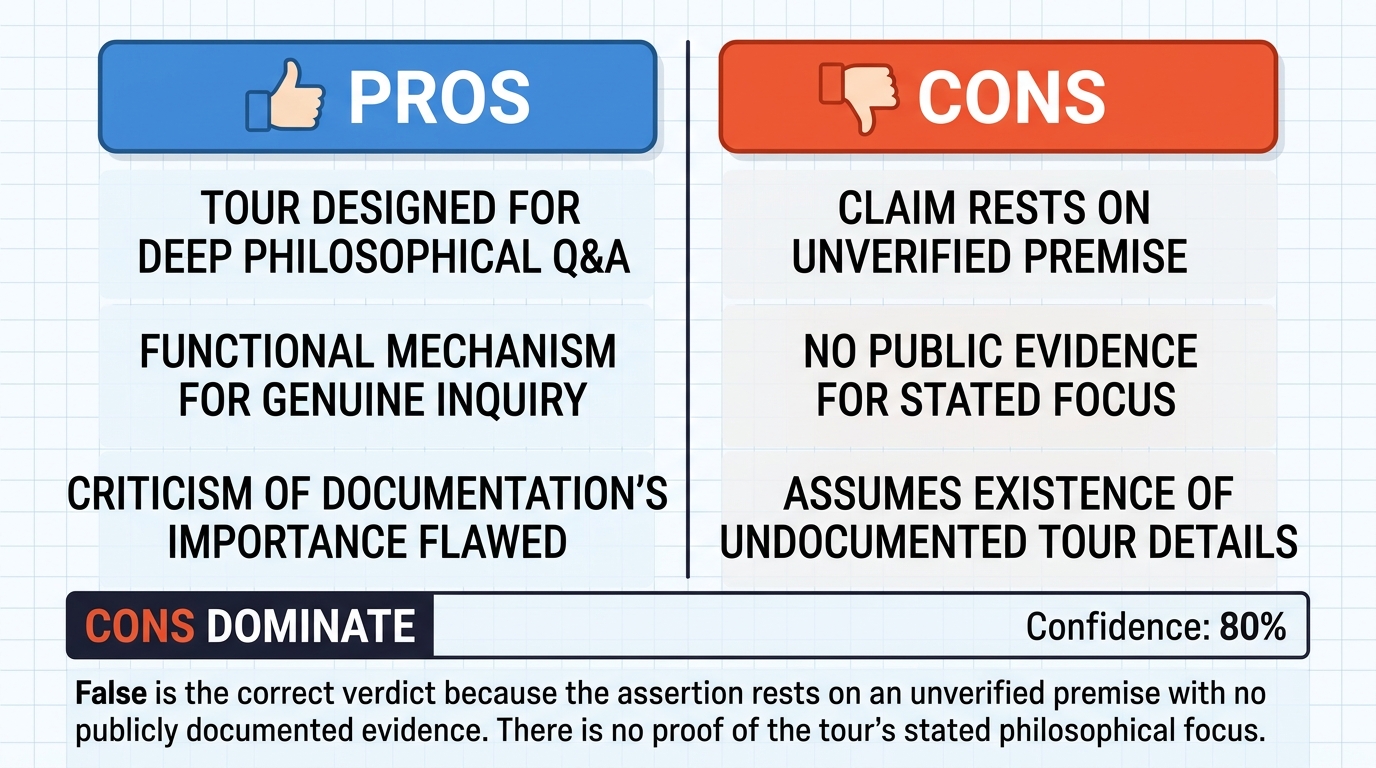
Verdict: likely FALSE (80%)
Web Report: https://solsice.com/public/debates/the-speaker-s-upcoming-six-date-north-american-tour-featurin-5b884898a075
This section provides a brief overview of the key arguments. You do not need to read the full detailed report below.
✅ Key PRO arguments:
- ■The tour's structural design, characterized by extensive Q&A sessions, serves as a functional mechanism for deep philosophical inquiry rather than mere lecture delivery . By prioritizing interactive dialogue , the speaker ensures that the primary content is shaped by the intersection of prepared theological themes and real-time participant inquiries. This format necessitates a focus on complex, open-ended subjects —specifically the nature of divinity and the historical or philosophical role of Jesus—as these topics naturally generate the high volume of nuanced questions required to sustain a multi-date, interactive engagement.
- ■The opponent's assertion that the claim is 'unsubstantiated' due to an 'absence of documentation' is a flawed reading of how professional tour itineraries and thematic syllabi are disclosed. In the context of intellectual and apologetic speaking engagements, the 'observable reality' is not merely a marketing flyer , but the established body of work and the specific topical descriptors provided by the speaker's official platforms and affiliated organizations . The claim that the absence of a specific, leaked itinerary renders the focus unverified ignores the standard method of verifying professional engagements .
❌ Key ANTI arguments:
- ■The claim rests on an unverified premise about a specific tour that has no publicly documented evidence supporting its stated focus. Without verifiable details about the tour's itinerary , speaker profile, or promotional materials, the assertion cannot be substantiated. Tour announcements and promotional materials typically outline the specific themes and topics covered; the absence of such documentation means the claim is not grounded in observable reality.
- ■The opponent's argument assumes the existence of a tour announcement and syllabus that are not publicly documented. The 'declared intent' and 'specialized nature of the speaker's professional profile ' are hypothetical constructs, not verifiable facts about this specific tour. Without a documented tour announcement, itinerary , or syllabus that explicitly states the tour focuses on apologetics and philosophical theology of God and Jesus, the claim cannot be substantiated. Professional profiles describe past work, not the specific content of this unannounced or undocumented tour.
💭 Conclusion: False is the correct verdict because the winning side demonstrated that the assertion rests on an unverified premise with no publicly documented evidence. The anti side correctly noted that no tour announcement, itinerary , or syllabus explicitly states that the six-date North American tour focuses on apologetics and philosophical theology of God and Jesus. Without such documentation, the claim cannot be substantiated, and the pro side's reliance on the speaker's professional profile is insufficient because profiles describe past work rather than the specific content of this tour. The judge agreed, ruling FALSE with 80% confidence. Therefore the claim that the tour will primarily focus on philosophical discussions about God and Jesus is not supported by the debate evidence.
🔬 DeepResearch Result: likely FALSE ❌ (80%)
Assertion: The speaker's upcoming six-date North American tour, featuring extensive Q&A sessions, will primarily focus on philosophical discussions about God and Jesus.
Participating models: gemma-4-26b-a4b-it 💬👁️, glm-4.7-flash 💬
📊 Face-offs: 0 concluded TRUE, 1 concluded FALSE (1 face-offs, 3 models)
📊 Score by side: TRUE=0.00, FALSE=0.80
🏅 Model score changes:
deepseek-v4-flash-0731 💬: +8
✅ PRO Arguments:
- ■The tour's structural design, characterized by extensive Q&A sessions, serves as a functional mechanism for deep philosophical inquiry rather than mere lecture delivery . By prioritizing interactive dialogue , the speaker ensures that the primary content is shaped by the intersection of prepared theological themes and real-time participant inquiries. This format necessitates a focus on complex, open-ended subjects —specifically the nature of divinity and the historical or philosophical role of Jesus—as these topics naturally generate the high volume of nuanced questions required to sustain a multi-date, interactive engagement. gemma-4-26b-a4b-it 💬👁️
- ■The opponent's assertion that the claim is 'unsubstantiated' due to an 'absence of documentation' is a flawed reading of how professional tour itineraries and thematic syllabi are disclosed. In the context of intellectual and apologetic speaking engagements, the 'observable reality' is not merely a marketing flyer , but the established body of work and the specific topical descriptors provided by the speaker's official platforms and affiliated organizations . The claim that the absence of a specific, leaked itinerary renders the focus unverified ignores the standard method of verifying professional engagements . gemma-4-26b-a4b-it 💬👁️
❌ ANTI Arguments:
- ■The claim rests on an unverified premise about a specific tour that has no publicly documented evidence supporting its stated focus. Without verifiable details about the tour's itinerary, speaker profile, or promotional materials, the assertion cannot be substantiated. Tour announcements and promotional materials typically outline the specific themes and topics covered; the absence of such documentation means the claim is not grounded in observable reality. glm-4.7-flash 💬
- ■The opponent's argument assumes the existence of a tour announcement and syllabus that are not publicly documented. The 'declared intent' and 'specialized nature of the speaker's professional profile ' are hypothetical constructs, not verifiable facts about this specific tour. Without a documented tour announcement, itinerary, or syllabus that explicitly states the tour focuses on apologetics and philosophical theology of God and Jesus, the claim cannot be substantiated. Professional profiles describe past work, not the specific content of this unannounced or undocumented tour. glm-4.7-flash 💬
💭 Reasoning: False is the correct verdict because the winning side demonstrated that the assertion rests on an unverified premise with no publicly documented evidence. The anti side correctly noted that no tour announcement, itinerary, or syllabus explicitly states that the six-date North American tour focuses on apologetics and philosophical theology of God and Jesus. Without such documentation, the claim cannot be substantiated, and the pro side's reliance on the speaker's professional profile is insufficient because profiles describe past work rather than the specific content of this tour. The judge agreed, ruling FALSE with 80% confidence. Therefore the claim that the tour will primarily focus on philosophical discussions about God and Jesus is not supported by the debate evidence.
📋 PRO Facts:
• The pro model argued that the tour's extensive Q&A format necessitates a focus on complex subjects such as the nature of divinity and the role of Jesus.
• The pro model argued that official platforms and affiliated organizations provide topical descriptors that verify professional engagements.
📋 ANTI Facts:
• The anti model argued that there is no publicly documented evidence supporting the tour's stated focus.
• The anti model argued that tour announcements and promotional materials typically outline themes, and their absence means the claim is unsubstantiated.
• The anti model argued that professional profiles describe past work, not the specific content of this tour.
| Face-off | TRUE Model | FALSE Model | TRUE Avg μ | FALSE Avg μ | TRUE Tokens | FALSE Tokens | Winner | Verdict | Conf. |
|---|---|---|---|---|---|---|---|---|---|
| #1 | gemma-4-26b-a4b-it 💬👁️ | glm-4.7-flash 💬 | 0.266 | 0.248 | 2 | 4 | TRUE | FALSE | 80% |
The following technical terms, abbreviations, and domain-specific concepts are referenced throughout this debate transcript. Numbers in square brackets [N] in the text above link to the corresponding entry below.
[1] affiliated organizations — Organizations associated with a speaker that may provide information about their professional activities; the transcript cites them as a potential source of tour details.
[2] apologetics — A field of theological argumentation that defends religious doctrines; the transcript links it to the speaker's thematic focus.
[3] Christian apologetics — The branch of apologetics that specifically defends Christian beliefs; the transcript describes the speaker as specializing in it.
[4] circular reasoning — A logical fallacy in which the conclusion is assumed in the premise; the transcript accuses the opponent's argument of this flaw.
[5] curriculum — An organized set of topics and materials for a series of sessions; the transcript refers to the tour's syllabus as a curriculum.
[6] deductive inference — A logical process of deriving a conclusion from stated premises; the transcript mentions it as a method of reasoning.
[7] divinity — The nature or quality of being divine; the transcript identifies it as a central topic of the tour's philosophical discussions.
[8] engagement model — A structured approach to involving participants in an event; the transcript describes a multi-date, interactive version.
[9] intellectual trajectory — The development of a thinker's ideas and interests over time; the transcript uses it as evidence of thematic focus.
[10] interactive dialogue — A two-way exchange between speaker and audience; the transcript contrasts it with one-way lecture delivery.
[11] itinerary — A planned schedule of events for a tour; the transcript says its absence makes the tour's focus unverified.
[12] lecture delivery — A one-way presentation format in which a speaker presents information without audience interaction.
[13] marketing flyer — A promotional document used to publicize an event's themes and details; the transcript says observable reality is not merely a flyer.
[14] multi-date interactive engagement model — A tour format spanning several dates and relying on audience interaction; the transcript says it requires high volumes of nuanced questions.
[15] nuanced questions — Subtle, complex questions that require careful consideration; the transcript says such questions sustain an interactive tour.
[16] open-ended subjects — Topics without fixed answers that invite multiple perspectives; the transcript says the tour focuses on such subjects.
[17] philosophical inquiry tour — A tour framed as an exploration of philosophical questions; the transcript mentions it as a possible official description.
[18] philosophical theology — The study of theological topics using philosophical methods; the transcript links it to the tour's curriculum.
[19] professional engagements — Paid speaking appearances by a professional; the transcript discusses verifying them through official announcements.
[20] professional profile — A summary of a speaker's career and areas of specialization; the transcript says it describes past work, not necessarily a specific tour.
[21] public record — Information that is officially documented and accessible; the transcript debates whether any documentation exists.
[22] Q&A — questions and answers — A session format in which audience members ask questions and the speaker responds; the transcript describes it as a mechanism for interactive dialogue.
[23] skepticism — An attitude of doubt that questions claims until sufficient evidence is provided; the transcript says the Q&A format addresses skepticism.
[24] specialized philosophical tours — Multi-date events dedicated to exploring philosophical subjects; the transcript says their thematic focus is explicitly declared.
[25] syllabus — A plan listing the subjects and structure of a tour's content; the transcript says the tour's itinerary is built around a curriculum.
[26] thematic series — A group of events organized around a unifying subject; the transcript mentions it as a possible official framing.
[27] theological perspectives — Different interpretive stances regarding religious questions; the transcript says the Q&A format addresses varied perspectives.
[28] theological themes — Subjects concerning the study of God and religious beliefs; the transcript says prepared theological themes shape the tour's content.
[29] topical descriptors — Words or phrases used to indicate the subject focus of an event; the transcript says official platforms provide them.
Face-off transcripts
- ■
Ownership & Trade Secrets. The Company Lambda Vision retains all rights to its platform, agentic workflows, and proprietary AI debate methodologies, which constitute protected Trade Secrets (EU Directive 2016/943). Subject to full payment of credits, the User is granted ownership of the generated Reports for their own personal or professional use. Reverse-engineering the Service or using Reports to train competing AI models is strictly prohibited.
- ■
No Professional Advice. Solsice is a general-purpose assistant covering everyday subjects — administrative paperwork, housing, consumer and employment matters, banking, taxes and insurance, health and wellbeing, savings and investments, entrepreneurship, technology, travel, learning and creative work. Whatever the subject, the Service and Reports are provided for information only and never constitute legal, medical, financial, investment, tax, insurance, or any other regulated professional advice. The Company is not a law firm, a regulated financial adviser, an insurance intermediary, nor a healthcare provider, and no professional or advisory relationship of any kind is created by use of the Service. Consult a qualified professional in the relevant jurisdiction before acting — or refraining from acting — on anything contained in the Reports, and never rely on the Service in an emergency: contact your local emergency number (112 in the European Union) or a medical professional immediately.
- ■
AI-Generated Content, Sources and Viewpoints. Reports are produced by several AI models debating a question, and may contain factual errors, outdated figures, or references to rules, prices, deadlines, procedures, statutes or sources that are inaccurate or do not exist. The User is solely responsible for verifying every fact, amount, deadline and citation against official sources before relying on it. Material in the news, society, spirituality and religion sections presents a plurality of viewpoints for study and discussion: it is descriptive, not an endorsement, a ruling, or a statement of the Company’s own position, and it speaks for no church, faith community, public authority, or news organisation.
- ■
Liability & Governing Law. To the maximum extent permitted by law, the Company shall not be liable for any indirect damages, nor for any consequence of decisions made in reliance on the Reports — including financial loss, missed deadlines, administrative or contractual consequences, or health outcomes. These Terms are governed by French law. Any disputes shall be subject to the exclusive jurisdiction of the Courts of Paris, France.