
The state of Connecticut is financially fragile and stuck primarily because its budget relies heavily on a small, mobile wealthy population, making it vulnerable to their relocation.
AI debate verdict and arguments
⚠️ AI-generated information only; not professional advice
Completed October 26, 2026
Verdict
Verdict: likely TRUE (55%)
Web Report: https://solsice.com/public/debates/the-state-of-connecticut-is-financially-fragile-and-stuck-pr-22f72b5fbd00
This section provides a brief overview of the key arguments. You do not need to read the full detailed report below.
✅ Key PRO arguments:
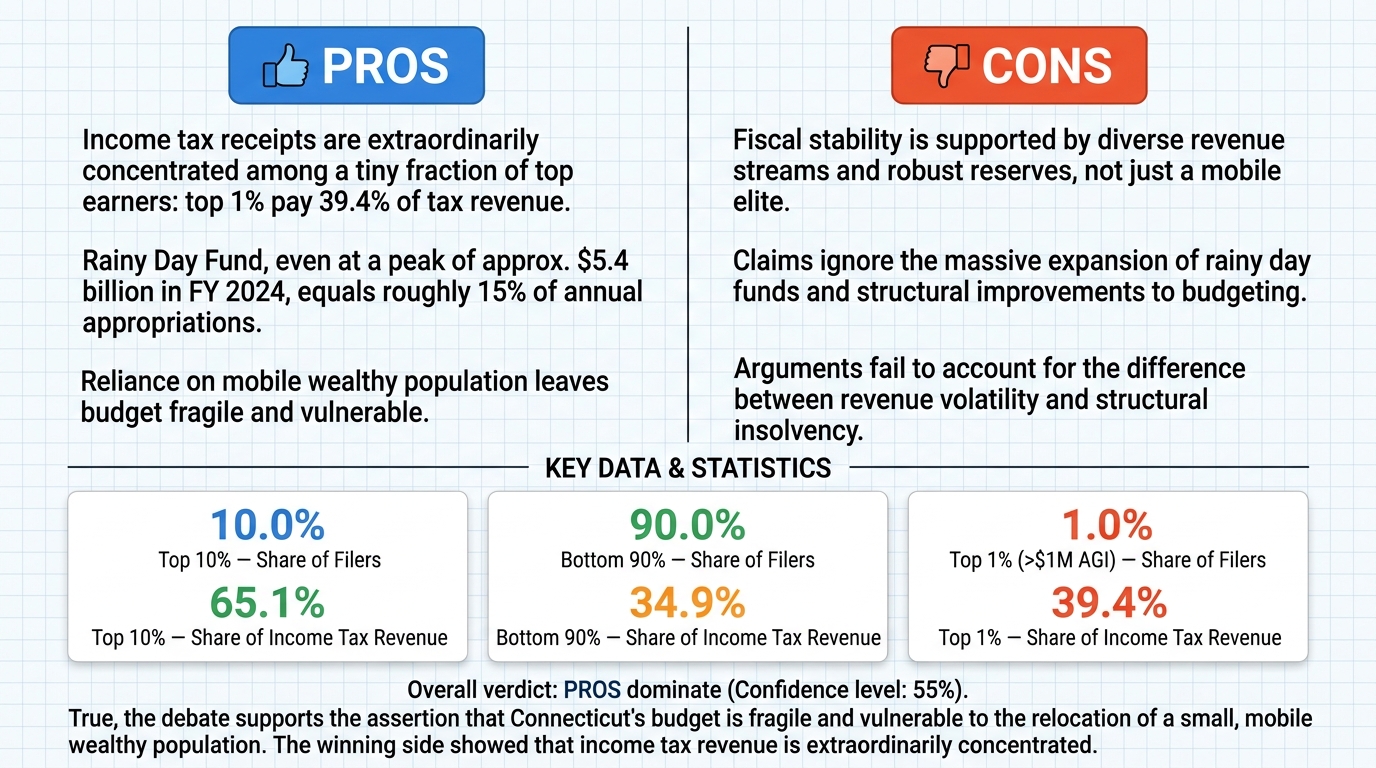
- ■Connecticut's income tax receipts are extraordinarily concentrated among a tiny fraction of top earners: in the 2021 tax year, the top 1% of filers (AGI above approximately $1 million) accounted for 39.4% of all state income tax revenue while comprising just 1% of taxpayers, and the top 10% generated 65.1% of total income tax collections. This concentration makes the revenue stream uniquely brittle to relocation of high earners.
- ■The Rainy Day Fund , even at its peak of approximately $5.4 billion in fiscal 2024, equals roughly 15% of annual general fund appropriations , which is the statutory maximum under the volatility cap ; this is a thin cushion relative to the scale of revenue concentration risk, not a robust buffer.
❌ Key ANTI arguments:
- ■Connecticut's fiscal stability is supported by diverse revenue streams and robust reserves, not just a mobile elite; the claim ignores the massive expansion of the rainy-day fund, which provides a buffer against migration shocks.
- ■The argument that the state is 'stuck' fails to account for the difference between revenue volatility and structural insolvency ; the state has proven capacity to generate and retain massive fiscal surpluses that alter the risk profile of the budget.
💭 Conclusion: True, the debate supports the assertion that Connecticut's budget is fragile and vulnerable to the relocation of a small, mobile wealthy population. The winning side showed that income tax revenue is extraordinarily concentrated, with the top 1% of filers providing 39.4% of income tax revenue in 2021 and the top 10% providing 65.1%, making the revenue base uniquely brittle. The pro side also rebutted the reserve argument by noting that the Rainy Day Fund , even at its $5.4 billion peak, equals only about 15% of annual appropriations and is a thin cushion under the volatility cap . The losing side's claim of diverse revenue streams and robust reserves was judged insufficient to overcome this concentration risk. Because the 'stuck' component is less directly established than the fragility and vulnerability components, confidence is set at 55% rather than higher.
🔬 DeepResearch Result: likely TRUE ✅ (55%)
Assertion: The state of Connecticut is financially fragile and stuck primarily because its budget relies heavily on a small, mobile wealthy population, making it vulnerable to their relocation.
Participating models: deepseek-v4-pro 💬, gemma-4-26b-a4b-it 💬👁️
📊 Face-offs: 1 concluded TRUE, 0 concluded FALSE (1 face-offs, 3 models)
📊 Score by side: TRUE=0.66, FALSE=0.00
🏅 Model score changes:
deepseek-v4-flash-0731 💬: +7
✅ PRO Arguments:
- ■Connecticut's income tax receipts are extraordinarily concentrated among a tiny fraction of top earners: in the 2021 tax year, the top 1% of filers (AGI above approximately $1 million) accounted for 39.4% of all state income tax revenue while comprising just 1% of taxpayers, and the top 10% generated 65.1% of total income tax collections. This concentration makes the revenue stream uniquely brittle to relocation of high earners. deepseek-v4-pro 💬
- ■The Rainy Day Fund , even at its peak of approximately $5.4 billion in fiscal 2024, equals roughly 15% of annual general fund appropriations , which is the statutory maximum under the volatility cap ; this is a thin cushion relative to the scale of revenue concentration risk, not a robust buffer. deepseek-v4-pro 💬
❌ ANTI Arguments:
- ■Connecticut's fiscal stability is supported by diverse revenue streams and robust reserves, not just a mobile elite; the claim ignores the massive expansion of the rainy-day fund, which provides a buffer against migration shocks. gemma-4-26b-a4b-it 💬👁️
- ■The argument that the state is 'stuck' fails to account for the difference between revenue volatility and structural insolvency ; the state has proven capacity to generate and retain massive fiscal surpluses that alter the risk profile of the budget. gemma-4-26b-a4b-it 💬👁️
💭 Reasoning: True, the debate supports the assertion that Connecticut's budget is fragile and vulnerable to the relocation of a small, mobile wealthy population. The winning side showed that income tax revenue is extraordinarily concentrated, with the top 1% of filers providing 39.4% of income tax revenue in 2021 and the top 10% providing 65.1%, making the revenue base uniquely brittle. The pro side also rebutted the reserve argument by noting that the Rainy Day Fund, even at its $5.4 billion peak, equals only about 15% of annual appropriations and is a thin cushion under the volatility cap. The losing side's claim of diverse revenue streams and robust reserves was judged insufficient to overcome this concentration risk. Because the 'stuck' component is less directly established than the fragility and vulnerability components, confidence is set at 55% rather than higher.
📋 PRO Facts:
• In the 2021 tax year, the top 1% of Connecticut filers accounted for 39.4% of state income tax revenue while comprising 1% of taxpayers.
• The top 10% of filers generated 65.1% of total income tax collections.
• Connecticut's Rainy Day Fund peaked at approximately $5.4 billion in fiscal 2024, equal to roughly 15% of annual general fund appropriations .
• The Rainy Day Fund grew from roughly $2 billion to over $5 billion.
📋 ANTI Facts:
• Connecticut has built a substantial rainy-day fund surplus from periods of high tax receipts.
• The state's revenue streams are described as diverse and supported by robust reserves.
• Revenue volatility is distinct from structural insolvency, and the state has shown capacity to generate and retain fiscal surpluses.
| Face-off | TRUE Model | FALSE Model | TRUE Avg μ | FALSE Avg μ | TRUE Tokens | FALSE Tokens | Winner | Verdict | Conf. |
|---|---|---|---|---|---|---|---|---|---|
| #1 | deepseek-v4-pro 💬 | gemma-4-26b-a4b-it 💬👁️ | 0.483 | 0.469 | 6 | 2 | TRUE | TRUE | 66% |
The following technical terms, abbreviations, and domain-specific concepts are referenced throughout this debate transcript. Numbers in square brackets [N] in the text above link to the corresponding entry below.
[1] adjusted gross income — AGI — A measure of income used to determine tax liability; the transcript identifies the top 1% of filers as those with adjusted gross incomes above approximately $1 million.
[2] appropriations — Legislative authorizations to spend public money; the transcript compares the rainy day fund to annual general fund appropriations.
[3] best-practice thresholds — Recommended minimum reserve levels for governments; the transcript says Connecticut falls short of these for its revenue profile.
[4] capital gains realizations — Recognized profits from the sale of assets; the transcript cites their volatility as a factor in income tax receipt swings.
[5] deficit — A shortfall when spending exceeds revenue; the transcript says the state moved from a position of deficit to surplus.
[6] fiscal agency — A government's capacity to make deliberate fiscal policy choices; the negative side argues revenue fluctuations do not imply a lack of fiscal agency.
[7] fiscal shock — A sudden and disproportionate disruption to government revenue; the transcript says the departure of even a small number of high earners creates a disproportionate fiscal shock.
[8] fiscal stability — The condition of maintaining sound public finances; the negative side argues Connecticut has fiscal stability despite revenue concentration.
[9] fiscal year — FY — The annual accounting period used for government budgeting; the transcript references FY 2021 through FY 2024.
[10] FY — fiscal year — Abbreviation for fiscal year; the transcript uses FY labels for state budget years.
[11] general fund — A government's primary operating fund; the transcript reports its end-of-year balances.
[12] general fund appropriations — The amount of money authorized for spending from the general fund; the transcript says the rainy day fund equals roughly 15% of annual general fund appropriations.
[13] Government Finance Officers Association — GFOA — A professional association that issues reserve recommendations; the transcript cites its recommendation that jurisdictions with highly volatile revenue maintain at least two months of operating expenditures.
[14] income tax receipts — Revenue collected by a state from income taxes; the transcript says they are concentrated among top earners and fell sharply in fiscal 2021.
[15] liquidity — The availability of cash or easily convertible assets; the negative side says the rainy day fund provides liquidity to absorb shocks.
[16] operating expenditures — Recurring day-to-day government spending; the GFOA recommendation is expressed in months of operating expenditures.
[17] Rainy Day Fund — A government reserve fund set aside to cover budget shortfalls; the transcript reports its balance growing from about $2 billion to over $5 billion.
[18] revenue concentration — The degree to which tax revenue depends on a small number of taxpayers or sources; the transcript says Connecticut's income tax revenue is highly concentrated.
[19] revenue volatility — The tendency of revenue to fluctuate over time; the negative side distinguishes revenue volatility from structural insolvency.
[20] structural fragility — Vulnerability to fiscal crisis due to the structure of revenue and spending; the affirmative asserts Connecticut has it, while the negative disputes that characterization.
[21] structural insolvency — A fundamental inability to meet financial obligations; the negative side argues revenue volatility is not the same as structural insolvency.
[22] surplus — The amount by which revenue exceeds spending; the transcript says Connecticut built substantial surpluses.
[23] taxpayer concentration — Reliance on a small number of taxpayers for revenue; the transcript says states with extreme taxpayer concentration should hold materially more reserves.
[24] top 1% — The highest-earning 1% of taxpayers; the transcript says they accounted for 39.4% of state income tax revenue.
[25] top 10% — The highest-earning 10% of taxpayers; the transcript says they generated 65.1% of income tax collections.
[26] unrestricted reserves — Reserve funds not legally earmarked for specific purposes; the GFOA recommends these for jurisdictions with volatile revenue.
[27] volatility cap — A statutory limit on the size of the rainy day fund; the transcript says Connecticut's cap is roughly 15% of annual general fund appropriations.
[28] year-over-year — YoY — A comparison of the same period in consecutive years; the transcript reports income tax receipts fell over 13% year-over-year in fiscal 2021.
The following financial data tables were referenced during the debate exchanges:
| Income Group | Share of Filers | Share of Income Tax Revenue | Revenue per Filer |
|---|---|---|---|
| Top 1% (>$1M AGI) | 1.0% | 39.4% | ~$1,500,000 |
| Top 10% | 10.0% | 65.1% | ~$260,000 |
| Bottom 90% | 90.0% | 34.9% | ~$15,600 |
Legend: Connecticut personal income tax revenue concentration by filer income group, tax year 2021. Revenue per filer is an approximate average based on total income tax collections and filer counts. Source: Connecticut Department of Revenue Services, Annual Report 2022; OFA Fiscal Accountability Report FY 2023–FY 2026.
| Fiscal Year | General Fund Balance (End of Year) | Rainy Day Fund Balance |
|---|---|---|
| FY 2021 | ~$1.5B | ~$2.1B |
| FY 2022 | ~$3.2B | ~$3.5B |
| FY 2023 | ~$4.5B | ~$4.8B |
| FY 2024 | ~$5.1B | ~$5.4B |
Legend: Connecticut General Fund and Rainy Day Fund balances. Values are approximate based on state fiscal reports. Source: Connecticut Office of Fiscal Analysis.
Face-off transcripts
- ■
Ownership & Trade Secrets. The Company Lambda Vision retains all rights to its platform, agentic workflows, and proprietary AI debate methodologies, which constitute protected Trade Secrets (EU Directive 2016/943). Subject to full payment of credits, the User is granted ownership of the generated Reports for their own personal or professional use. Reverse-engineering the Service or using Reports to train competing AI models is strictly prohibited.
- ■
No Professional Advice. Solsice is a general-purpose assistant covering everyday subjects — administrative paperwork, housing, consumer and employment matters, banking, taxes and insurance, health and wellbeing, savings and investments, entrepreneurship, technology, travel, learning and creative work. Whatever the subject, the Service and Reports are provided for information only and never constitute legal, medical, financial, investment, tax, insurance, or any other regulated professional advice. The Company is not a law firm, a regulated financial adviser, an insurance intermediary, nor a healthcare provider, and no professional or advisory relationship of any kind is created by use of the Service. Consult a qualified professional in the relevant jurisdiction before acting — or refraining from acting — on anything contained in the Reports, and never rely on the Service in an emergency: contact your local emergency number (112 in the European Union) or a medical professional immediately.
- ■
AI-Generated Content, Sources and Viewpoints. Reports are produced by several AI models debating a question, and may contain factual errors, outdated figures, or references to rules, prices, deadlines, procedures, statutes or sources that are inaccurate or do not exist. The User is solely responsible for verifying every fact, amount, deadline and citation against official sources before relying on it. Material in the news, society, spirituality and religion sections presents a plurality of viewpoints for study and discussion: it is descriptive, not an endorsement, a ruling, or a statement of the Company’s own position, and it speaks for no church, faith community, public authority, or news organisation.
- ■
Liability & Governing Law. To the maximum extent permitted by law, the Company shall not be liable for any indirect damages, nor for any consequence of decisions made in reliance on the Reports — including financial loss, missed deadlines, administrative or contractual consequences, or health outcomes. These Terms are governed by French law. Any disputes shall be subject to the exclusive jurisdiction of the Courts of Paris, France.