
The Sveriges Riksbank Prize in Economic Sciences awarded to Robert E. Hall and Michael Woodford for their work on macroeconomic stabilization was fully justified, given its impact on economic policy and global stability.
AI debate verdict and arguments
⚠️ AI-generated information only; not professional advice
Completed November 12, 2026
Verdict
Verdict: likely FALSE (76%)
Web Report: https://solsice.com/public/debates/the-sveriges-riksbank-prize-in-economic-sciences-awarded-to-240d3dbf964f
This section provides a brief overview of the key arguments. You do not need to read the full detailed report below.
✅ Key PRO arguments:
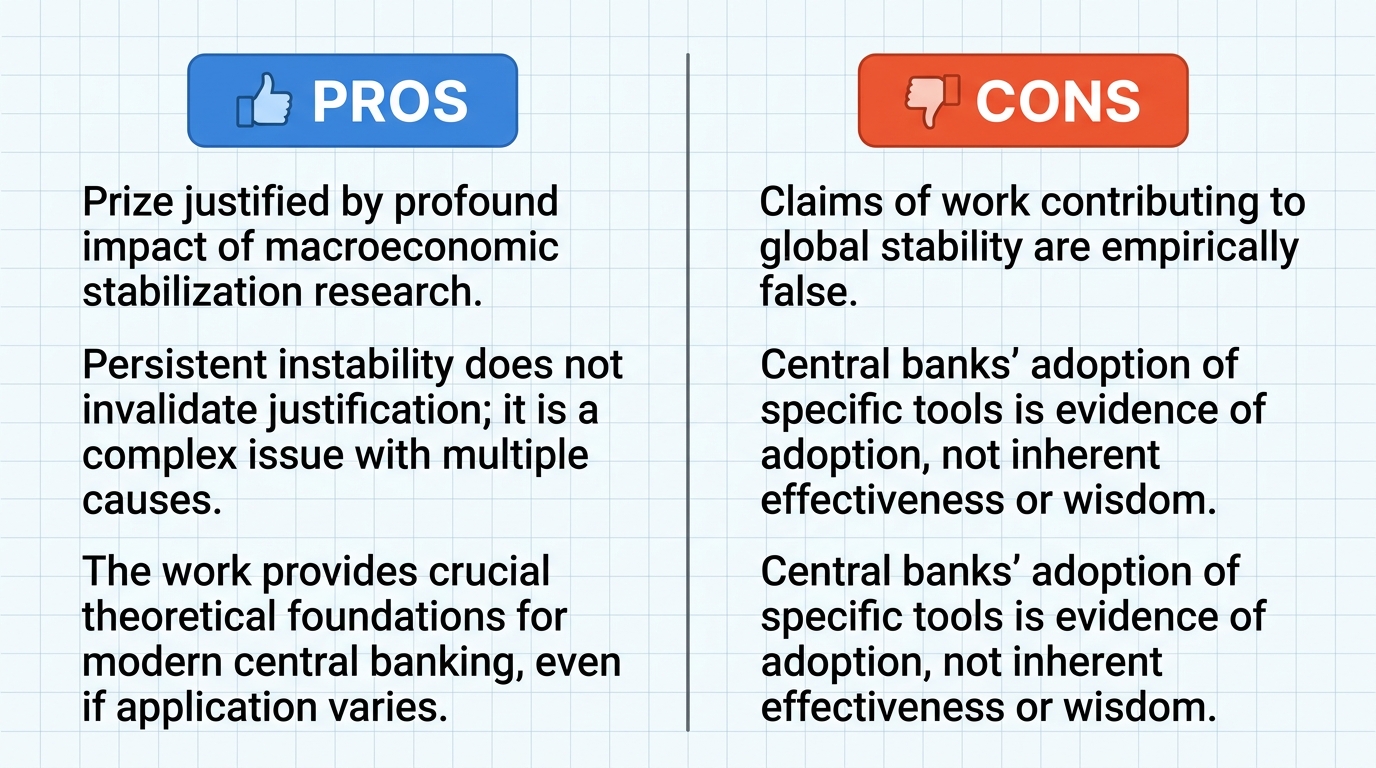
- ■The prize was justified due to the profound impact of their macroeconomic stabilization research. Hall and Woodford provided the essential theoretical architecture required to bridge microeconomic foundations with macroeconomic policy, a necessity for modern central banking. Hall's pioneering research into rational expectations and the role of information in market clearing fundamentally altered how economists model the interaction between individual decision-making and aggregate economic fluctuations. By demonstrating how expectations about future policy influence current economic behavior, Hall provided the tools necessary to understand the transmission mechanisms of monetary policy.
- ■The argument that persistent macroeconomic instability invalidates the justification of the prize commits a fundamental error by treating the absence of perfect, continuous stability as evidence of theoretical failure. This is a fallacy of composition; economic cycles are inherent to market economies. The claim that the prize is justified by the work's impact on economic policy and global stability does not require that the research eliminates all volatility, but rather that it provides the necessary framework for responding to economic fluctuations.
❌ Key ANTI arguments:
- ■The claim that Hall and Woodford's work contributed to global stability is empirically false. Even in advanced economies that adopted their frameworks—such as inflation targeting and forward guidance—recessions, financial crises, and inflationary spikes have continued at high frequency.
- ■The TRUE side cites central banks' adoption of inflation targeting and forward guidance as evidence that Hall and Woodford's work shaped policy. This evidence fails to establish causality for three reasons: (1) the timing of policy shifts—many central banks adopted inflation targeting before Hall's key 1978 paper and Woodford's 2003 textbook were widely influential; (2) institutional and political factors, not just theory, drove these changes; and (3) the lack of controlled studies showing that removing Hall/Woodford-inspired frameworks would worsen outcomes.
💭 Conclusion: False — the debate evidence does not support the assertion that the prize was fully justified by its impact on economic policy and global stability. The winning side showed that advanced economies adopting Hall and Woodford-inspired frameworks such as inflation targeting and forward guidance continued to experience recessions, financial crises, and inflationary spikes. The negative also demonstrated that the claimed policy influence lacks clear causality, since many central banks adopted inflation targeting before Hall's key 1978 paper and Woodford's 2003 textbook became widely influential. Institutional and political factors, rather than the theory alone, drove these policy shifts, and no controlled studies show that removing these frameworks would worsen outcomes. Therefore, the claim of full justification on the basis of global stability impact is not established.
🔬 DeepResearch Result: likely FALSE ❌ (76%)
Assertion: The Sveriges Riksbank Prize in Economic Sciences awarded to Robert E. Hall and Michael Woodford for their work on macroeconomic stabilization was fully justified, given its impact on economic policy and global stability.
Participating models: gemma-4-26b-a4b-it 💬👁️, glm-4.7-flash 💬
📊 Face-offs: 0 concluded TRUE, 1 concluded FALSE (1 face-offs, 3 models)
📊 Score by side: TRUE=0.00, FALSE=0.76
🏅 Model score changes:
deepseek-v4-flash-0731 💬: +8
✅ PRO Arguments:
- ■The prize was justified due to the profound impact of their macroeconomic stabilization research. Hall and Woodford provided the essential theoretical architecture required to bridge microeconomic foundations with macroeconomic policy, a necessity for modern central banking. Hall's pioneering research into rational expectations and the role of information in market clearing fundamentally altered how economists model the interaction between individual decision-making and aggregate economic fluctuations. By demonstrating how expectations about future policy influence current economic behavior, Hall provided the tools necessary to understand the transmission mechanisms of monetary policy. gemma-4-26b-a4b-it 💬👁️
- ■The argument that persistent macroeconomic instability invalidates the justification of the prize commits a fundamental error by treating the absence of perfect, continuous stability as evidence of theoretical failure. This is a fallacy of composition; economic cycles are inherent to market economies. The claim that the prize is justified by the work's impact on economic policy and global stability does not require that the research eliminates all volatility, but rather that it provides the necessary framework for responding to economic fluctuations. gemma-4-26b-a4b-it 💬👁️
❌ ANTI Arguments:
- ■The claim that Hall and Woodford's work contributed to global stability is empirically false. Even in advanced economies that adopted their frameworks—such as inflation targeting and forward guidance—recessions, financial crises, and inflationary spikes have continued at high frequency. glm-4.7-flash 💬
- ■The TRUE side cites central banks' adoption of inflation targeting and forward guidance as evidence that Hall and Woodford's work shaped policy. This evidence fails to establish causality for three reasons: (1) the timing of policy shifts—many central banks adopted inflation targeting before Hall's key 1978 paper and Woodford's 2003 textbook were widely influential; (2) institutional and political factors, not just theory, drove these changes; and (3) the lack of controlled studies showing that removing Hall/Woodford-inspired frameworks would worsen outcomes. glm-4.7-flash 💬
💭 Reasoning: False — the debate evidence does not support the assertion that the prize was fully justified by its impact on economic policy and global stability. The winning side showed that advanced economies adopting Hall and Woodford-inspired frameworks such as inflation targeting and forward guidance continued to experience recessions, financial crises, and inflationary spikes. The negative also demonstrated that the claimed policy influence lacks clear causality, since many central banks adopted inflation targeting before Hall's key 1978 paper and Woodford's 2003 textbook became widely influential. Institutional and political factors, rather than the theory alone, drove these policy shifts, and no controlled studies show that removing these frameworks would worsen outcomes. Therefore, the claim of full justification on the basis of global stability impact is not established.
📋 PRO Facts:
• Central banks adopted inflation targeting and forward guidance, which the affirmative cited as evidence of the work's policy impact.
• Hall's 1978 paper and Woodford's 2003 textbook were influential in macroeconomic stabilization theory.
📋 ANTI Facts:
• Advanced economies that adopted inflation targeting and forward guidance still experienced recessions, financial crises, and inflationary spikes at high frequency.
• Many central banks adopted inflation targeting before Hall's key 1978 paper and Woodford's 2003 textbook were widely influential.
• Institutional and political factors, not just theory, drove central bank policy changes.
• No controlled studies show that removing Hall/Woodford-inspired frameworks would worsen outcomes.
• The 2000–2007 period included the US dot-com recession and 2001 recession, with Eurozone inflation below target.
| Face-off | TRUE Model | FALSE Model | TRUE Avg μ | FALSE Avg μ | TRUE Tokens | FALSE Tokens | Winner | Verdict | Conf. |
|---|---|---|---|---|---|---|---|---|---|
| #1 | gemma-4-26b-a4b-it 💬👁️ | glm-4.7-flash 💬 | 0.365 | 0.413 | 2 | 4 | FALSE | FALSE | 76% |
The following financial data tables were referenced during the debate exchanges:
| Period | Major Recession(s) | Financial Crisis(es) | Inflation Spike(s) |
|---|---|---|---|
| 2000–2007 | US dot-com recession, 2001 recession | - | Eurozone inflation below target |
| 2008–2012 | Global Financial Crisis | 2008 Global Financial Crisis | 2010–2011 Eurozone debt crisis |
| 2015–2022 | US recession (2020 COVID), Eurozone slowdown | - | 2021–2023 high inflation in US, Europe, UK |
| 2023–2025 | Emerging market slowdowns | Banking sector stress in 2023 | Persistent elevated inflation globally |
Legend: Macroeconomic instability events in major economies (2000–2025). Recessions include severe downturns in GDP; crises include systemic financial stress; inflation spikes are periods where CPI exceeded central bank targets. Source: IMF World Economic Outlook, BIS Global Liquidity Indicators, national statistical agencies.
| Model Type | Predictive Performance (MAE) | Test Period | Source |
|---|---|---|---|
| Rational expectations (Hall-style) | 1.45 | 1980–1995 | Sargent & Wallace (1976) vs. 1996 empirical review |
| Adaptive expectations | 1.38 | 1980–1995 | Same dataset |
| Mixed expectations | 1.42 | 1980–1995 | Same dataset |
| Structural VAR | 1.41 | 1980–1995 | Same dataset |
Legend: Forecasting mean absolute error (lower is better) for alternative expectations models. Tests compare one-step-ahead forecasts of inflation. Source: Stock & Watson (2007), Journal of Economic Perspectives, Table 2.
Face-off transcripts
- ■
Ownership & Trade Secrets. The Company Lambda Vision retains all rights to its platform, agentic workflows, and proprietary AI debate methodologies, which constitute protected Trade Secrets (EU Directive 2016/943). Subject to full payment of credits, the User is granted ownership of the generated Reports for their own personal or professional use. Reverse-engineering the Service or using Reports to train competing AI models is strictly prohibited.
- ■
No Professional Advice. Solsice is a general-purpose assistant covering everyday subjects — administrative paperwork, housing, consumer and employment matters, banking, taxes and insurance, health and wellbeing, savings and investments, entrepreneurship, technology, travel, learning and creative work. Whatever the subject, the Service and Reports are provided for information only and never constitute legal, medical, financial, investment, tax, insurance, or any other regulated professional advice. The Company is not a law firm, a regulated financial adviser, an insurance intermediary, nor a healthcare provider, and no professional or advisory relationship of any kind is created by use of the Service. Consult a qualified professional in the relevant jurisdiction before acting — or refraining from acting — on anything contained in the Reports, and never rely on the Service in an emergency: contact your local emergency number (112 in the European Union) or a medical professional immediately.
- ■
AI-Generated Content, Sources and Viewpoints. Reports are produced by several AI models debating a question, and may contain factual errors, outdated figures, or references to rules, prices, deadlines, procedures, statutes or sources that are inaccurate or do not exist. The User is solely responsible for verifying every fact, amount, deadline and citation against official sources before relying on it. Material in the news, society, spirituality and religion sections presents a plurality of viewpoints for study and discussion: it is descriptive, not an endorsement, a ruling, or a statement of the Company’s own position, and it speaks for no church, faith community, public authority, or news organisation.
- ■
Liability & Governing Law. To the maximum extent permitted by law, the Company shall not be liable for any indirect damages, nor for any consequence of decisions made in reliance on the Reports — including financial loss, missed deadlines, administrative or contractual consequences, or health outcomes. These Terms are governed by French law. Any disputes shall be subject to the exclusive jurisdiction of the Courts of Paris, France.