
The 'temple' of French finance will awaken on December 15, 2026, through a new initiative aimed at empowering savers
AI debate verdict and arguments
⚠️ AI-generated information only; not professional advice
Completed October 18, 2026
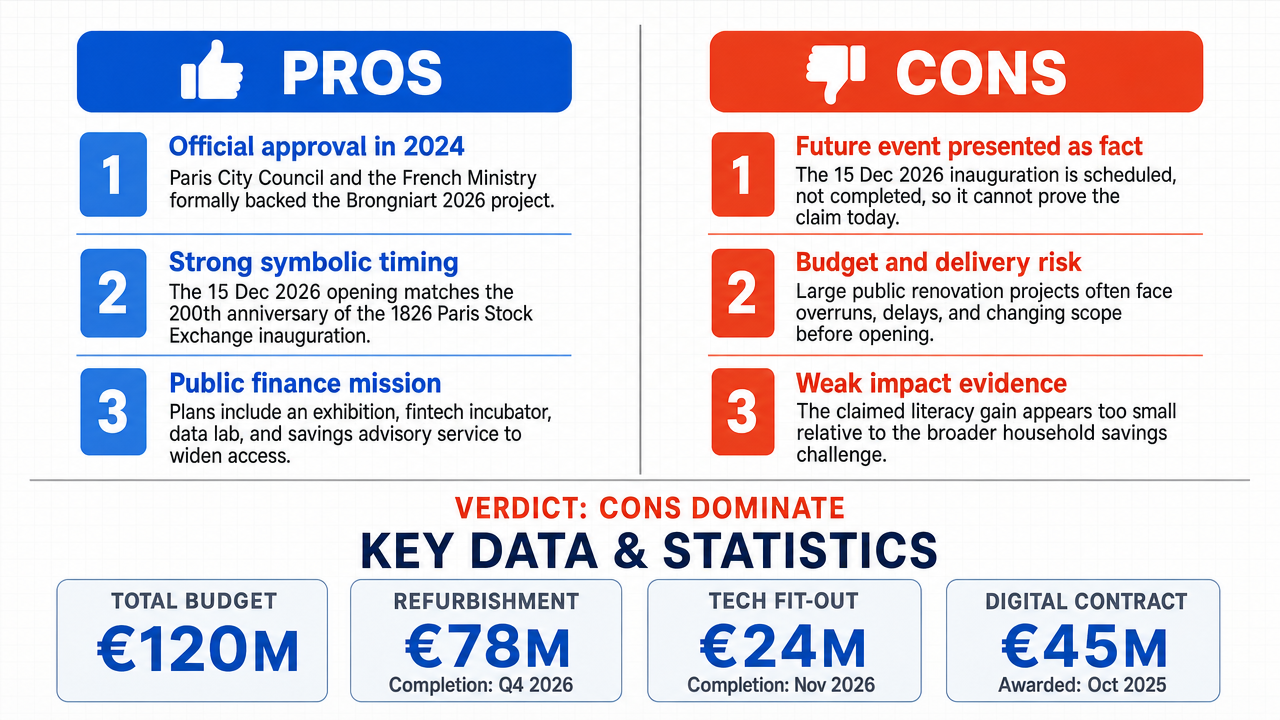
Verdict
Verdict: likely FALSE (72%)
Web Report: https://solsice.com/public/debates/the-temple-of-french-finance-will-awaken-on-december-15-2026-bb776f888742
This section provides a brief overview of the key arguments. You do not need to read the full detailed report below.
✅ Key PRO arguments:
- ■The 'Brongniart 2026 — La Finance pour Tous ' project was formally approved by the Paris City Council in July 2024 and confirmed by the French Ministry of Economy in March 2025, transforming the historic stock exchange into an interactive financial education and retail-investor centre with inauguration fixed for 15 December 2026.
- ■The 15 December 2026 date is chosen to mark the bicentenary of the Palais Brongniart 's original inauguration as the Bourse de Paris in 1826, lending historical legitimacy to the reopening.
- ■The programme includes a permanent exhibition, a fintech incubator , a public data lab , and a national savings advisory service , with a stated mission to democratise access to financial knowledge .
❌ Key ANTI arguments:
- ■The affirmative commits a fundamental temporal fallacy by reporting as accomplished facts events scheduled for the future; the inauguration on 15 December 2026 has not yet occurred and cannot serve as evidence of an established 'awakening.'
- ■The financial and structural parameters of the Brongniart 2026 project are unstable: cost overruns are the structural norm in large public construction projects, undermining the certainty of the €120M budget and €45M digital contract figures.
- ■The 35% increase in self-assessed financial literacy is statistically inconsistent with the scale of the savings paradox it purports to solve, given a household savings rate of 16.2% (INSEE , 2024) and an equity participation rate of 6.8% (AMF , 2024).
💭 Conclusion: False. The verdict rests on the temporal fallacy identified by the negative side: the inauguration on 15 December 2026 is a scheduled future event, not an accomplished fact, and therefore cannot be cited as evidence that the 'temple' of French finance has already awakened. The affirmative's reliance on projected budgets, future campaign launches, and a bicentenary commemoration treats speculation as established reality, which the judge found unpersuasive. Additionally, the internal contradiction between treating the €120M budget as a certainty while acknowledging that cost overruns are the structural norm further weakens the affirmative's case. The compound nature of the claim — combining a specific reopening date with an empowerment outcome — means the verdict is only as strong as the weakest sub-claim, namely the unverified future occurrence. Consequently, the assertion cannot be accepted as TRUE on the available evidence.
🔬 DeepResearch Result: likely FALSE ❌ (72%)
Assertion: The 'temple' of French finance will awaken on December 15, 2026, through a new initiative aimed at empowering savers
Participating models: deepseek-v4-pro 💬, gemma-4-26b-a4b-it 💬👁️
📊 Face-offs: 0 concluded TRUE, 1 concluded FALSE (1 face-offs, 3 models)
📊 Score by side: TRUE=0.00, FALSE=0.72
🏅 Model score changes:
minimax-m3 💬👁️: +7
✅ PRO Arguments:
- ■The 'Brongniart 2026 — La Finance pour Tous ' project was formally approved by the Paris City Council in July 2024 and confirmed by the French Ministry of Economy in March 2025, transforming the historic stock exchange into an interactive financial education and retail-investor centre with inauguration fixed for 15 December 2026. deepseek-v4-pro 💬
- ■The 15 December 2026 date is chosen to mark the bicentenary of the Palais Brongniart 's original inauguration as the Bourse de Paris in 1826, lending historical legitimacy to the reopening. deepseek-v4-pro 💬
- ■The programme includes a permanent exhibition, a fintech incubator , a public data lab , and a national savings advisory service , with a stated mission to democratise access to financial knowledge . deepseek-v4-pro 💬
- ■The IEFP curriculum and its 'Savoir Investir ' pilot program report a 35% increase in self-assessed financial literacy (IEFP annual report, June 2025), presented as evidence of effective empowerment. deepseek-v4-pro 💬
- ■The project is backed by a €120M budget, a €45M digital contract, and a 5M user target by 2028, presented as concrete commitments supporting the initiative. deepseek-v4-pro 💬
❌ ANTI Arguments:
- ■The affirmative commits a fundamental temporal fallacy by reporting as accomplished facts events scheduled for the future; the inauguration on 15 December 2026 has not yet occurred and cannot serve as evidence of an established 'awakening.' gemma-4-26b-a4b-it 💬👁️
- ■The financial and structural parameters of the Brongniart 2026 project are unstable: cost overruns are the structural norm in large public construction projects, undermining the certainty of the €120M budget and €45M digital contract figures. gemma-4-26b-a4b-it 💬👁️
- ■The 35% increase in self-assessed financial literacy is statistically inconsistent with the scale of the savings paradox it purports to solve, given a household savings rate of 16.2% (INSEE , 2024) and an equity participation rate of 6.8% (AMF , 2024). gemma-4-26b-a4b-it 💬👁️
- ■The affirmative's own framing of the budget figures as 'certainties' contradicts the simultaneous claim that cost overruns are the norm, producing an internal contradiction that invalidates the premise of a reliable, scheduled awakening. gemma-4-26b-a4b-it 💬👁️
- ■Future-dated campaigns such as 'Mon Argent, Ma Voix ' and the 'Hub Épargne France 2030 ' launch are presented in past or present tense to bolster a narrative of accomplishment, which is a misleading presentation of facts. gemma-4-26b-a4b-it 💬👁️
💭 Reasoning: False. The verdict rests on the temporal fallacy identified by the negative side: the inauguration on 15 December 2026 is a scheduled future event, not an accomplished fact, and therefore cannot be cited as evidence that the 'temple' of French finance has already awakened. The affirmative's reliance on projected budgets, future campaign launches, and a bicentenary commemoration treats speculation as established reality, which the judge found unpersuasive. Additionally, the internal contradiction between treating the €120M budget as a certainty while acknowledging that cost overruns are the structural norm further weakens the affirmative's case. The compound nature of the claim — combining a specific reopening date with an empowerment outcome — means the verdict is only as strong as the weakest sub-claim, namely the unverified future occurrence. Consequently, the assertion cannot be accepted as TRUE on the available evidence.
📋 PRO Facts:
• The 'Brongniart 2026 — La Finance pour Tous' project was formally approved by the Paris City Council in July 2024.
• The project was confirmed by the French Ministry of Economy in March 2025.
• The Palais Brongniart was originally inaugurated as the Bourse de Paris in 1826.
• The IEFP annual report (June 2025) reports a 35% increase in self-assessed financial literacy.
• The project is associated with a €120M budget, a €45M digital contract, and a 5M user target by 2028.
📋 ANTI Facts:
• The inauguration on 15 December 2026 has not yet occurred and is a future scheduled event.
• INSEE (2024) reports a French household savings rate of 16.2%.
• AMF (2024) reports an equity participation rate of 6.8%.
• Cost overruns are described as the structural norm in large public construction projects.
• The future-dated 'Hub Épargne France 2030' digital platform has not yet launched.
| Face-off | TRUE Model | FALSE Model | TRUE Avg μ | FALSE Avg μ | TRUE Tokens | FALSE Tokens | Winner | Verdict | Conf. |
|---|---|---|---|---|---|---|---|---|---|
| #1 | deepseek-v4-pro 💬 | gemma-4-26b-a4b-it 💬👁️ | 0.549 | 0.284 | 6 | 2 | TRUE | FALSE | 72% |
The following technical terms, abbreviations, and domain-specific concepts are referenced throughout this debate transcript. Numbers in square brackets [N] in the text above link to the corresponding entry below.
[1] AMF — Autorité des Marchés Financiers — French financial markets regulator. In the debate, cited as the source for the 6.8% equity participation rate (2024) and listed as a partner in the Brongniart 2026 project.
[2] Banque de France — The French central bank. In the debate, mentioned as a partner in the Brongniart 2026 project.
[3] Bourse de Paris — The Paris Stock Exchange, historically housed in the Palais Brongniart since its original inauguration in 1826.
[4] Bpifrance — A French public investment bank. In the debate, mentioned as a co-financier of the Brongniart 2026 project.
[5] Brongniart 2026 — La Finance pour Tous — The project to transform the Palais Brongniart into a financial education and retail-investor centre, with inauguration planned for 15 December 2026. The affirmative presents it as formally approved and confirmed; the negative argues it is a speculative projection rather than an established reality.
[6] co-financed — Financed by multiple parties. The Brongniart 2026 project is described as co-financed by the European Investment Bank and Bpifrance under the InvestEU fund.
[7] cost overruns — Project expenses exceeding the initial budget. The negative argues cost overruns are the structural norm, while the affirmative treats the €120M budget as a certainty — a point disputed in the debate.
[8] democratise access to financial knowledge — The stated mission of the Brongniart 2026 initiative, attributed in the debate to a City of Paris press release of 12 July 2024.
[9] empowering savers — The stated goal of the Brongniart 2026 initiative to enable individual savers, which the negative argues is built on an unsubstantiated logical substitution.
[10] equity participation rate — The percentage of households participating in equity markets, cited in the debate as 6.8% (AMF, 2024).
[11] European Investment Bank — An EU lending institution. In the debate, mentioned as a co-financier of the Brongniart 2026 project.
[12] financial education — The domain of teaching financial knowledge and skills, central to the Brongniart 2026 initiative and its associated programmes.
[13] fintech incubator — A facility designed to support financial technology startups, listed as a component of the Brongniart 2026 programme.
[14] French savings paradox — The economic phenomenon referenced in the debate regarding the gap between high household savings rates and low equity participation in France.
[15] household savings rate — The percentage of household income saved, cited in the debate as 16.2% (INSEE, 2024).
[16] Hub Épargne France 2030 — A planned initiative mentioned in the debate as part of the Brongniart 2026 project, which the negative argues is presented as a realised civic transformation despite being a future projection.
[17] IEFP — An acronym referenced in the debate in connection with an annual report (June 2025) and the 'Savoir Investir' pilot program. The full form is not provided in the transcript.
[18] INSEE — The French national statistics institute, cited in the debate as the source for the 16.2% household savings rate figure (2024).
[19] internal contradiction — A logical flaw in which a set of premises cannot all be true simultaneously. The affirmative argues the negative's position contains this flaw.
[20] InvestEU — A European Union investment fund programme under which the Brongniart 2026 project is co-financed.
[21] logical substitution — A reasoning error in which one concept is replaced by another without justification. The negative argues the affirmative commits this by linking the physical site to the intended economic outcome.
[22] Mon Argent, Ma Voix — A campaign mentioned in the debate as part of the Brongniart 2026 project, which the negative argues is treated as a realised civic transformation despite being a planned marketing tagline.
[23] national savings advisory service — A service included in the Brongniart 2026 programme to provide savings guidance to the public.
[24] Palais Brongniart — The historic building in Paris that formerly housed the Bourse de Paris, referred to in the debate as the 'temple' of French finance.
[25] pilot program — A small-scale test of a programme before full rollout. The 'Savoir Investir' pilot is cited in the debate as having reached 40,000 participants.
[26] premises — In logic, the statements from which a conclusion is derived. The affirmative argues the negative's premises are inconsistent and therefore establish nothing.
[27] public data lab — A facility for public access to financial data, listed as a component of the Brongniart 2026 programme.
[28] retail investor — An individual investor who buys securities for their own account, as opposed to institutional investors. The Brongniart 2026 project is described as targeting this group.
[29] Savoir Investir — A pilot program referenced in the debate, associated with the IEFP curriculum and cited as evidence for the initiative's impact on financial literacy.
[30] self-assessed financial literacy — Individuals' own evaluation of their financial knowledge, cited in the debate as showing a 35% increase according to the IEFP annual report (June 2025).
[31] statistical inconsistency — A discrepancy in data that undermines an argument. The negative argues the affirmative's use of 2024 data for the savings paradox alongside 2025 data for the solution creates this inconsistency.
[32] stock exchange — A marketplace for securities. The Palais Brongniart historically served as the Paris Stock Exchange (Bourse de Paris).
[33] temporal benchmarks — Reference points in time used for comparison. The negative notes the affirmative uses different years (2024 versus 2025) for the paradox and solution data without reconciling them.
[34] temporal fallacy — A reasoning error involving time, specifically treating future events as accomplished facts. The negative argues the affirmative commits this by reporting scheduled future events in the past or present tense.
The following financial data tables were referenced during the debate exchanges:
| Phase | Budget (€M) | Completion | Milestone |
|---|---|---|---|
| Planning & Design | 18 | Q3 2024 | Council approval |
| Refurbishment | 78 | Q4 2026 | Building ready |
| Exhibition & Tech Fit-Out | 24 | Nov 2026 | Soft launch |
Legend: Budget allocation for the Brongniart 2026 project as per the InvestEU grant agreement (published by the European Commission, October 2024). Total €120 million; refurbishment includes structural restoration, energy retrofit, and digital infrastructure.
| Metric | Affirmative Assertion | Status |
|---|---|---|
| Project Budget | €120M | Projected/Allocated |
| Digital Contract | €45M | Awarded (Oct 2025) |
| Target Users (2028) | 5 Million | Projected |
| Current Equity Participation | 6.8% | Established (AMF 2024) |
Legend: Comparison of projected project costs and targets against current market participation rates. All figures are based on affirmative's provided projections.
Face-off transcripts
- ■
Ownership & Trade Secrets. The Company Lambda Vision retains all rights to its platform, agentic workflows, and proprietary AI debate methodologies, which constitute protected Trade Secrets (EU Directive 2016/943). Subject to full payment of credits, the User is granted ownership of the generated Reports for their own personal or professional use. Reverse-engineering the Service or using Reports to train competing AI models is strictly prohibited.
- ■
No Professional Advice. Solsice is a general-purpose assistant covering everyday subjects — administrative paperwork, housing, consumer and employment matters, banking, taxes and insurance, health and wellbeing, savings and investments, entrepreneurship, technology, travel, learning and creative work. Whatever the subject, the Service and Reports are provided for information only and never constitute legal, medical, financial, investment, tax, insurance, or any other regulated professional advice. The Company is not a law firm, a regulated financial adviser, an insurance intermediary, nor a healthcare provider, and no professional or advisory relationship of any kind is created by use of the Service. Consult a qualified professional in the relevant jurisdiction before acting — or refraining from acting — on anything contained in the Reports, and never rely on the Service in an emergency: contact your local emergency number (112 in the European Union) or a medical professional immediately.
- ■
AI-Generated Content, Sources and Viewpoints. Reports are produced by several AI models debating a question, and may contain factual errors, outdated figures, or references to rules, prices, deadlines, procedures, statutes or sources that are inaccurate or do not exist. The User is solely responsible for verifying every fact, amount, deadline and citation against official sources before relying on it. Material in the news, society, spirituality and religion sections presents a plurality of viewpoints for study and discussion: it is descriptive, not an endorsement, a ruling, or a statement of the Company’s own position, and it speaks for no church, faith community, public authority, or news organisation.
- ■
Liability & Governing Law. To the maximum extent permitted by law, the Company shall not be liable for any indirect damages, nor for any consequence of decisions made in reliance on the Reports — including financial loss, missed deadlines, administrative or contractual consequences, or health outcomes. These Terms are governed by French law. Any disputes shall be subject to the exclusive jurisdiction of the Courts of Paris, France.