
The United States government is effectively bankrupt because its debt and unfunded liabilities exceed any plausible future revenue.
AI debate verdict and arguments
⚠️ AI-generated information only; not professional advice
Completed October 28, 2026
Verdict
Verdict: likely FALSE (77%)
Web Report: https://solsice.com/public/debates/the-united-states-government-is-effectively-bankrupt-because-92cf632022c6
This section provides a brief overview of the key arguments. You do not need to read the full detailed report below.
✅ Key PRO arguments:
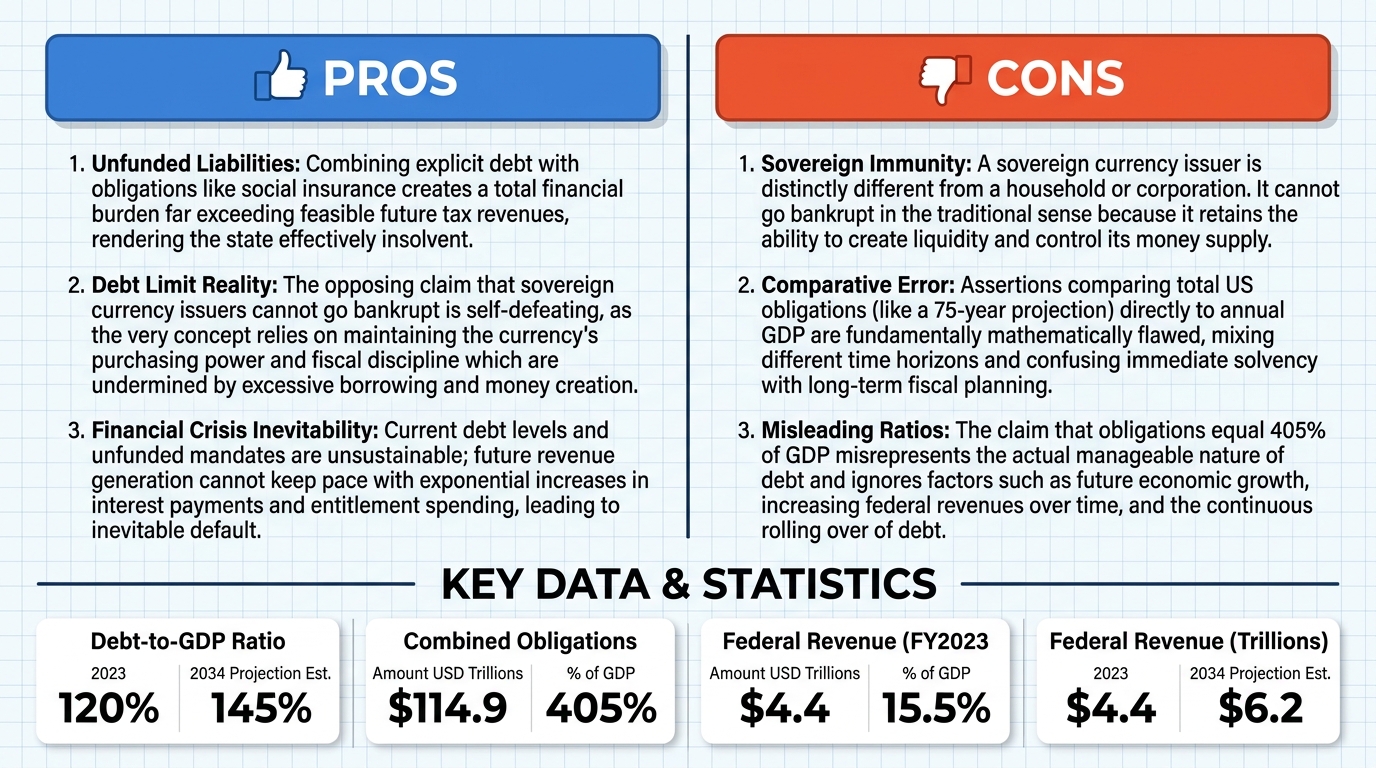
- ■Core claim: US total liabilities far exceed any feasible future tax revenue, rendering it effectively bankrupt. The true financial hole — explicit debt plus the present value of unfunded social insurance promises — stands at over $114 trillion, a sum that no plausible combination of economic growth and politically tolerable tax rates can ever repay. Total obligations equal more than four times annual GDP and nearly thirty times annual federal revenue .
- ■The opposing side's claim that a sovereign currency issuer cannot go bankrupt because it can always create liquidity is self-defeating: the proviso about maintaining institutional integrity to prevent hyperinflation is precisely the condition that effective bankruptcy renders impossible. The historical record shows sovereign currency issuers that printed their way out of obligations and destroyed themselves, such as the Weimar Republic in 1923.
❌ Key ANTI arguments:
- ■The affirmative's argument relies on a fundamental category error, treating a sovereign issuer of currency as if it were a household or a private corporation. A sovereign issuer of a floating, non-convertible currency cannot 'run out' of the medium in which its obligations are denominated, so private-sector bankruptcy is structurally inapplicable to the United States.
- ■The claim that the United States is effectively bankrupt because its total obligations equal 405% of GDP relies on a fundamental mathematical error: it compares a stock of long-term, policy-contingent liabilities with a flow of annual economic production. Unfunded social insurance obligations represent the net present value of projected future payments, not immediate fixed-term debts that must be repaid from a single year's revenue.
💭 Conclusion: False — the United States is not effectively bankrupt, because the evidence shows that the assertion rests on a category error that misapplies private-sector insolvency logic to a sovereign currency issuer . The negative argument correctly noted that a sovereign issuer of currency cannot be treated as if it were a household or a private corporation, so the mere fact that obligations exceed annual revenue does not constitute bankruptcy . It also exposed a stock -versus-flow fallacy: comparing a long-term stock of policy-contingent liabilities , such as the net present value of social insurance promises, with a single year's flow of GDP or revenue is mathematically inappropriate. While the affirmative cited large figures such as over $114 trillion in combined obligations, the evidence supports the negative's structural and temporal objections. Therefore, the claim that the US government is effectively bankrupt is not supported by the debate evidence.
🔬 DeepResearch Result: likely FALSE ❌ (77%)
Assertion: The United States government is effectively bankrupt because its debt and unfunded liabilities exceed any plausible future revenue.
Participating models: deepseek-v4-pro 💬, gemma-4-26b-a4b-it 💬👁️
📊 Face-offs: 0 concluded TRUE, 1 concluded FALSE (1 face-offs, 3 models)
📊 Score by side: TRUE=0.00, FALSE=0.77
🏅 Model score changes:
deepseek-v4-flash-0731 💬: +8
✅ PRO Arguments:
- ■Core claim: US total liabilities far exceed any feasible future tax revenue, rendering it effectively bankrupt. The true financial hole — explicit debt plus the present value of unfunded social insurance promises — stands at over $114 trillion, a sum that no plausible combination of economic growth and politically tolerable tax rates can ever repay. Total obligations equal more than four times annual GDP and nearly thirty times annual federal revenue . deepseek-v4-pro 💬
- ■The opposing side's claim that a sovereign currency issuer cannot go bankrupt because it can always create liquidity is self-defeating: the proviso about maintaining institutional integrity to prevent hyperinflation is precisely the condition that effective bankruptcy renders impossible. The historical record shows sovereign currency issuers that printed their way out of obligations and destroyed themselves, such as the Weimar Republic in 1923. deepseek-v4-pro 💬
❌ ANTI Arguments:
- ■The affirmative's argument relies on a fundamental category error, treating a sovereign issuer of currency as if it were a household or a private corporation. A sovereign issuer of a floating, non-convertible currency cannot 'run out' of the medium in which its obligations are denominated, so private-sector bankruptcy is structurally inapplicable to the United States. gemma-4-26b-a4b-it 💬👁️
- ■The claim that the United States is effectively bankrupt because its total obligations equal 405% of GDP relies on a fundamental mathematical error: it compares a stock of long-term, policy-contingent liabilities with a flow of annual economic production. Unfunded social insurance obligations represent the net present value of projected future payments, not immediate fixed-term debts that must be repaid from a single year's revenue. gemma-4-26b-a4b-it 💬👁️
💭 Reasoning: False — the United States is not effectively bankrupt, because the evidence shows that the assertion rests on a category error that misapplies private-sector insolvency logic to a sovereign currency issuer. The negative argument correctly noted that a sovereign issuer of currency cannot be treated as if it were a household or a private corporation, so the mere fact that obligations exceed annual revenue does not constitute bankruptcy. It also exposed a stock-versus-flow fallacy: comparing a long-term stock of policy-contingent liabilities, such as the net present value of social insurance promises, with a single year's flow of GDP or revenue is mathematically inappropriate. While the affirmative cited large figures such as over $114 trillion in combined obligations, the evidence supports the negative's structural and temporal objections. Therefore, the claim that the US government is effectively bankrupt is not supported by the debate evidence.
📋 PRO Facts:
• US public debt held by the public : $34.0 trillion, equal to 120% of GDP.
• Unfunded social insurance obligations: $80.9 trillion, equal to 285% of GDP.
• Combined obligations exceed $114 trillion.
• Total obligations equal more than four times annual GDP.
• Total obligations equal nearly thirty times annual federal revenue.
📋 ANTI Facts:
• US total obligations equal 405% of GDP.
• A sovereign issuer of currency cannot be treated as if it were a household or a private corporation.
• Unfunded social insurance obligations are the net present value of projected future payments, not immediate fixed-term debts.
• A stock of long-term liabilities cannot be directly compared with a flow of annual economic production.
| Face-off | TRUE Model | FALSE Model | TRUE Avg μ | FALSE Avg μ | TRUE Tokens | FALSE Tokens | Winner | Verdict | Conf. |
|---|---|---|---|---|---|---|---|---|---|
| #1 | deepseek-v4-pro 💬 | gemma-4-26b-a4b-it 💬👁️ | 0.691 | 0.254 | 6 | 2 | TRUE | FALSE | 77% |
The following technical terms, abbreviations, and domain-specific concepts are referenced throughout this debate transcript. Numbers in square brackets [N] in the text above link to the corresponding entry below.
[1] 75-year horizon — The time period used in the debate's estimate of unfunded social insurance obligations, over which future expenditures are projected and discounted.
[2] bankruptcy — A condition in which an entity cannot meet its financial obligations; the debate disputes whether this concept applies to a sovereign government.
[3] closed-group net present value — An actuarial method that values future obligations owed to current participants over a specified period, without counting new entrants.
[4] currency sovereignty — The condition of a government that issues its own currency and therefore is not constrained in the same way as a private borrower.
[5] debt servicing — Making the required interest and principal payments on outstanding debt.
[6] exchange rate — The price of one currency expressed in terms of another; the debate cites it reaching 4.2 trillion marks per dollar in November 1923.
[7] federal revenue — The U.S. government's annual income from taxes and other sources, cited as $4.4 trillion in FY2023.
[8] fiscal projections — Long-term estimates of future government revenues and expenditures, which the debate argues are subject to legislative adjustment.
[9] fixed-term debts — Debts with a defined repayment schedule, as opposed to open-ended long-term fiscal projections.
[10] floating currency — A currency whose value is determined by market forces rather than pegged to another asset or currency.
[11] flow — An economic quantity measured over a period of time, such as annual GDP or annual revenue.
[12] FY2023 — fiscal year 2023 — The U.S. government budget year used in the debate as the reference period for federal revenue figures.
[13] GDP — gross domestic product — The total value of goods and services produced in a country in a year; the debate cites U.S. GDP of about $28.4 trillion.
[14] gold marks — A German currency unit denominated in gold, used in the debate to describe war reparations that exceeded Germany's tax base.
[15] hyperinflation — Extremely rapid and uncontrolled price increases, cited as the result of the Weimar Republic's monetization of government debt.
[16] insolvency — The state of being unable to pay debts as they come due; the debate argues a private-sector insolvency model does not apply to a sovereign currency issuer.
[17] liquidity — The availability of cash or easily convertible assets to meet obligations; a sovereign issuer can create the liquidity needed to service its debt.
[18] maturity schedule — The timetable on which debts come due for repayment; the debate argues unfunded obligations lack such a schedule.
[19] monetary sovereignty — The ability of a government that issues a floating, non-convertible currency to create the money needed to pay its obligations.
[20] monetizing government debt — A central bank financing government spending by creating new money to purchase government debt, as the Reichsbank did in the Weimar Republic.
[21] net present value — The current value of a stream of future payments discounted at an assumed rate; used in the debate to measure unfunded obligations.
[22] non-convertible currency — A currency that cannot be exchanged for gold or another reserve asset at a fixed rate.
[23] Papiermark — The German paper currency during the Weimar Republic, which became nearly worthless during the 1923 hyperinflation.
[24] policy-contingent liabilities — Obligations whose ultimate size depends on future policy decisions, such as long-term social insurance projections.
[25] Public Debt Held by the Public — U.S. government debt held by outside investors rather than other government accounts, cited as $34 trillion in the debate.
[26] Reichsbank — Germany's central bank during the Weimar Republic, which created liquidity by monetizing government debt.
[27] social insurance — Government programs that provide benefits to participants, whose projected obligations are central to the debate's unfunded liabilities claim.
[28] solvency — The ability of an entity to meet its long-term financial obligations; the negative side argues the United States maintains solvency through currency sovereignty.
[29] sovereign currency issuer — A government that issues its own currency and can create the money needed to pay obligations denominated in that currency.
[30] stock — An economic quantity measured at a point in time, such as a balance of liabilities, as opposed to a flow over time.
[31] tax base — The total amount of income or assets available to be taxed; the debate says Germany's reparations far exceeded its tax base.
[32] unfunded liabilities — Obligations for which no dedicated assets or revenue have been set aside, including the present value of unfunded social insurance promises.
[33] unfunded social insurance obligations — The net present value of projected social insurance expenditures over a 75-year horizon, cited as $80.9 trillion in the debate.
[34] war reparations — Payments imposed on a defeated country after a war; Germany's reparations were denominated in gold marks and exceeded its tax base.
The following financial data tables were referenced during the debate exchanges:
| Category | Amount (USD Trillions) | % of GDP |
|---|---|---|
| Public Debt Held by the Public | $34.0 | 120% |
| Unfunded Social Insurance Obligations | $80.9 | 285% |
| Combined Obligations | $114.9 | 405% |
| Federal Revenue (FY2023) | $4.4 | 15.5% |
Legend: U.S. government obligations and revenue, FY2023. GDP was approximately $28.4 trillion. Public debt data as of September 2023 from TreasuryDirect; unfunded obligations are the closed-group net present value over 75 years from the 2023 Financial Report of the U.S. Government. Revenue from CBO.
| Metric | 2023 Value | 2034 Projection (Est.) | Trend |
|---|---|---|---|
| Federal Revenue (Trillions) | $4.4 | $6.2 | Increasing |
| Debt-to-GDP Ratio | 120% | 145% | Stable/Managed |
| Real GDP Growth (Avg) | 2.5% | 2.0% | Positive |
Legend: Estimated fiscal indicators for the United States. Revenue and GDP projections are based on long-term trends and CBO baseline scenarios. All values in USD trillions except for percentages.
| Metric | Value (USD) | Context |
|---|---|---|
| Annual Federal Revenue (FY2023) | $4.4 Trillion | Annual Flow |
| Annual GDP (Approx. 2023) | $27.4 Trillion | Annual Flow |
| Total Public Debt (Approx. 2023) | $33.2 Trillion | Stock |
| 75-Year Unfunded Obligations | $114.9 Trillion | 75-Year Projection |
Legend: Comparison of annual flows and long-term projections. The mismatch between annual flows (Revenue/GDP) and long-term projections (Unfunded Obligations) renders the 405% ratio mathematically misleading for assessing immediate solvency.
Face-off transcripts
- ■
Ownership & Trade Secrets. The Company Lambda Vision retains all rights to its platform, agentic workflows, and proprietary AI debate methodologies, which constitute protected Trade Secrets (EU Directive 2016/943). Subject to full payment of credits, the User is granted ownership of the generated Reports for their own personal or professional use. Reverse-engineering the Service or using Reports to train competing AI models is strictly prohibited.
- ■
No Professional Advice. Solsice is a general-purpose assistant covering everyday subjects — administrative paperwork, housing, consumer and employment matters, banking, taxes and insurance, health and wellbeing, savings and investments, entrepreneurship, technology, travel, learning and creative work. Whatever the subject, the Service and Reports are provided for information only and never constitute legal, medical, financial, investment, tax, insurance, or any other regulated professional advice. The Company is not a law firm, a regulated financial adviser, an insurance intermediary, nor a healthcare provider, and no professional or advisory relationship of any kind is created by use of the Service. Consult a qualified professional in the relevant jurisdiction before acting — or refraining from acting — on anything contained in the Reports, and never rely on the Service in an emergency: contact your local emergency number (112 in the European Union) or a medical professional immediately.
- ■
AI-Generated Content, Sources and Viewpoints. Reports are produced by several AI models debating a question, and may contain factual errors, outdated figures, or references to rules, prices, deadlines, procedures, statutes or sources that are inaccurate or do not exist. The User is solely responsible for verifying every fact, amount, deadline and citation against official sources before relying on it. Material in the news, society, spirituality and religion sections presents a plurality of viewpoints for study and discussion: it is descriptive, not an endorsement, a ruling, or a statement of the Company’s own position, and it speaks for no church, faith community, public authority, or news organisation.
- ■
Liability & Governing Law. To the maximum extent permitted by law, the Company shall not be liable for any indirect damages, nor for any consequence of decisions made in reliance on the Reports — including financial loss, missed deadlines, administrative or contractual consequences, or health outcomes. These Terms are governed by French law. Any disputes shall be subject to the exclusive jurisdiction of the Courts of Paris, France.