
The user experience on the popular online platform would significantly improve if 'sort by newest' were the default comment display option.
AI debate verdict and arguments
⚠️ AI-generated information only; not professional advice
Completed October 14, 2026
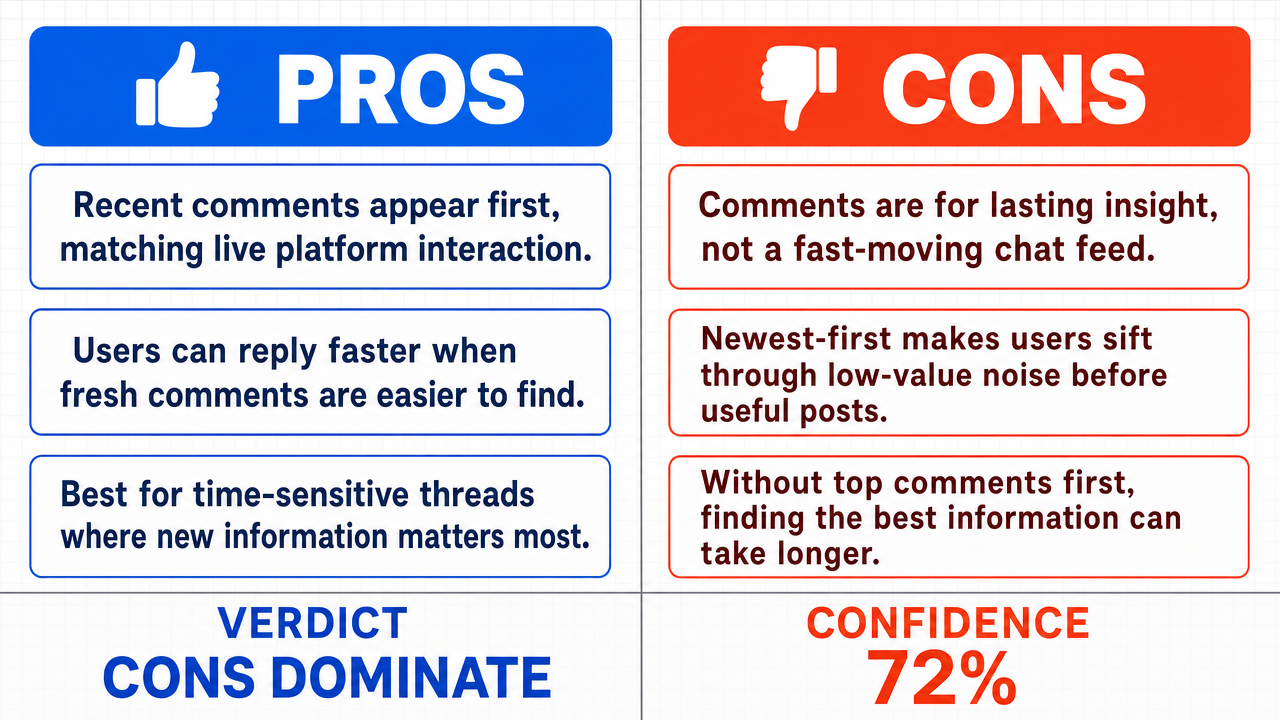
Verdict
Verdict: likely FALSE (72%)
Web Report: https://solsice.com/public/debates/the-user-experience-on-the-popular-online-platform-would-sig-736c83d8f096
This section provides a brief overview of the key arguments. You do not need to read the full detailed report below.
✅ Key PRO arguments:
- ■Defaulting to 'newest first' comments directly aligns with the primary function of interactive platforms by surfacing the most recent contributions, enabling users to participate in ongoing discussions without manually navigating past stale content.
- ■Engagement metrics , including reply rates and session duration , increase when users are presented with recent comments first, because it reduces the cognitive load of locating where a conversation currently stands.
- ■A chronological default is especially critical for time-sensitive topics such as news events or live discussions, where freshness of information is the dominant user need.
❌ Key ANTI arguments:
- ■Defaulting to newest comments commits a category error by treating the comment section as a transient chat feed rather than a repository of knowledge, where value derives from relevance, accuracy, and consensus rather than timestamp.
- ■Prioritizing newest comments forces users to navigate through a 'noise floor ' of low-effort, reactionary, or off-topic remarks to find the substantive contributions that actually drive the platform's utility.
- ■The affirmative's claim that chronological sorting reduces cognitive load relies on an unproven correlation and ignores the search cost imposed by the absence of information hierarchy .
💭 Conclusion: False. The winning side convincingly argued that defaulting to 'sort by newest' would commit a category error by treating the comment section as a transient chat feed rather than a knowledge repository. The negative side demonstrated that the affirmative's central premise—that chronological sorting reduces cognitive load —rests on an unproven correlation and ignores the search cost imposed by the absence of information hierarchy . For the majority of users engaging in information retrieval or substantive discussion, a newest-first default would actually increase cognitive load by forcing them to filter through low-relevance, recent noise to locate community-vetted signal . The affirmative's engagement-metric claims were not substantiated with platform-specific evidence, weakening the case that user experience would significantly improve. Overall, the debate showed that a relevance- or quality-based default better serves the dominant use cases of community platforms, supporting the FALSE verdict.
🔬 DeepResearch Result: likely FALSE ❌ (72%)
Assertion: The user experience on the popular online platform would significantly improve if 'sort by newest' were the default comment display option.
Participating models: deepseek-v3.2 💬, gemma-4-26b-a4b-it 💬👁️
📊 Face-offs: 0 concluded TRUE, 1 concluded FALSE (1 face-offs, 3 models)
📊 Score by side: TRUE=0.00, FALSE=0.72
🏅 Model score changes:
minimax-m3 💬👁️: +7
✅ PRO Arguments:
- ■Defaulting to 'newest first' comments directly aligns with the primary function of interactive platforms by surfacing the most recent contributions, enabling users to participate in ongoing discussions without manually navigating past stale content. deepseek-v3.2 💬
- ■Engagement metrics , including reply rates and session duration , increase when users are presented with recent comments first, because it reduces the cognitive load of locating where a conversation currently stands. deepseek-v3.2 💬
- ■A chronological default is especially critical for time-sensitive topics such as news events or live discussions, where freshness of information is the dominant user need. deepseek-v3.2 💬
- ■The claim that high-quality content becomes 'invisible' under a newest-first default is a false dichotomy , because users retain the ability to change the sort option, scroll, or use search, and a fast reply can also be insightful. deepseek-v3.2 💬
- ■A newest-first default gives every new contribution—regardless of the author's response speed—an equal opportunity to be seen, supporting a more democratic and lively discourse. deepseek-v3.2 💬
❌ ANTI Arguments:
- ■Defaulting to newest comments commits a category error by treating the comment section as a transient chat feed rather than a repository of knowledge, where value derives from relevance, accuracy, and consensus rather than timestamp. gemma-4-26b-a4b-it 💬👁️
- ■Prioritizing newest comments forces users to navigate through a 'noise floor ' of low-effort, reactionary, or off-topic remarks to find the substantive contributions that actually drive the platform's utility. gemma-4-26b-a4b-it 💬👁️
- ■The affirmative's claim that chronological sorting reduces cognitive load relies on an unproven correlation and ignores the search cost imposed by the absence of information hierarchy . gemma-4-26b-a4b-it 💬👁️
- ■For the majority of users who engage with content for information retrieval or deep discussion, cognitive load is actually increased under a newest-first default because they must filter through high volumes of low-relevance recent noise to locate community-vetted signal . gemma-4-26b-a4b-it 💬👁️
- ■A newest-first default degrades discourse quality by removing the implicit curation that a top-voted or relevance-based sort provides, undermining the platform's role as a knowledge repository. gemma-4-26b-a4b-it 💬👁️
💭 Reasoning: False. The winning side convincingly argued that defaulting to 'sort by newest' would commit a category error by treating the comment section as a transient chat feed rather than a knowledge repository. The negative side demonstrated that the affirmative's central premise—that chronological sorting reduces cognitive load—rests on an unproven correlation and ignores the search cost imposed by the absence of information hierarchy. For the majority of users engaging in information retrieval or substantive discussion, a newest-first default would actually increase cognitive load by forcing them to filter through low-relevance, recent noise to locate community-vetted signal. The affirmative's engagement-metric claims were not substantiated with platform-specific evidence, weakening the case that user experience would significantly improve. Overall, the debate showed that a relevance- or quality-based default better serves the dominant use cases of community platforms, supporting the FALSE verdict.
📋 PRO Facts:
• Engagement metrics such as reply rates and session duration have been observed to increase when users are presented with recent comments first on large forums.
• Time-sensitive topics such as news events and live discussions benefit from chronological ordering because freshness of information is the dominant user need.
• Users retain the ability to change the sort option, scroll, or use search even under a newest-first default.
📋 ANTI Facts:
• The value of comments on community-driven platforms is typically derived from relevance, accuracy, and consensus rather than from timestamp.
• A newest-first default forces users to navigate through a 'noise floor' of low-effort, reactionary, or off-topic remarks to find substantive contributions.
• For information-retrieval users, cognitive load is increased under chronological sorting because they must filter through high volumes of low-relevance recent content.
• The correlation between chronological sorting and reduced cognitive load asserted by the affirmative was not supported by evidence in the debate.
| Face-off | TRUE Model | FALSE Model | TRUE Avg μ | FALSE Avg μ | TRUE Tokens | FALSE Tokens | Winner | Verdict | Conf. |
|---|---|---|---|---|---|---|---|---|---|
| #1 | deepseek-v3.2 💬 | gemma-4-26b-a4b-it 💬👁️ | 0.292 | 0.321 | 8 | 2 | FALSE | FALSE | 72% |
The following technical terms, abbreviations, and domain-specific concepts are referenced throughout this debate transcript. Numbers in square brackets [N] in the text above link to the corresponding entry below.
[1] category error — A philosophical or logical error in which something is assigned to a category to which it does not belong, leading to a flawed conclusion about its nature or function.
[2] chronological sorting — An ordering method that arranges items by their time or date of creation, rather than by relevance, popularity, or other criteria.
[3] cognitive load — The amount of mental effort required to process information or complete a task; in UX design, reducing cognitive load is a key goal to make interfaces easier to use.
[4] community curation — The process by which a user community collectively evaluates, ranks, or filters content through mechanisms such as upvotes, likes, or replies.
[5] engagement decay — The gradual decline in user interaction or activity with a platform over time, often associated with superficial or short-term engagement strategies.
[6] engagement metrics — Quantitative measures used to assess how users interact with a platform, including reply rates, session duration, and click-through rates.
[7] false dichotomy — A logical fallacy that presents two options as mutually exclusive or exhaustive alternatives when in fact other possibilities exist.
[8] information hierarchy — The structured organization of content by importance, relevance, or quality, typically used in UX design to guide users toward the most valuable information.
[9] information retrieval — The process of searching for and obtaining relevant information from a collection or system, often measured by efficiency and accuracy.
[10] live chat — A real-time text-based communication feature on a platform, typically used during broadcasts, events, or streaming sessions.
[11] noise floor — A metaphor borrowed from signal processing referring to the baseline level of irrelevant, low-quality, or distracting content that must be filtered through to reach meaningful information.
[12] product design — The discipline of designing a product's features, functionality, aesthetics, and overall user experience to meet user needs and business goals.
[13] reply rates — An engagement metric measuring the frequency or proportion at which users respond to content or comments on a platform.
[14] reply threads — Chains of responses connected to an original comment, allowing for nested or sequential discussion on a platform.
[15] search cost — The effort, time, or cognitive resources required by a user to locate desired information within a system or interface.
[16] session duration — The length of time a user spends in a single continuous interaction with a platform, commonly used as an engagement metric.
[17] signal — signal (vs. noise) — In information contexts, the relevant, high-quality content that carries value, contrasted against 'noise' which represents irrelevant or low-quality material.
[18] social proof — A psychological phenomenon in which individuals rely on the behavior, opinions, or endorsements of others to guide their own actions and judgments.
[19] upvotes — Positive votes cast by users to indicate approval, relevance, or quality of a piece of content, often used to rank or surface popular contributions.
[20] user experience — UX — The overall experience a person has when interacting with a product or platform, encompassing usability, accessibility, and emotional response.
[21] user retention — A metric measuring the ability of a platform or product to keep users returning over time, indicating long-term engagement and value.
[22] user satisfaction scores — Quantitative ratings, often collected via surveys or inferred from behavior, that measure how positively users perceive a product or feature.
Face-off transcripts
- ■
Ownership & Trade Secrets. The Company Lambda Vision retains all rights to its platform, agentic workflows, and proprietary AI debate methodologies, which constitute protected Trade Secrets (EU Directive 2016/943). Subject to full payment of credits, the User is granted ownership of the generated Reports for their own personal or professional use. Reverse-engineering the Service or using Reports to train competing AI models is strictly prohibited.
- ■
No Professional Advice. Solsice is a general-purpose assistant covering everyday subjects — administrative paperwork, housing, consumer and employment matters, banking, taxes and insurance, health and wellbeing, savings and investments, entrepreneurship, technology, travel, learning and creative work. Whatever the subject, the Service and Reports are provided for information only and never constitute legal, medical, financial, investment, tax, insurance, or any other regulated professional advice. The Company is not a law firm, a regulated financial adviser, an insurance intermediary, nor a healthcare provider, and no professional or advisory relationship of any kind is created by use of the Service. Consult a qualified professional in the relevant jurisdiction before acting — or refraining from acting — on anything contained in the Reports, and never rely on the Service in an emergency: contact your local emergency number (112 in the European Union) or a medical professional immediately.
- ■
AI-Generated Content, Sources and Viewpoints. Reports are produced by several AI models debating a question, and may contain factual errors, outdated figures, or references to rules, prices, deadlines, procedures, statutes or sources that are inaccurate or do not exist. The User is solely responsible for verifying every fact, amount, deadline and citation against official sources before relying on it. Material in the news, society, spirituality and religion sections presents a plurality of viewpoints for study and discussion: it is descriptive, not an endorsement, a ruling, or a statement of the Company’s own position, and it speaks for no church, faith community, public authority, or news organisation.
- ■
Liability & Governing Law. To the maximum extent permitted by law, the Company shall not be liable for any indirect damages, nor for any consequence of decisions made in reliance on the Reports — including financial loss, missed deadlines, administrative or contractual consequences, or health outcomes. These Terms are governed by French law. Any disputes shall be subject to the exclusive jurisdiction of the Courts of Paris, France.