
Traditional media outlets like radio, magazines, newspapers, and television advertising will become largely irrelevant for businesses due to their high cost and poor return on investment compared to digital platforms.
AI debate verdict and arguments
⚠️ AI-generated information only; not professional advice
Completed October 18, 2026
Verdict
Verdict: likely FALSE (82%)
Web Report: https://solsice.com/public/debates/traditional-media-outlets-like-radio-magazines-newspapers-an-53555ed467ab
This section provides a brief overview of the key arguments. You do not need to read the full detailed report below.
✅ Key PRO arguments:
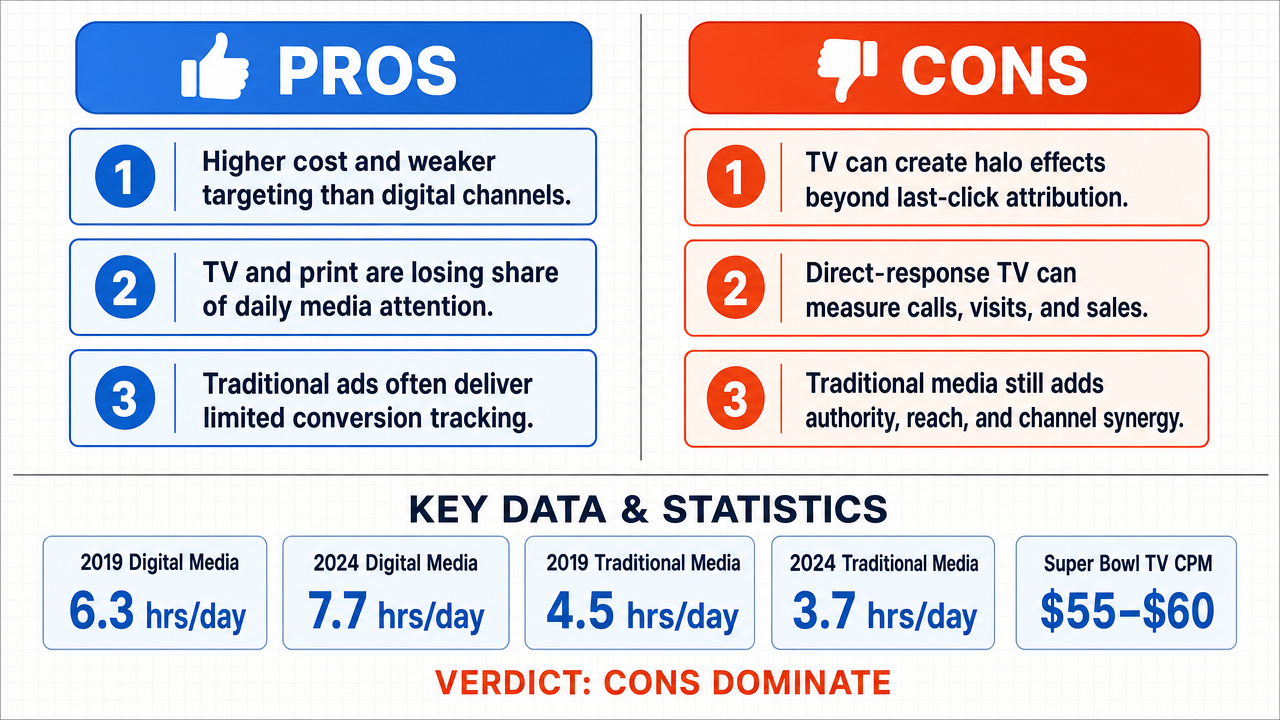
- ■Traditional media carries a structural cost-efficiency disadvantage: a 2024 30-second Super Bowl commercial cost approximately $7 million for roughly 123 million viewers (~$57 CPM ), whereas targeted digital video campaigns on YouTube routinely achieve CPMs between $10 and $20 with precise demographic, behavioral, and geographic targeting — a multiplicative gap that lets businesses reach three to five times as many qualified prospects per dollar.
- ■The brand-building versus conversion distinction used to defend traditional media is a post-hoc rationalization invented to insulate traditional channels from accountability, treating strategic purpose as an inherent property of the medium rather than an outcome that should be measured against cost.
❌ Key ANTI arguments:
- ■Equating value exclusively with deterministic, user-level click attribution ignores the halo effect : a consumer may see a television advertisement that builds brand salience and only later perform a Google search, meaning digital attribution systems systematically undercount traditional media's contribution to conversions.
- ■The claim that traditional media is unmeasurable is contradicted by the documented existence of Direct-Response Television (DRTV ), which uses dedicated phone numbers, SMS short codes , and specialized URLs to track consumer response from broadcast to purchase, providing clear conversion data within the channel itself.
- ■Traditional media retains essential roles in brand authority, mass reach, and cross-channel synergy that digital platforms cannot fully replicate, meaning the assertion of 'largely irrelevant' overstates the displacement and ignores complementary strategic functions.
💭 Conclusion: False. The assertion that traditional media will become largely irrelevant is not fully supported because the negative side demonstrated that traditional channels generate measurable conversion impact through mechanisms like Direct-Response Television tracking using phone, SMS, and URL responses. The affirmative's CPM comparison, while factually grounded in figures such as the ~$57 Super Bowl CPM versus $10–$20 YouTube CPMs, conflates cost-per-impression differentials with a categorical claim of irrelevance. The negative's strongest point is that ROI measurement itself uses different frameworks: traditional media relies on Marketing Mix Modeling while digital uses Multi-Touch Attribution , meaning the two are not directly comparable. Consequently, the claim that traditional media will be 'largely irrelevant' overstates the evidence, though confidence is not absolute because the cost gap is real.
🔬 DeepResearch Result: likely FALSE ❌ (82%)
Assertion: Traditional media outlets like radio, magazines, newspapers, and television advertising will become largely irrelevant for businesses due to their high cost and poor return on investment compared to digital platforms.
Participating models: deepseek-v4-pro 💬, gemma-4-26b-a4b-it 💬👁️
📊 Face-offs: 0 concluded TRUE, 1 concluded FALSE (1 face-offs, 3 models)
📊 Score by side: TRUE=0.00, FALSE=0.82
🏅 Model score changes:
minimax-m3 💬👁️: +8
✅ PRO Arguments:
- ■Traditional media carries a structural cost-efficiency disadvantage: a 2024 30-second Super Bowl commercial cost approximately $7 million for roughly 123 million viewers (~$57 CPM ), whereas targeted digital video campaigns on YouTube routinely achieve CPMs between $10 and $20 with precise demographic, behavioral, and geographic targeting — a multiplicative gap that lets businesses reach three to five times as many qualified prospects per dollar. deepseek-v4-pro 💬
- ■The brand-building versus conversion distinction used to defend traditional media is a post-hoc rationalization invented to insulate traditional channels from accountability, treating strategic purpose as an inherent property of the medium rather than an outcome that should be measured against cost. deepseek-v4-pro 💬
❌ ANTI Arguments:
- ■Equating value exclusively with deterministic, user-level click attribution ignores the halo effect : a consumer may see a television advertisement that builds brand salience and only later perform a Google search, meaning digital attribution systems systematically undercount traditional media's contribution to conversions. gemma-4-26b-a4b-it 💬👁️
- ■The claim that traditional media is unmeasurable is contradicted by the documented existence of Direct-Response Television (DRTV ), which uses dedicated phone numbers, SMS short codes , and specialized URLs to track consumer response from broadcast to purchase, providing clear conversion data within the channel itself. gemma-4-26b-a4b-it 💬👁️
- ■Traditional media retains essential roles in brand authority, mass reach, and cross-channel synergy that digital platforms cannot fully replicate, meaning the assertion of 'largely irrelevant' overstates the displacement and ignores complementary strategic functions. gemma-4-26b-a4b-it 💬👁️
💭 Reasoning: False. The assertion that traditional media will become largely irrelevant is not fully supported because the negative side demonstrated that traditional channels generate measurable conversion impact through mechanisms like Direct-Response Television tracking using phone, SMS, and URL responses. The affirmative's CPM comparison, while factually grounded in figures such as the ~$57 Super Bowl CPM versus $10–$20 YouTube CPMs, conflates cost-per-impression differentials with a categorical claim of irrelevance. The negative's strongest point is that ROI measurement itself uses different frameworks: traditional media relies on Marketing Mix Modeling while digital uses Multi-Touch Attribution, meaning the two are not directly comparable. Consequently, the claim that traditional media will be 'largely irrelevant' overstates the evidence, though confidence is not absolute because the cost gap is real.
📋 PRO Facts:
• A 30-second Super Bowl commercial in 2024 cost approximately $7 million for a single airing reaching roughly 123 million viewers, implying a CPM of about $57.
• Targeted digital video campaigns on YouTube routinely achieve CPMs between $10 and $20 with individual behavioral targeting capabilities.
📋 ANTI Facts:
• Direct-Response Television (DRTV) uses phone numbers, SMS, and URLs to track consumer response from broadcast to purchase.
| Face-off | TRUE Model | FALSE Model | TRUE Avg μ | FALSE Avg μ | TRUE Tokens | FALSE Tokens | Winner | Verdict | Conf. |
|---|---|---|---|---|---|---|---|---|---|
| #1 | deepseek-v4-pro 💬 | gemma-4-26b-a4b-it 💬👁️ | 0.576 | 0.206 | 6 | 2 | TRUE | FALSE | 82% |
The following technical terms, abbreviations, and domain-specific concepts are referenced throughout this debate transcript. Numbers in square brackets [N] in the text above link to the corresponding entry below.
[1] attribution — The process of identifying which marketing touchpoints or channels contribute to a desired outcome such as a sale or conversion. The affirmative and negative disagree on how attribution should be measured across traditional and digital media.
[2] behavioral targeting — A form of audience targeting that uses data on user behavior (such as browsing history or past purchases) to deliver relevant advertisements. The affirmative cites this as a capability of digital platforms.
[3] bottom-of-funnel — A marketing funnel term referring to the final stage of the customer journey, where prospects are closest to making a purchase decision. The affirmative argues digital platforms are not confined to this stage.
[4] brand salience — The degree to which a brand comes to mind when a consumer thinks about a product category. The negative argues traditional media builds brand salience that drives later digital searches.
[5] brand-building — The process of creating awareness, identity, and emotional association with a brand over time. The negative argues traditional media excels at this while digital excels at conversion.
[6] budget allocation — The strategic distribution of financial resources across different channels or activities. The affirmative argues rational budget allocation will continue migrating to digital channels.
[7] connected TV — Television content delivered over the internet rather than through traditional broadcast, cable, or satellite signals. The affirmative cites YouTube's connected TV ad formats as combining TV-style storytelling with digital targeting.
[8] conversion — A desired action taken by a consumer, such as a purchase, sign-up, or click. The debate centers on whether traditional or digital media better drives conversions.
[9] conversion pixel — A snippet of code placed on a website to track user actions and attribute them to specific advertising sources. The negative argues traditional media is dismissed because it lacks a conversion pixel.
[10] CPM — Cost Per Thousand Impressions — A standard advertising metric measuring the cost to reach 1,000 viewers or readers. The affirmative compares CPMs across Super Bowl TV ads and digital video campaigns.
[11] cross-channel synergy — The combined effect of marketing efforts across multiple channels that produces results greater than the sum of individual channel effects. The negative argues traditional media contributes to this synergy.
[12] demographic targeting — Audience segmentation based on demographic attributes such as age, gender, income, or education. The affirmative cites this as a capability of digital platforms.
[13] deterministic attribution — An attribution model that uses identifiable user data (such as user IDs or cookies) to assign credit for conversions to specific touchpoints. The negative argues the affirmative relies exclusively on this method.
[14] DRTV — Direct-Response Television — Television advertising designed to generate an immediate, measurable response from viewers, typically through phone numbers, URLs, or SMS codes. The negative cites this as evidence that television does generate conversion data.
[15] falsified — In scientific and philosophical methodology, a claim or hypothesis that has been shown to be false or contradicted by evidence. The negative argues the affirmative's universal claim is falsified by counterexamples in television, magazines, and newspapers.
[16] geographic targeting — Audience segmentation based on physical location, allowing advertisers to reach consumers in specific regions or markets. The affirmative cites this as a capability of digital platforms.
[17] halo effect — A cognitive bias or marketing phenomenon where positive perception in one area spills over to influence perception in another. The negative argues traditional media creates a halo effect that drives later digital searches.
[18] impressions — A standard advertising metric counting the number of times an advertisement is displayed or viewed, regardless of whether the viewer takes action. Used in CPM calculations.
[19] interpretive theory — A philosophical or legal framework that emphasizes understanding meaning and context rather than applying fixed rules. The negative accuses the affirmative of appealing to an interpretive theory of value.
[20] landing pages — Standalone web pages designed specifically for a marketing or advertising campaign, where visitors arrive after clicking a link. The negative cites dedicated landing pages as a print media attribution mechanism.
[21] linear television — Traditional television programming delivered in real-time according to a fixed schedule, as opposed to on-demand or streaming content. The affirmative compares connected TV ad formats to linear television.
[22] logical error — A flaw in reasoning that invalidates an argument. The negative accuses the affirmative of a logical error of scale and purpose when comparing CPMs across channels.
[23] non-skippable — A type of digital video advertisement that viewers cannot skip or bypass before viewing. The affirmative cites YouTube's non-skippable formats as delivering TV-like impact.
[24] post-hoc rationalization — A logical fallacy or rhetorical move where a conclusion is reached first and a justification is constructed afterward. The affirmative accuses the negative of inventing the brand-building/conversion distinction as a post-hoc rationalization.
[25] qualified prospects — Potential customers who have been assessed as meeting specific criteria indicating they are likely to convert. The affirmative argues digital channels reach more qualified prospects per dollar.
[26] reader-service cards — Cards included in print publications (magazines, newspapers) that readers can mail in to request information or make purchases, allowing publishers to track responses. The negative cites these as a print media attribution mechanism.
[27] ROI — Return on Investment — A financial metric measuring the efficiency or profitability of an investment, calculated as the ratio of net profit to cost. The affirmative argues traditional media has poor ROI compared to digital.
[28] SMS short codes — Short numeric telephone numbers used to send and receive text messages, often used in marketing campaigns for consumers to opt in or respond to ads. The negative cites these as a DRTV attribution mechanism.
[29] unique coupon codes — Promotional codes specific to a particular campaign, publication, or advertisement that allow businesses to track which ads generate redemptions. The negative cites these as a print media attribution mechanism.
[30] user-level attribution — An attribution approach that tracks and credits individual users across touchpoints, typically using deterministic data. The negative argues the affirmative equates value exclusively with this method.
The following financial data tables were referenced during the debate exchanges:
| Channel | CPM Range | Targeting Precision | Measurable Conversions |
|---|---|---|---|
| Super Bowl TV | $55–$60 | Broad demographic | Minimal |
| Prime-time TV | $25–$35 | Age/gender | Low |
| Digital Video | $10–$20 | Individual behavioral | Full attribution |
| Social Media Ads | $5–$15 | Individual + lookalike | Full attribution |
Legend: Cost per thousand impressions (CPM) and targeting capabilities across advertising channels, 2024 data. Digital platforms offer granular targeting and end-to-end conversion tracking unavailable to traditional broadcast. Sources: Variety advertising rate cards, Meta and Google Ads benchmarks.
| Year | Daily Digital Media (hrs) | Daily Traditional Media (hrs) | Digital Share |
|---|---|---|---|
| 2019 | 6.3 | 4.5 | 58.3% |
| 2021 | 7.0 | 4.0 | 63.6% |
| 2023 | 7.4 | 3.8 | 66.1% |
| 2024 | 7.7 | 3.7 | 67.5% |
Legend: Average daily media consumption among U.S. adults, 2019–2024. Traditional media includes linear TV, radio, newspapers, and magazines. Digital share represents the proportion of total media time. Source: eMarketer/Insider Intelligence, annual time-spent benchmarks.
| Media Type | Primary Strategic Goal | Measurement Metric | Attribution Model |
|---|---|---|---|
| Traditional (TV/Print) | Brand Awareness & Authority | Reach & Frequency | Marketing Mix Modeling (MMM) |
| Digital (Social/Search) | Direct Response & Conversion | CTR & CPA | Multi-Touch Attribution (MTA) |
Legend: Comparison of strategic utility and measurement methodologies. Traditional media focuses on top-of-funnel awareness, while digital focuses on bottom-of-funnel conversion.
| Channel | Brand Lift ROAS | Conversion ROAS | Total Measurable ROAS |
|---|---|---|---|
| Linear TV | 1.2x | Not measurable | Partial only |
| YouTube CTV | 1.5x | 2.8x | Full attribution |
| Meta Brand Awareness | 1.3x | 3.2x | Full attribution |
| TikTok Spark Ads | 1.1x | 2.5x | Full attribution |
Legend: Return on ad spend (ROAS) across brand and conversion objectives, comparing traditional and digital channels. Digital platforms deliver measurable ROAS on both dimensions while linear TV provides only partial measurement. Brand lift ROAS based on Nielsen-measured awareness and consideration lift. Sources: Google/Nielsen ROI benchmark studies 2023-2024, Meta conversion lift studies.
| Media Branch | Conversion Tracking Mechanism | Attribution Type |
|---|---|---|
| Television (DRTV) | Phone/SMS/URL | Direct Response |
| Magazines | Reader-Service/Coupons | Direct Response |
| Newspapers | Coupon/URL/Phone | Direct Response |
| Digital | Pixels/Cookies/ID | Deterministic |
Legend: Comparison of conversion tracking mechanisms across media branches. Traditional media utilizes direct-response triggers to achieve measurable attribution, refuting the claim of a total "attribution vacuum."
Face-off transcripts
- ■
Ownership & Trade Secrets. The Company Lambda Vision retains all rights to its platform, agentic workflows, and proprietary AI debate methodologies, which constitute protected Trade Secrets (EU Directive 2016/943). Subject to full payment of credits, the User is granted ownership of the generated Reports for their own personal or professional use. Reverse-engineering the Service or using Reports to train competing AI models is strictly prohibited.
- ■
No Professional Advice. Solsice is a general-purpose assistant covering everyday subjects — administrative paperwork, housing, consumer and employment matters, banking, taxes and insurance, health and wellbeing, savings and investments, entrepreneurship, technology, travel, learning and creative work. Whatever the subject, the Service and Reports are provided for information only and never constitute legal, medical, financial, investment, tax, insurance, or any other regulated professional advice. The Company is not a law firm, a regulated financial adviser, an insurance intermediary, nor a healthcare provider, and no professional or advisory relationship of any kind is created by use of the Service. Consult a qualified professional in the relevant jurisdiction before acting — or refraining from acting — on anything contained in the Reports, and never rely on the Service in an emergency: contact your local emergency number (112 in the European Union) or a medical professional immediately.
- ■
AI-Generated Content, Sources and Viewpoints. Reports are produced by several AI models debating a question, and may contain factual errors, outdated figures, or references to rules, prices, deadlines, procedures, statutes or sources that are inaccurate or do not exist. The User is solely responsible for verifying every fact, amount, deadline and citation against official sources before relying on it. Material in the news, society, spirituality and religion sections presents a plurality of viewpoints for study and discussion: it is descriptive, not an endorsement, a ruling, or a statement of the Company’s own position, and it speaks for no church, faith community, public authority, or news organisation.
- ■
Liability & Governing Law. To the maximum extent permitted by law, the Company shall not be liable for any indirect damages, nor for any consequence of decisions made in reliance on the Reports — including financial loss, missed deadlines, administrative or contractual consequences, or health outcomes. These Terms are governed by French law. Any disputes shall be subject to the exclusive jurisdiction of the Courts of Paris, France.