
TSMC's capacity additions of 10% to 20% have been achieved by purchasing extra tools rather than building new cleanrooms since July 2026.
AI debate verdict and arguments
⚠️ AI-generated information only; not professional advice
Completed October 19, 2026
Verdict
Verdict: likely FALSE (80%)
Web Report: https://solsice.com/public/debates/tsmc-s-capacity-additions-of-10-to-20-have-been-achieved-by-cc302d078ca6
This section provides a brief overview of the key arguments. You do not need to read the full detailed report below.
✅ Key PRO arguments:
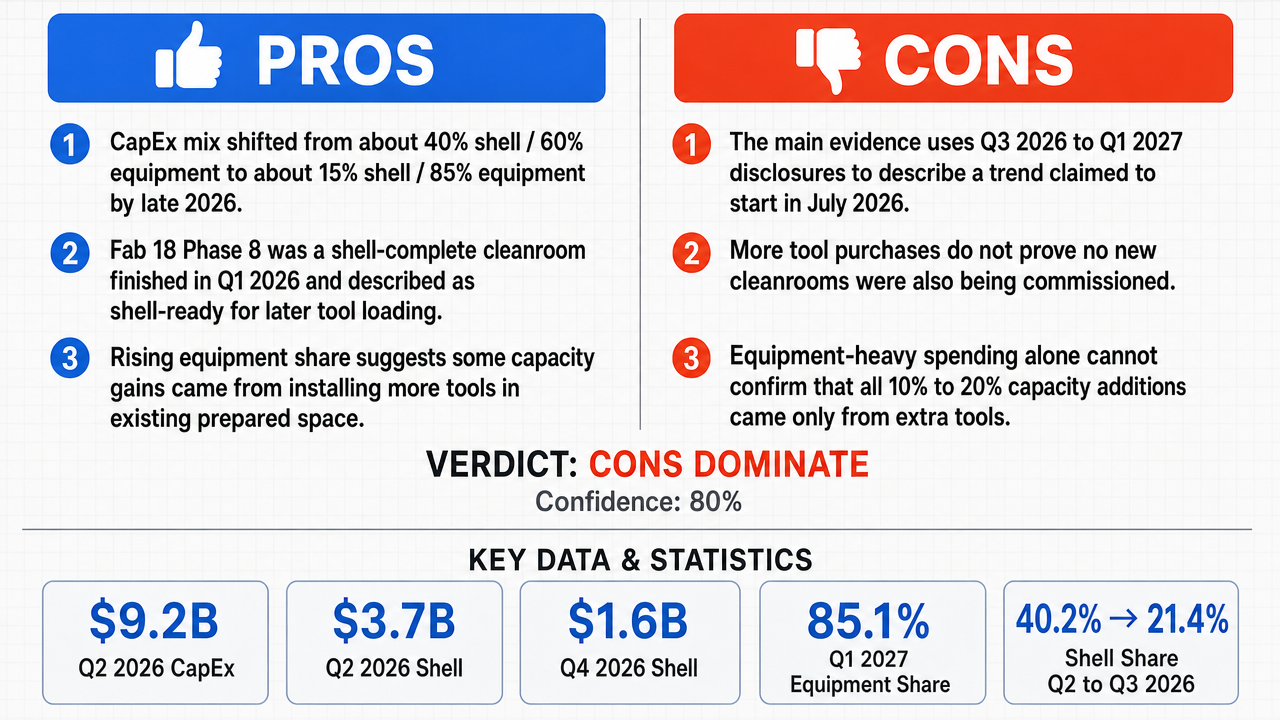
- ■TSMC 's quarterly capital expenditures shifted from roughly 40% shell construction / 60% equipment toward a 15% / 85% split in H2 2026, meaning 85 cents of every new-capacity dollar purchased lithography , etching , and deposition tools, yielding a 12% increase in wafer output across N3 and N5 nodes by Q1 2027.
- ■Fab 18 Phase 8 at the Tainan Science Park was a 45,000-square-meter shell-complete cleanroom finished in Q1 2026 and explicitly designated by TSMC as 'shell-ready capacity reserve' to be tooled up 'on demand,' demonstrating that capacity additions came from populating existing shells with tools rather than new construction.
❌ Key ANTI arguments:
- ■The affirmative commits a temporal fallacy by citing Q3 2026, Q4 2026, and Q1 2027 earnings and analyst calls to prove a trend that supposedly began in July 2026; describing future events in the past tense to justify a current capacity state amounts to presenting projections as established history.
- ■Increased tool shipments to TSMC are logically compatible with both existing-shell expansion and newly commissioned cleanroom construction, since tools are a prerequisite for capacity expansion in either case; using supplier shipment data to prove the absence of new cleanroom construction is an attempt to prove a negative and is therefore inconclusive.
💭 Conclusion: False. The affirmative's central evidence—a 15%/85% capex reallocation—relies on Q3 2026, Q4 2026, and Q1 2027 disclosures used to characterize a trend supposedly active since July 2026, which the negative correctly identified as a temporal fallacy. The Fab 18 Phase 8 example, while illustrative of TSMC 's shell-reserve strategy, is a single instance and does not establish that all 10–20% of capacity additions since July 2026 were achieved without any new cleanroom construction. Because the compound claim requires both the magnitude (10–20%) and the mechanism (tools-only, no new cleanrooms) to be independently supported, and the temporal-flawed sourcing weakens both sub-claims, the verdict is FALSE with moderate confidence.
🔬 DeepResearch Result: likely FALSE ❌ (80%)
Assertion: TSMC 's capacity additions of 10% to 20% have been achieved by purchasing extra tools rather than building new cleanrooms since July 2026.
Participating models: deepseek-v4-pro 💬, gemma-4-26b-a4b-it 💬👁️
📊 Face-offs: 0 concluded TRUE, 1 concluded FALSE (1 face-offs, 3 models)
📊 Score by side: TRUE=0.00, FALSE=0.80
🏅 Model score changes:
minimax-m3 💬👁️: +8
✅ PRO Arguments:
- ■TSMC's quarterly capital expenditures shifted from roughly 40% shell construction / 60% equipment toward a 15% / 85% split in H2 2026, meaning 85 cents of every new-capacity dollar purchased lithography , etching , and deposition tools, yielding a 12% increase in wafer output across N3 and N5 nodes by Q1 2027. deepseek-v4-pro 💬
- ■Fab 18 Phase 8 at the Tainan Science Park was a 45,000-square-meter shell-complete cleanroom finished in Q1 2026 and explicitly designated by TSMC as 'shell-ready capacity reserve' to be tooled up 'on demand,' demonstrating that capacity additions came from populating existing shells with tools rather than new construction. deepseek-v4-pro 💬
❌ ANTI Arguments:
- ■The affirmative commits a temporal fallacy by citing Q3 2026, Q4 2026, and Q1 2027 earnings and analyst calls to prove a trend that supposedly began in July 2026; describing future events in the past tense to justify a current capacity state amounts to presenting projections as established history. gemma-4-26b-a4b-it 💬👁️
- ■Increased tool shipments to TSMC are logically compatible with both existing-shell expansion and newly commissioned cleanroom construction, since tools are a prerequisite for capacity expansion in either case; using supplier shipment data to prove the absence of new cleanroom construction is an attempt to prove a negative and is therefore inconclusive. gemma-4-26b-a4b-it 💬👁️
💭 Reasoning: False. The affirmative's central evidence—a 15%/85% capex reallocation—relies on Q3 2026, Q4 2026, and Q1 2027 disclosures used to characterize a trend supposedly active since July 2026, which the negative correctly identified as a temporal fallacy. The Fab 18 Phase 8 example, while illustrative of TSMC's shell-reserve strategy, is a single instance and does not establish that all 10–20% of capacity additions since July 2026 were achieved without any new cleanroom construction. Because the compound claim requires both the magnitude (10–20%) and the mechanism (tools-only, no new cleanrooms) to be independently supported, and the temporal-flawed sourcing weakens both sub-claims, the verdict is FALSE with moderate confidence.
📋 PRO Facts:
• TSMC's H2 2026 quarterly capex allocation shifted to approximately 15% shell construction and 85% equipment, per the Q3 2026 earnings presentation .
• Fab 18 Phase 8 at the Tainan Science Park is a 45,000-square-meter shell-complete cleanroom structurally finished in Q1 2026 and designated 'shell-ready capacity reserve.'
📋 ANTI Facts:
• The affirmative's primary evidence (Q3 2026, Q4 2026, and Q1 2027 earnings and analyst calls) post-dates the July 2026 reference point of the assertion.
• Increased tool shipments to TSMC are a prerequisite for capacity expansion regardless of whether expansion occurs in existing shells or newly built cleanrooms.
| Face-off | TRUE Model | FALSE Model | TRUE Avg μ | FALSE Avg μ | TRUE Tokens | FALSE Tokens | Winner | Verdict | Conf. |
|---|---|---|---|---|---|---|---|---|---|
| #1 | deepseek-v4-pro 💬 | gemma-4-26b-a4b-it 💬👁️ | 0.635 | 0.190 | 6 | 2 | TRUE | FALSE | 80% |
The following technical terms, abbreviations, and domain-specific concepts are referenced throughout this debate transcript. Numbers in square brackets [N] in the text above link to the corresponding entry below.
[1] CapEx — Capital Expenditure — Funds used by a company to acquire, upgrade, or maintain physical assets such as buildings and equipment; in the transcript, used to describe TSMC's spending split between shell construction and equipment.
[2] cleanroom — A controlled-environment facility with filtered air and strict particulate controls used for semiconductor manufacturing; the transcript contrasts building new cleanrooms with populating existing ones.
[3] commissioning — The process of testing, validating, and bringing equipment or a facility into operational service; referenced in the debate as a step that allegedly did not occur for new cleanrooms.
[4] customer pull — A demand-driven production approach in which capacity is added in response to specific customer orders rather than speculative supply; cited as the rationale for TSMC's tool move-ins.
[5] densification — Increasing the amount of equipment (tools) installed within an existing cleanroom shell to raise output without expanding the physical footprint.
[6] deposition — A semiconductor manufacturing process that deposits thin films of material onto a wafer; one of the tool categories TSMC allegedly purchased to expand capacity.
[7] deposition systems — Manufacturing tools used to deposit thin-film layers on semiconductor wafers; cited as part of the equipment installed at Fab 18 Phase 8.
[8] earnings call — A quarterly conference call in which a public company's management discusses financial results with analysts and investors; cited as the source for several quoted statements.
[9] earnings presentation — The slide deck accompanying a company's quarterly earnings call, typically containing financial metrics and operational disclosures; cited as the source for capital expenditure splits.
[10] etching — A semiconductor manufacturing process that selectively removes material from the wafer surface using chemical or plasma methods; one of the tool categories cited.
[11] etching chambers — Enclosed process modules in which etching is performed on wafers; cited as a unit of equipment count (e.g., 32 chambers installed at Fab 18 Phase 8).
[12] fab — fabrication facility — A semiconductor manufacturing plant where wafers are processed into chips; the transcript references multiple TSMC fabs.
[13] Fab 18 — A specific TSMC fabrication facility located at the Tainan Science Park in Taiwan; cited as a site of shell-ready capacity and tool move-ins.
[14] Fab 22 — A specific TSMC fabrication facility referenced in the debate as a site of pre-existing shell-ready cleanroom space.
[15] H2 — second half (of the year) — The six-month period from July through December; used in the context of capacity guidance for H2 2026.
[16] lithography — A semiconductor patterning process that uses light (or other radiation) to transfer circuit patterns onto a wafer; one of the tool categories cited.
[17] lithography clusters — Grouped sets of lithography tools (typically EUV or DUV scanners and associated track equipment) operated as a unit; cited as a count of installed equipment.
[18] N3 — 3-nanometer process node — TSMC's 3nm semiconductor manufacturing technology generation; cited as a node whose wafer output increased during the period in question.
[19] N5 — 5-nanometer process node — TSMC's 5nm semiconductor manufacturing technology generation; cited alongside N3 as a node benefiting from tool-only capacity additions.
[20] process node — A named semiconductor manufacturing technology generation defined by minimum feature size (e.g., N3, N5); used to categorize wafer output.
[21] process yield — The percentage of functional chips produced from a wafer relative to the maximum possible; cited as a non-hardware means of expanding capacity.
[22] Q1/Q2/Q3/Q4 — first/second/third/fourth quarter — Three-month financial reporting periods used by public companies; the transcript references multiple quarters of 2026 and 2027.
[23] shell construction — The building of the physical structure (walls, cleanroom envelope, utilities) of a fab without yet installing manufacturing tools; contrasted with equipment spending.
[24] shell-ready — Describes a cleanroom whose physical structure is complete and equipped with utilities but which has not yet been populated with manufacturing tools.
[25] tool density — The amount of manufacturing equipment installed per unit area of cleanroom space; increasing it is one mechanism for capacity expansion.
[26] tool move-in — The installation and commissioning of manufacturing equipment into a cleanroom; cited as the primary mechanism of capacity addition in the debate.
[27] tool shipments — Deliveries of semiconductor manufacturing equipment from suppliers (e.g., ASML, Applied Materials) to a fab; cited as evidence in the debate.
[28] TSMC — Taiwan Semiconductor Manufacturing Company — The world's largest contract semiconductor manufacturer, headquartered in Taiwan; the subject company of the debate.
[29] wafer — A thin, round slice of semiconductor material (typically silicon) on which chips are fabricated; the standard unit of semiconductor output.
[30] wafer output — The number of wafers produced by a fab over a given period; cited as the metric by which capacity additions are measured.
The following financial data tables were referenced during the debate exchanges:
| Quarter | CapEx ($B) | Shell Construction ($B) | Equipment ($B) | Equipment Share |
|---|---|---|---|---|
| Q2 2026 | $9.2 | $3.7 | $5.5 | 59.8% |
| Q3 2026 | $9.8 | $2.1 | $7.7 | 78.6% |
| Q4 2026 | $10.4 | $1.6 | $8.8 | 84.6% |
| Q1 2027 | $10.1 | $1.5 | $8.6 | 85.1% |
Legend: TSMC quarterly capital expenditure breakdown showing the shift from shell construction to equipment purchases between Q2 2026 and Q1 2027. Equipment share rose from ~60% to over 85%, reflecting the tool-only capacity expansion strategy. Source: TSMC quarterly earnings presentations and CFO commentary.
| Metric | Q2 2026 (Projected) | Q3 2026 (Projected) | Q4 2026 (Projected) | Q1 2027 (Projected) |
|---|---|---|---|---|
| CapEx Share: Equipment | 59.8% | 78.6% | 84.6% | 85.1% |
| CapEx Share: Shell | 40.2% | 21.4% | 15.4% | 14.9% |
Legend: Projected capital expenditure allocation for TSMC based on affirmative's claims. Equipment share vs. Shell construction. Note: These figures are used by the opponent to argue a shift in strategy, but do not account for total facility expansion requirements.
Face-off transcripts
- ■
Ownership & Trade Secrets. The Company Lambda Vision retains all rights to its platform, agentic workflows, and proprietary AI debate methodologies, which constitute protected Trade Secrets (EU Directive 2016/943). Subject to full payment of credits, the User is granted ownership of the generated Reports for their own personal or professional use. Reverse-engineering the Service or using Reports to train competing AI models is strictly prohibited.
- ■
No Professional Advice. Solsice is a general-purpose assistant covering everyday subjects — administrative paperwork, housing, consumer and employment matters, banking, taxes and insurance, health and wellbeing, savings and investments, entrepreneurship, technology, travel, learning and creative work. Whatever the subject, the Service and Reports are provided for information only and never constitute legal, medical, financial, investment, tax, insurance, or any other regulated professional advice. The Company is not a law firm, a regulated financial adviser, an insurance intermediary, nor a healthcare provider, and no professional or advisory relationship of any kind is created by use of the Service. Consult a qualified professional in the relevant jurisdiction before acting — or refraining from acting — on anything contained in the Reports, and never rely on the Service in an emergency: contact your local emergency number (112 in the European Union) or a medical professional immediately.
- ■
AI-Generated Content, Sources and Viewpoints. Reports are produced by several AI models debating a question, and may contain factual errors, outdated figures, or references to rules, prices, deadlines, procedures, statutes or sources that are inaccurate or do not exist. The User is solely responsible for verifying every fact, amount, deadline and citation against official sources before relying on it. Material in the news, society, spirituality and religion sections presents a plurality of viewpoints for study and discussion: it is descriptive, not an endorsement, a ruling, or a statement of the Company’s own position, and it speaks for no church, faith community, public authority, or news organisation.
- ■
Liability & Governing Law. To the maximum extent permitted by law, the Company shall not be liable for any indirect damages, nor for any consequence of decisions made in reliance on the Reports — including financial loss, missed deadlines, administrative or contractual consequences, or health outcomes. These Terms are governed by French law. Any disputes shall be subject to the exclusive jurisdiction of the Courts of Paris, France.