
Uber Eats is not a profitable venture for the majority of its drivers in November 2026.
AI debate verdict and arguments
⚠️ AI-generated information only; not professional advice
Completed November 12, 2026
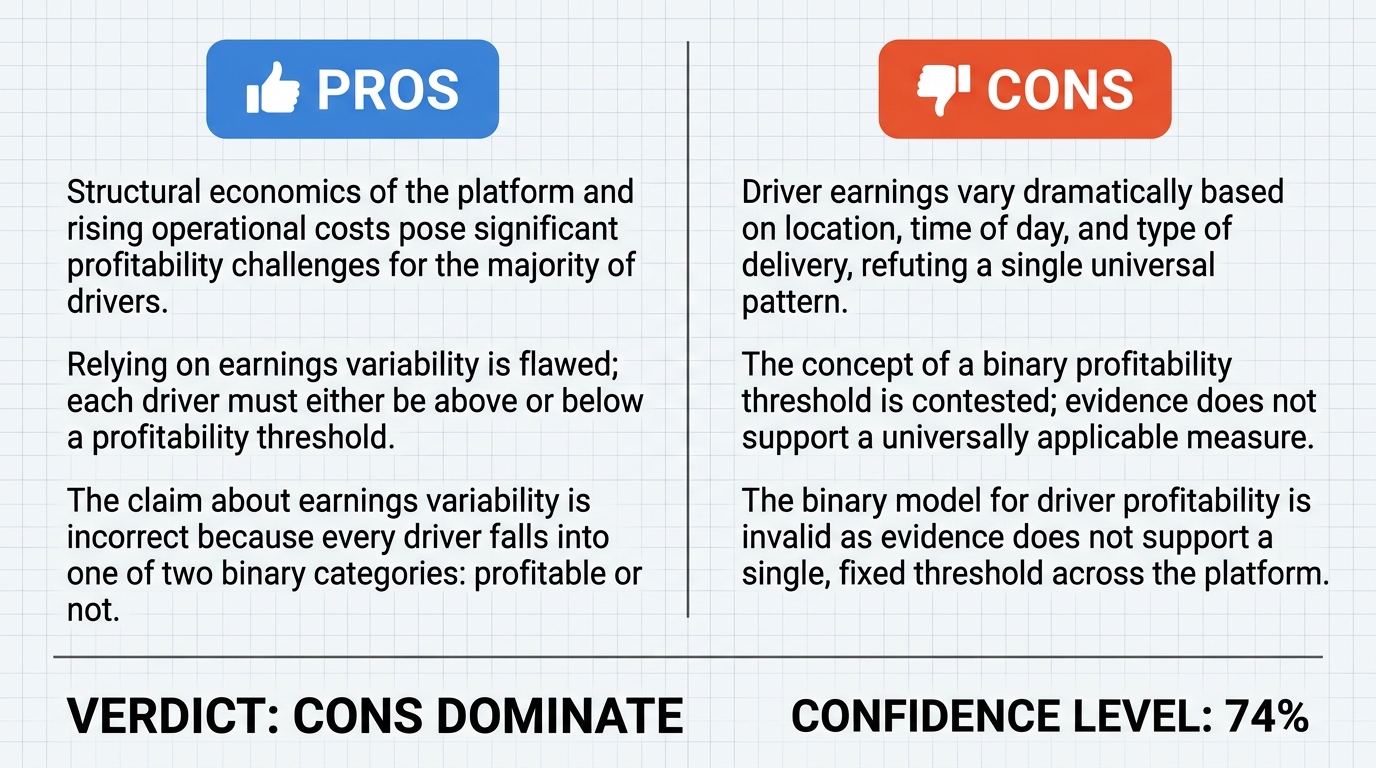
Verdict
Verdict: likely FALSE (74%)
Web Report: https://solsice.com/public/debates/uber-eats-is-not-a-profitable-venture-for-the-majority-of-it-37a80d0c68b7
This section provides a brief overview of the key arguments. You do not need to read the full detailed report below.
✅ Key PRO arguments:
- ■The structural economics and rising operational costs of the Uber Eats platform create significant profitability challenges for the majority of drivers. Drivers receive gross payouts but must personally absorb fuel, vehicle depreciation, insurance, and maintenance costs, while inflation erodes real purchasing power and high-frequency urban driving accelerates depreciation.
- ■The opponent's reliance on earnings variability is flawed because every driver is either above or below the profitability threshold. Even if a subset of drivers achieves high margins as outliers, that does not prevent the majority from falling below the threshold.
❌ Key ANTI arguments:
- ■The claim assumes a single universally applicable profitability threshold, but Uber Eats earnings vary dramatically by time of day, location, and delivery volume. The 2025 Chicago rideshare study found substantial temporal and spatial variation, with late-evening and overnight drivers earning higher per-trip and hourly rates while low-demand regions faced deficits, so the evidence does not establish that a majority are unprofitable.
- ■The binary framing of profitability is contested: available evidence does not support a single universally applicable profitability threshold. Because profitability depends heavily on circumstances such as time, location, and demand, the data do not show that the majority of drivers are unprofitable.
💭 Conclusion: False. The debate's winning side successfully showed that the assertion is not established because Uber Eats driver earnings exhibit high temporal and spatial variability rather than a uniform pattern of unprofitability. The 2025 Chicago rideshare study cited in the debate found that late-evening and overnight drivers earned higher per-trip and hourly rates while low-demand regions faced deficits, undermining any claim about a majority. The winning side also exposed the assertion's reliance on a single universal profitability threshold, which the evidence does not support. The affirmative's structural-cost argument about fuel, depreciation, and maintenance was acknowledged but did not overcome the lack of majority-level evidence. Therefore the verdict is FALSE with moderate confidence based on the single judge's 74% confidence.
🔬 DeepResearch Result: likely FALSE ❌ (74%)
Assertion: Uber Eats is not a profitable venture for the majority of its drivers in November 2026.
Participating models: gemma-4-26b-a4b-it 💬👁️, glm-4.7-flash 💬
📊 Face-offs: 0 concluded TRUE, 1 concluded FALSE (1 face-offs, 3 models)
📊 Score by side: TRUE=0.00, FALSE=0.74
🏅 Model score changes:
deepseek-v4-flash-0731 💬: +7
✅ PRO Arguments:
- ■The structural economics and rising operational costs of the Uber Eats platform create significant profitability challenges for the majority of drivers. Drivers receive gross payouts but must personally absorb fuel, vehicle depreciation, insurance, and maintenance costs, while inflation erodes real purchasing power and high-frequency urban driving accelerates depreciation. gemma-4-26b-a4b-it 💬👁️
- ■The opponent's reliance on earnings variability is flawed because every driver is either above or below the profitability threshold. Even if a subset of drivers achieves high margins as outliers, that does not prevent the majority from falling below the threshold. gemma-4-26b-a4b-it 💬👁️
❌ ANTI Arguments:
- ■The claim assumes a single universally applicable profitability threshold, but Uber Eats earnings vary dramatically by time of day, location, and delivery volume. The 2025 Chicago rideshare study found substantial temporal and spatial variation, with late-evening and overnight drivers earning higher per-trip and hourly rates while low-demand regions faced deficits, so the evidence does not establish that a majority are unprofitable. glm-4.7-flash 💬
- ■The binary framing of profitability is contested: available evidence does not support a single universally applicable profitability threshold. Because profitability depends heavily on circumstances such as time, location, and demand, the data do not show that the majority of drivers are unprofitable. glm-4.7-flash 💬
💭 Reasoning: False. The debate's winning side successfully showed that the assertion is not established because Uber Eats driver earnings exhibit high temporal and spatial variability rather than a uniform pattern of unprofitability. The 2025 Chicago rideshare study cited in the debate found that late-evening and overnight drivers earned higher per-trip and hourly rates while low-demand regions faced deficits, undermining any claim about a majority. The winning side also exposed the assertion's reliance on a single universal profitability threshold, which the evidence does not support. The affirmative's structural-cost argument about fuel, depreciation, and maintenance was acknowledged but did not overcome the lack of majority-level evidence. Therefore the verdict is FALSE with moderate confidence based on the single judge's 74% confidence.
📋 PRO Facts:
• Uber Eats drivers personally absorb fuel, vehicle depreciation, insurance, and maintenance costs.
• Inflation into the mid-2020s erodes the real purchasing power of driver earnings.
• High-frequency short-distance urban driving accelerates vehicle depreciation cycles .
• A driver's economic state is either above or below the profitability threshold.
📋 ANTI Facts:
• The 2025 Chicago rideshare earnings study (arXiv:2502.08893v1) found substantial temporal and spatial variation in earnings.
• Late-evening and overnight drivers earned higher per-trip and hourly rates in the Chicago study.
• Low-demand region drivers faced earnings deficits in the Chicago study.
• Uber Eats earnings vary dramatically by time of day, location, and delivery volume.
| Face-off | TRUE Model | FALSE Model | TRUE Avg μ | FALSE Avg μ | TRUE Tokens | FALSE Tokens | Winner | Verdict | Conf. |
|---|---|---|---|---|---|---|---|---|---|
| #1 | gemma-4-26b-a4b-it 💬👁️ | glm-4.7-flash 💬 | 0.221 | 0.379 | 2 | 4 | FALSE | FALSE | 74% |
The following technical terms, abbreviations, and domain-specific concepts are referenced throughout this debate transcript. Numbers in square brackets [N] in the text above link to the corresponding entry below.
[1] after-tax net income — Net income calculated after taxes and adjusted for vehicle operating costs, insurance, and depreciation; the negative side proposes it as a consistent profitability metric.
[2] algorithmic dispatching — Automated assignment of delivery orders to drivers; the affirmative mentions it as part of the platform's structural economics.
[3] binary framing — Treating a situation as two mutually exclusive categories; the negative contests the binary framing of profitable versus unprofitable drivers.
[4] commission — A fee taken by the platform from each transaction; the transcript refers to the platform's commission and fee model.
[5] commission and fee model — The platform's structure of charges that the affirmative argues creates a regressive income environment.
[6] depreciation cycles — Repeated reductions in vehicle value due to intensive use; the affirmative says high-frequency urban driving accelerates these cycles.
[7] dynamic pricing — A pricing model that adjusts delivery fees or pay based on demand and supply conditions; the transcript links it to the platform's commission and fee model.
[8] earnings deficits — Situations where earnings fall below costs or a benchmark; the transcript mentions low-demand region drivers faced earnings deficits.
[9] empirical studies — Research based on observed data; the negative cites the Chicago study as empirical evidence of variability.
[10] falsifiable — A claim that can be proven false by evidence; the negative argues the majority-unprofitability claim is not falsifiable without a rigorous operational definition.
[11] gross earnings — The total amount drivers receive before deducting vehicle operating costs such as fuel, depreciation, insurance, and maintenance.
[12] gross pay — Total earnings before deductions; the transcript contrasts it with net income after variable costs.
[13] gross payout — The gross amount paid per delivery before subtracting the driver's operating costs.
[14] high margins — Large profit margins achieved by some drivers; the affirmative grants a subset achieves high margins but says the majority may still be below the threshold.
[15] hourly rates — Earnings per hour of work; the transcript notes variation by time and location.
[16] inflation —
Face-off transcripts
- ■
Ownership & Trade Secrets. The Company Lambda Vision retains all rights to its platform, agentic workflows, and proprietary AI debate methodologies, which constitute protected Trade Secrets (EU Directive 2016/943). Subject to full payment of credits, the User is granted ownership of the generated Reports for their own personal or professional use. Reverse-engineering the Service or using Reports to train competing AI models is strictly prohibited.
- ■
No Professional Advice. Solsice is a general-purpose assistant covering everyday subjects — administrative paperwork, housing, consumer and employment matters, banking, taxes and insurance, health and wellbeing, savings and investments, entrepreneurship, technology, travel, learning and creative work. Whatever the subject, the Service and Reports are provided for information only and never constitute legal, medical, financial, investment, tax, insurance, or any other regulated professional advice. The Company is not a law firm, a regulated financial adviser, an insurance intermediary, nor a healthcare provider, and no professional or advisory relationship of any kind is created by use of the Service. Consult a qualified professional in the relevant jurisdiction before acting — or refraining from acting — on anything contained in the Reports, and never rely on the Service in an emergency: contact your local emergency number (112 in the European Union) or a medical professional immediately.
- ■
AI-Generated Content, Sources and Viewpoints. Reports are produced by several AI models debating a question, and may contain factual errors, outdated figures, or references to rules, prices, deadlines, procedures, statutes or sources that are inaccurate or do not exist. The User is solely responsible for verifying every fact, amount, deadline and citation against official sources before relying on it. Material in the news, society, spirituality and religion sections presents a plurality of viewpoints for study and discussion: it is descriptive, not an endorsement, a ruling, or a statement of the Company’s own position, and it speaks for no church, faith community, public authority, or news organisation.
- ■
Liability & Governing Law. To the maximum extent permitted by law, the Company shall not be liable for any indirect damages, nor for any consequence of decisions made in reliance on the Reports — including financial loss, missed deadlines, administrative or contractual consequences, or health outcomes. These Terms are governed by French law. Any disputes shall be subject to the exclusive jurisdiction of the Courts of Paris, France.