
Using GOI smart lights as DIY film lights provides a superior and cost-effective alternative to professional film lighting for low-budget productions.
AI debate verdict and arguments
⚠️ AI-generated information only; not professional advice
Completed October 18, 2026
Verdict
Verdict: likely FALSE (86%)
Web Report: https://solsice.com/public/debates/using-goi-smart-lights-as-diy-film-lights-provides-a-superio-3553cb6d700e
This section provides a brief overview of the key arguments. You do not need to read the full detailed report below.
✅ Key PRO arguments:
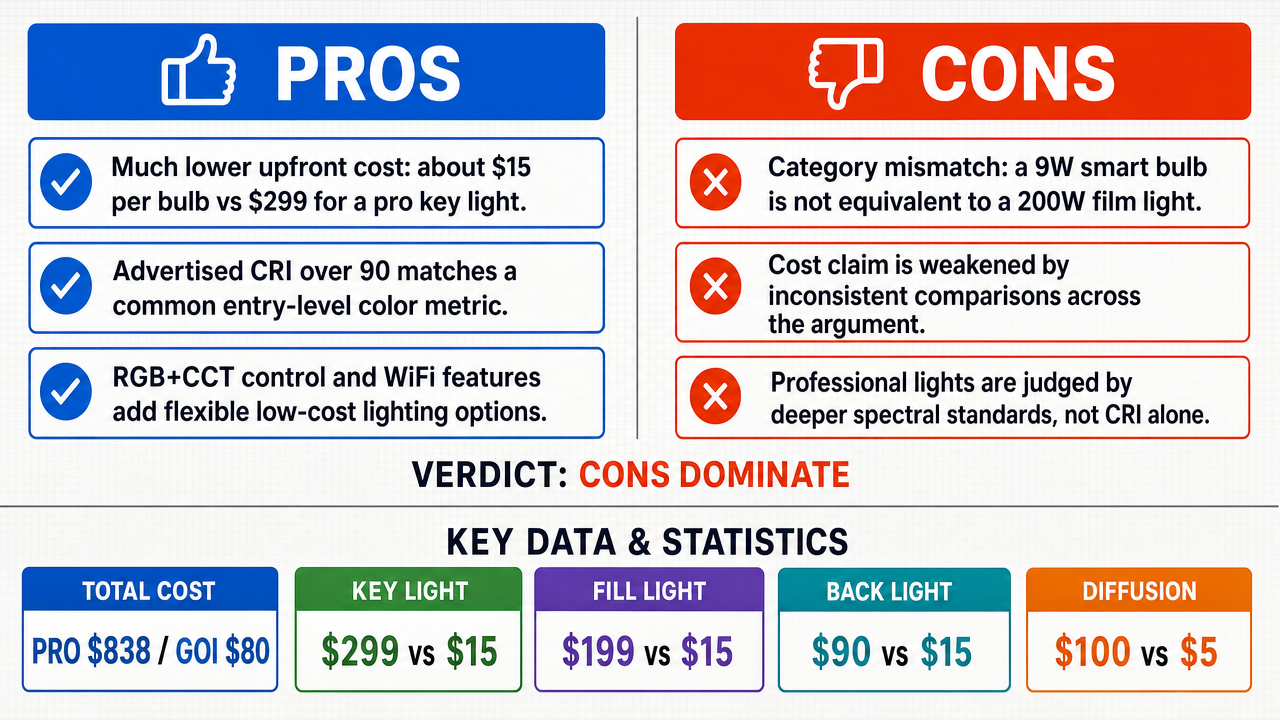
- ■GOI smart bulbs cost approximately $15 each versus roughly $300 for a single Aputure Amaran 200d professional LED panel, meaning a filmmaker can buy 20 GOI bulbs for the price of one professional fixture , enabling affordable multi-point lighting setups.
- ■GOI bulbs advertise CRI >90, which is the same headline color-fidelity metric by which entry-level professional film lights like the Aputure Amaran 200d are themselves marketed and accepted, making them adequate for low-budget productions .
- ■GOI smart bulbs offer RGB+CCT color flexibility and WiFi control, providing versatile lighting options at consumer-grade prices that reduce both capital expenditure and accessory costs compared to professional softboxes and stands.
❌ Key ANTI arguments:
- ■The affirmative commits a fundamental category error by comparing a 9W consumer smart bulb to a 200W professional LED panel; these exist in different domains of intensity and light quality, and no valid transfer operator bridges consumer lumen output to professional-grade film lighting requirements.
- ■The affirmative's cost comparison is internally inconsistent: one turn states the professional kit costs 'over $800' while the formal data table in the same turn lists the total as '$838,' creating an unstable baseline that invalidates the entire cost-benefit analysis .
- ■Professional cinema lighting is evaluated by broadcast-grade spectral metrics such as R9 and TM-30 , not merely CRI ; the affirmative's reliance on CRI >90 as proof of professional equivalence misapplies the relevant technical standards for film production.
💭 Conclusion: False. The assertion that GOI smart lights provide a superior and cost-effective alternative to professional film lighting is not supported because the affirmative's argument rests on a fundamental category error —comparing a 9W consumer bulb to an Aputure Amaran 200d professional LED panel without establishing any valid transfer operator between consumer output and professional-grade light quality. The affirmative's own cost figures were internally inconsistent ('over $800' vs $838), undermining the reliability of the cost-benefit analysis . Professional cinema lighting is evaluated by broadcast-grade spectral metrics (R9 , TM-30 ) and requires sustained output, thermal management , and DMX/flicker-free performance that consumer smart bulbs cannot deliver. While GOI bulbs are inexpensive, the claim requires both superiority AND cost-effectiveness, and the superiority component is not demonstrated by the evidence presented.
🔬 DeepResearch Result: likely FALSE ❌ (86%)
Assertion: Using GOI smart lights as DIY film lights provides a superior and cost-effective alternative to professional film lighting for low-budget productions .
Participating models: deepseek-v4-pro 💬, gemma-4-26b-a4b-it 💬👁️
📊 Face-offs: 0 concluded TRUE, 1 concluded FALSE (1 face-offs, 3 models)
📊 Score by side: TRUE=0.00, FALSE=0.86
🏅 Model score changes:
minimax-m3 💬👁️: +9
✅ PRO Arguments:
- ■GOI smart bulbs cost approximately $15 each versus roughly $300 for a single Aputure Amaran 200d professional LED panel, meaning a filmmaker can buy 20 GOI bulbs for the price of one professional fixture , enabling affordable multi-point lighting setups. deepseek-v4-pro 💬
- ■GOI bulbs advertise CRI >90, which is the same headline color-fidelity metric by which entry-level professional film lights like the Aputure Amaran 200d are themselves marketed and accepted, making them adequate for low-budget productions. deepseek-v4-pro 💬
- ■GOI smart bulbs offer RGB+CCT color flexibility and WiFi control, providing versatile lighting options at consumer-grade prices that reduce both capital expenditure and accessory costs compared to professional softboxes and stands. deepseek-v4-pro 💬
❌ ANTI Arguments:
- ■The affirmative commits a fundamental category error by comparing a 9W consumer smart bulb to a 200W professional LED panel; these exist in different domains of intensity and light quality, and no valid transfer operator bridges consumer lumen output to professional-grade film lighting requirements. gemma-4-26b-a4b-it 💬👁️
- ■The affirmative's cost comparison is internally inconsistent: one turn states the professional kit costs 'over $800' while the formal data table in the same turn lists the total as '$838,' creating an unstable baseline that invalidates the entire cost-benefit analysis . gemma-4-26b-a4b-it 💬👁️
- ■Professional cinema lighting is evaluated by broadcast-grade spectral metrics such as R9 and TM-30 , not merely CRI; the affirmative's reliance on CRI >90 as proof of professional equivalence misapplies the relevant technical standards for film production. gemma-4-26b-a4b-it 💬👁️
- ■GOI smart bulbs lack the sustained output, thermal management , DMX control, flicker-free high-frame-rate performance, and mounting ecosystem required for actual film production workflows, making them technically inadequate substitutes regardless of price. gemma-4-26b-a4b-it 💬👁️
💭 Reasoning: False. The assertion that GOI smart lights provide a superior and cost-effective alternative to professional film lighting is not supported because the affirmative's argument rests on a fundamental category error—comparing a 9W consumer bulb to an Aputure Amaran 200d professional LED panel without establishing any valid transfer operator between consumer output and professional-grade light quality. The affirmative's own cost figures were internally inconsistent ('over $800' vs $838), undermining the reliability of the cost-benefit analysis. Professional cinema lighting is evaluated by broadcast-grade spectral metrics (R9, TM-30) and requires sustained output, thermal management, and DMX/flicker-free performance that consumer smart bulbs cannot deliver. While GOI bulbs are inexpensive, the claim requires both superiority AND cost-effectiveness, and the superiority component is not demonstrated by the evidence presented.
📋 PRO Facts:
• A single Aputure Amaran 200d professional LED panel costs approximately $300.
• A GOI Smart WiFi LED Bulb (9W RGB+CCT) retails for approximately $15.
📋 ANTI Facts:
• A 9W smart bulb and an Aputure Amaran 200d professional LED panel exist in different domains of intensity and are not comparable units of measure for film production.
• The affirmative cited two different values for the total cost of a professional lighting kit ('over $800' and '$838') without correction.
• Professional cinema lighting is evaluated using R9 and TM-30 spectral metrics, not solely CRI.
| Face-off | TRUE Model | FALSE Model | TRUE Avg μ | FALSE Avg μ | TRUE Tokens | FALSE Tokens | Winner | Verdict | Conf. |
|---|---|---|---|---|---|---|---|---|---|
| #1 | deepseek-v4-pro 💬 | gemma-4-26b-a4b-it 💬👁️ | 0.407 | 0.277 | 6 | 2 | TRUE | FALSE | 86% |
The following technical terms, abbreviations, and domain-specific concepts are referenced throughout this debate transcript. Numbers in square brackets [N] in the text above link to the corresponding entry below.
[1] beam shaping — The control and modification of a light source's direction, spread, and intensity to achieve a desired illumination pattern, often cited in the debate as a capability distinguishing professional fixtures from consumer bulbs.
[2] broadcast-grade — A quality designation referring to equipment or output meeting the technical standards required for television broadcast delivery, invoked in the debate to argue for stricter spectral metrics.
[3] capital expenditure — Funds used by a business or individual to acquire, upgrade, or maintain physical assets; in the debate, used to describe the upfront cost of professional lighting fixtures.
[4] category error — A philosophical/logical concept where things from one category are treated as if they belong to another; in the debate, applied to comparing consumer bulbs with professional cinema lights.
[5] clamp lights — Inexpensive household light holders with a clamp base, cited in the debate as part of a DIY three-point lighting kit using GOI bulbs.
[6] color fidelity — The degree to which a light source accurately renders the true colors of illuminated objects, central to the debate's discussion of CRI and related metrics.
[7] correlated color temperature (CCT) — correlated color temperature — A specification of the color appearance of a light source, measured in Kelvin, indicating whether the light appears warm (yellowish) or cool (bluish); referenced via the 'CCT' in 'RGB+CCT'.
[8] cost-benefit analysis — A systematic process for comparing the costs and benefits of alternatives; the negative side argues the affirmative's cost-benefit analysis is invalid due to comparing non-comparable units.
[9] CRI — Color Rendering Index — A quantitative measure of a light source's ability to reveal the colors of objects faithfully compared to a reference light source, on a scale up to 100; the debate disputes whether CRI >90 is sufficient for film work.
[10] DIY — Do It Yourself — Refers to building or assembling something oneself rather than purchasing a finished professional product; the debate concerns DIY film lighting using consumer smart bulbs.
[11] E26 — A standard screw-type light bulb socket size (26 mm diameter), commonly used in North America; cited as the socket type compatible with GOI bulbs.
[12] fallacy of false equivalence — A logical fallacy in which two fundamentally different things are treated as equivalent for the purpose of comparison; the negative side accuses the affirmative of this when comparing a 9W bulb to a 200W panel.
[13] fixture — lighting fixture — A complete lighting unit, including the housing, lamp, and any integrated controls or optics; the debate contrasts professional fixtures with bare consumer bulbs.
[14] indie creators — independent creators — Filmmakers or content creators working outside major studio systems, typically with limited budgets; cited as the target audience for low-budget lighting solutions.
[15] key lighting — The primary and usually strongest light source illuminating a subject in a scene; cited as a task the negative argues a 9W bulb cannot adequately perform.
[16] LED — Light Emitting Diode — A semiconductor light source; both the professional Aputure Amaran 200d and the GOI smart bulbs discussed in the debate are LED-based.
[17] low-budget productions — Film or video productions operating under constrained financial resources; the debate's scope is explicitly limited to this category.
[18] lumen — The SI unit of luminous flux measuring the total quantity of visible light emitted by a source; the negative argues consumer lumen output is not comparable to professional-grade output.
[19] multi-point lighting — A lighting setup using multiple light sources positioned at different angles to shape a scene; the affirmative argues GOI bulbs enable this affordably.
[20] R9 — A specific test color sample (saturated red) within the extended CRI system, often used as a stricter indicator of red color rendering; the debate disputes whether R9 is the relevant standard for low-budget work.
[21] RGB+CCT — Red, Green, Blue + Correlated Color Temperature — A designation for LED lighting products that combine RGB color-mixing capability with adjustable correlated color temperature; describes the GOI Smart WiFi LED Bulb.
[22] softbox — A lighting accessory that diffuses and softens the output of a light source, typically used in professional film lighting; cited as a costly accessory the DIY approach avoids.
[23] spectral metrics — Quantitative measurements characterizing the spectral power distribution of a light source; the negative argues broadcast-grade spectral metrics are the proper standard.
[24] SSI — Spectral Similarity Index — A metric developed by the Academy of Motion Picture Arts and Sciences to compare the spectral output of a light source to a reference source; the negative notes the affirmative never supplies an SSI value for the GOI bulb.
[25] thermal management — The design and engineering of systems to dissipate heat generated by a light source; cited as one of the domains in which professional fixtures differ from consumer bulbs.
[26] three-point lighting — A standard film lighting technique using three light sources (key, fill, and back) to shape a subject; the affirmative proposes a DIY version using three GOI bulbs.
[27] TLCI — Television Lighting Consistency Index — A color rendering metric developed by the European Broadcasting Union specifically for television camera sensors; cited alongside CRI as a marketing claim for the Aputure Amaran 200d.
[28] TM-30 — IES TM-30 — An Illuminating Engineering Society method (TM-30) for evaluating light source color rendition using multiple fidelity and gamut metrics; the negative argues this is the proper professional standard.
[29] transfer operator — In the debate's usage, a conceptual correlation or mapping between two distinct measurement domains (e.g., consumer lumen output and professional-grade light quality) that would justify comparing them; the negative argues the affirmative fails to supply one.
The following financial data tables were referenced during the debate exchanges:
| Item | Professional Option | GOI DIY Option | Savings |
|---|---|---|---|
| Key Light | Aputure Amaran 200d ($299) | GOI Smart Bulb 9W RGB+CCT ($15) | $284 |
| Fill Light | Aputure Amaran 100d ($199) | GOI Smart Bulb 9W RGB+CCT ($15) | $184 |
| Back Light | Aputure MC ($90) | GOI Smart Bulb 9W RGB+CCT ($15) | $75 |
| Stands & Mounts | 3x Light Stands + Mounts ($150) | 3x Clamp Lights ($30) | $120 |
| Diffusion | Softbox ($100) | Parchment Paper ($5) | $95 |
| Total | $838 | $80 | $758 |
Legend: Cost comparison of a basic three-point lighting kit. Professional prices from manufacturer websites (Aputure, B&H Photo) as of 2025; GOI bulb price from Amazon. All figures in USD. Savings = professional cost minus GOI cost.
Face-off transcripts
- ■
Ownership & Trade Secrets. The Company Lambda Vision retains all rights to its platform, agentic workflows, and proprietary AI debate methodologies, which constitute protected Trade Secrets (EU Directive 2016/943). Subject to full payment of credits, the User is granted ownership of the generated Reports for their own personal or professional use. Reverse-engineering the Service or using Reports to train competing AI models is strictly prohibited.
- ■
No Professional Advice. Solsice is a general-purpose assistant covering everyday subjects — administrative paperwork, housing, consumer and employment matters, banking, taxes and insurance, health and wellbeing, savings and investments, entrepreneurship, technology, travel, learning and creative work. Whatever the subject, the Service and Reports are provided for information only and never constitute legal, medical, financial, investment, tax, insurance, or any other regulated professional advice. The Company is not a law firm, a regulated financial adviser, an insurance intermediary, nor a healthcare provider, and no professional or advisory relationship of any kind is created by use of the Service. Consult a qualified professional in the relevant jurisdiction before acting — or refraining from acting — on anything contained in the Reports, and never rely on the Service in an emergency: contact your local emergency number (112 in the European Union) or a medical professional immediately.
- ■
AI-Generated Content, Sources and Viewpoints. Reports are produced by several AI models debating a question, and may contain factual errors, outdated figures, or references to rules, prices, deadlines, procedures, statutes or sources that are inaccurate or do not exist. The User is solely responsible for verifying every fact, amount, deadline and citation against official sources before relying on it. Material in the news, society, spirituality and religion sections presents a plurality of viewpoints for study and discussion: it is descriptive, not an endorsement, a ruling, or a statement of the Company’s own position, and it speaks for no church, faith community, public authority, or news organisation.
- ■
Liability & Governing Law. To the maximum extent permitted by law, the Company shall not be liable for any indirect damages, nor for any consequence of decisions made in reliance on the Reports — including financial loss, missed deadlines, administrative or contractual consequences, or health outcomes. These Terms are governed by French law. Any disputes shall be subject to the exclusive jurisdiction of the Courts of Paris, France.