
When a platform like Twitter commands billions of eyeballs, monetization is inherently possible regardless of its initial business model.
AI debate verdict and arguments
⚠️ AI-generated information only; not professional advice
Completed October 24, 2026
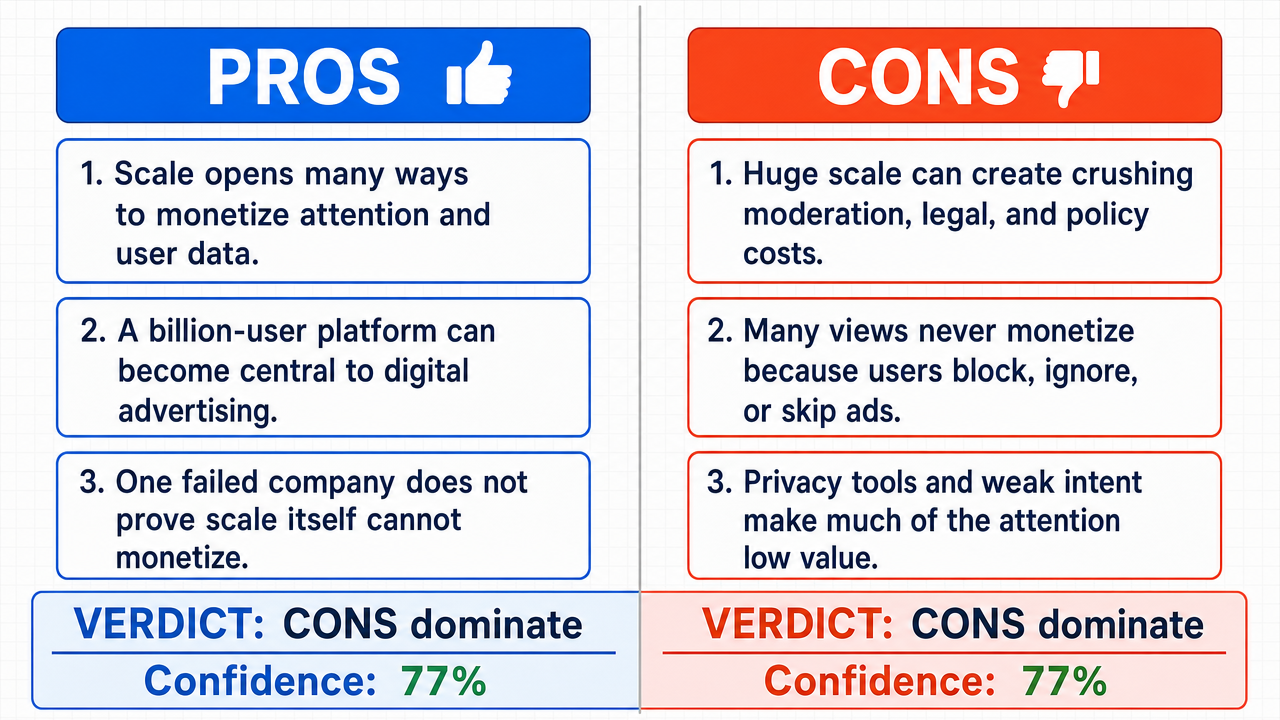
Verdict
Verdict: likely FALSE (77%)
Web Report: https://solsice.com/public/debates/when-a-platform-like-twitter-commands-billions-of-eyeballs-m-993a27cfbd2e
This section provides a brief overview of the key arguments. You do not need to read the full detailed report below.
✅ Key PRO arguments:
- ■Massive user scale guarantees monetization opportunities through diverse revenue extraction methods, because user attention and data become commodifiable assets that advertisers will pay a premium to access.
- ■When a platform reaches billions of users, it becomes an indispensable component of the global digital advertising ecosystem , regardless of whether its initial model was social networking, information dissemination, or utility.
- ■The argument that scale creates a 'liability drag ' relies on substituting the financial distress of a specific struggling corporate entity and incorrectly projecting those operational failures as a universal law of scale, lacking a causal transfer operator .
❌ Key ANTI arguments:
- ■Massive user scale creates a 'liability drag ' that can render a business model mathematically insolvent , because content moderation costs, legal claims, and political scrutiny scale exponentially with user engagement rather than linearly, creating a poverty trap where marginal costs exceed marginal revenue .
- ■The 'eyeballs ' generated by billions of users are frequently blocked, ignored, or irrelevant due to technical and behavioral barriers such as ad blockers and privacy regulations , rendering a significant portion of the user base invisible to the monetization engine.
- ■Sheer volume of user attention is not a uniformly valuable commodity; when a majority of users employ blockers or privacy tools that prevent tracking, the attention becomes valueless to advertisers and the resulting market is flooded with low-quality impressions.
💭 Conclusion: False. The assertion that monetization is inherently possible at billion-user scale regardless of initial business model is not supported, because scale introduces disproportionate liability costs and diminishing returns on attention. The winning side demonstrated that content moderation , legal exposure, and political scrutiny scale disproportionately with user engagement , potentially outpacing any revenue stream . Furthermore, the assumption that all 'eyeballs ' are monetizable ignores the widespread use of ad blockers and privacy regulations that render large portions of user attention invisible to advertisers. The affirmative's reliance on advertising as a universal monetization path fails to account for these structural barriers that can make scale a liability rather than an asset. Therefore, monetization is not inherently guaranteed by user scale alone.
🔬 DeepResearch Result: likely FALSE ❌ (77%)
Assertion: When a platform like Twitter commands billions of eyeballs , monetization is inherently possible regardless of its initial business model.
Participating models: gemma-4-26b-a4b-it 💬👁️, glm-4.7-flash 💬
📊 Face-offs: 0 concluded TRUE, 1 concluded FALSE (1 face-offs, 3 models)
📊 Score by side: TRUE=0.00, FALSE=0.77
🏅 Model score changes:
minimax-m3 💬👁️: +8
✅ PRO Arguments:
- ■Massive user scale guarantees monetization opportunities through diverse revenue extraction methods, because user attention and data become commodifiable assets that advertisers will pay a premium to access. gemma-4-26b-a4b-it 💬👁️
- ■When a platform reaches billions of users, it becomes an indispensable component of the global digital advertising ecosystem , regardless of whether its initial model was social networking, information dissemination, or utility. gemma-4-26b-a4b-it 💬👁️
- ■The argument that scale creates a 'liability drag ' relies on substituting the financial distress of a specific struggling corporate entity and incorrectly projecting those operational failures as a universal law of scale, lacking a causal transfer operator . gemma-4-26b-a4b-it 💬👁️
❌ ANTI Arguments:
- ■Massive user scale creates a 'liability drag' that can render a business model mathematically insolvent , because content moderation costs, legal claims, and political scrutiny scale exponentially with user engagement rather than linearly, creating a poverty trap where marginal costs exceed marginal revenue . glm-4.7-flash 💬
- ■The 'eyeballs' generated by billions of users are frequently blocked, ignored, or irrelevant due to technical and behavioral barriers such as ad blockers and privacy regulations , rendering a significant portion of the user base invisible to the monetization engine. glm-4.7-flash 💬
- ■Sheer volume of user attention is not a uniformly valuable commodity; when a majority of users employ blockers or privacy tools that prevent tracking, the attention becomes valueless to advertisers and the resulting market is flooded with low-quality impressions. glm-4.7-flash 💬
💭 Reasoning: False. The assertion that monetization is inherently possible at billion-user scale regardless of initial business model is not supported, because scale introduces disproportionate liability costs and diminishing returns on attention. The winning side demonstrated that content moderation, legal exposure, and political scrutiny scale disproportionately with user engagement, potentially outpacing any revenue stream . Furthermore, the assumption that all 'eyeballs' are monetizable ignores the widespread use of ad blockers and privacy regulations that render large portions of user attention invisible to advertisers. The affirmative's reliance on advertising as a universal monetization path fails to account for these structural barriers that can make scale a liability rather than an asset. Therefore, monetization is not inherently guaranteed by user scale alone.
📋 PRO Facts:
• Platforms with billions of users become part of the global digital advertising ecosystem
• Advertisers pay premiums to access specific demographics , behaviors, and interests mapped through user activity
📋 ANTI Facts:
• Content moderation and copyright defense costs scale disproportionately rather than linearly with user engagement
• Ad blockers and privacy regulations can render significant portions of a user base invisible to monetization
• Political and legal scrutiny intensifies disproportionately at billion-user scale
| Face-off | TRUE Model | FALSE Model | TRUE Avg μ | FALSE Avg μ | TRUE Tokens | FALSE Tokens | Winner | Verdict | Conf. |
|---|---|---|---|---|---|---|---|---|---|
| #1 | gemma-4-26b-a4b-it 💬👁️ | glm-4.7-flash 💬 | 0.225 | 0.358 | 4 | 4 | FALSE | FALSE | 77% |
The following technical terms, abbreviations, and domain-specific concepts are referenced throughout this debate transcript. Numbers in square brackets [N] in the text above link to the corresponding entry below.
[1] ad blockers — Software tools (browser extensions or built-in features) that prevent advertisements from being displayed on web pages or mobile apps, reducing the viewability of ads to users.
[2] capital — Financial resources or assets available to a business for funding operations, investment, or monetization efforts.
[3] commodification — The process of transforming something (such as user attention or data) into a commodity that can be bought, sold, or traded in a market.
[4] content moderation — The practice of monitoring, reviewing, and managing user-generated content on a platform to enforce policies, remove harmful material, and comply with legal requirements.
[5] copyright infringement — The unauthorized use of copyrighted material, which can create legal liability for platforms that host user-generated content.
[6] critical mass — The threshold of user adoption or market presence beyond which a product, platform, or technology achieves self-sustaining growth and network effects.
[7] data licensing — The practice of granting third parties permission to use a platform's collected user data in exchange for fees or other compensation.
[8] demographics — Statistical characteristics of a population (such as age, gender, income, location) used by advertisers to target specific audience segments.
[9] digital advertising ecosystem — The interconnected network of platforms, ad networks, exchanges, and technologies that facilitate the buying, selling, and delivery of digital advertisements.
[10] eyeballs — Industry jargon referring to the number of users or viewers who can potentially see content or advertisements on a platform; a metric of audience reach.
[11] fallacy of composition — A logical error in which one assumes that what is true of the parts is necessarily true of the whole, or vice versa.
[12] financial distress — A condition in which a company cannot meet its financial obligations or generate sufficient revenue to cover its costs.
[13] hyper-scale platforms — Digital platforms operating at extremely large scale, typically serving billions of users and requiring massive infrastructure to handle traffic and data.
[14] liability drag — A term used in the debate to describe the disproportionate growth of legal, operational, and compliance costs as a platform scales, potentially outpacing revenue growth.
[15] marginal cost — The additional cost incurred by producing or serving one more unit; in platform economics, the cost of accommodating one additional user.
[16] marginal revenue — The additional revenue generated from selling or monetizing one more unit; in platform economics, the revenue from one additional user.
[17] mathematically insolvent — A condition in which a business's liabilities exceed its assets to such a degree that recovery is considered impossible by quantitative analysis.
[18] micro-transactions — Small, often in-app purchases made by users, typically for digital goods, services, or premium features.
[19] monetization — The process of converting a user base, asset, or service into revenue, typically through advertising, subscriptions, or transactions.
[20] multi-faceted ecosystem — A business model that generates revenue from multiple distinct sources or streams rather than relying on a single revenue channel.
[21] non-commodifiable — Describing an asset or resource that cannot be easily converted into a marketable commodity or traded for value.
[22] operational architecture — The structural design of a platform's systems, processes, and workflows that determine how it operates and scales.
[23] poverty trap — A situation in which escalating costs prevent a business from achieving profitability, trapping it in a cycle of losses despite growing scale.
[24] privacy regulations — Legal frameworks (such as GDPR or CCPA) that restrict how platforms collect, process, and monetize user data.
[25] profitability — The state of generating revenue that exceeds costs, resulting in net financial gain for a business.
[26] programmatic advertising — The automated buying and selling of digital ad inventory using algorithms and real-time bidding systems, rather than traditional manual negotiations.
[27] revenue stream — A distinct source of income for a business, such as advertising, subscriptions, or transaction fees.
[28] single-stream revenue model — A business model that relies on one primary source of income, as opposed to diversifying across multiple revenue streams.
[29] sponsored content — Media or posts on a platform that are paid for by an advertiser to promote a product, service, or brand, often designed to blend with organic content.
[30] transfer operator — A term borrowed from mathematics used in the debate to describe the causal link or logical bridge required to apply findings from one case to another.
[31] user engagement — A measure of how actively users interact with a platform, including time spent, actions taken, and content consumed.
[32] utility-first — Describing a platform or product designed primarily to provide a specific functional service rather than to generate revenue directly.
[33] value proposition — The unique benefit, value, or utility that a product or service offers to its users or customers.
[34] viewability — An advertising metric measuring whether an ad was actually seen by a user, as opposed to merely being served or loaded on a page.
The following financial data tables were referenced during the debate exchanges:
| Metric | Scale Requirement | Primary Monetization Driver |
|---|---|---|
| Advertising | High (Billions) | Targeted Impressions & Reach |
| Subscriptions | Moderate (Millions) | Feature Differentiation & UX |
| Data Licensing | High (Billions) | Aggregate Behavioral Insights |
| Creator Economy | High (Millions) | Transactional Fees & Micro-payments |
Legend: Relationship between user scale and the viability of different monetization drivers.
| Metric | Fiscal Year 2023 | Notes |
|---|---|---|
| Total Revenue | $1.3 billion | Advertising and subscriptions |
| Legal and Content Moderation Costs | ~$4.0 billion | Cumulative copyright and liability settlements |
| Operating Loss | -$2.7 billion | Revenue insufficient to cover costs |
Legend: Financial performance of X (formerly Twitter) for fiscal year 2023. Revenue and costs in USD. Source: SEC filings and corporate financial reports.
| Platform Category | Scale (Users) | Primary Revenue Model | Profitability Status |
|---|---|---|---|
| Social Media (Global Leaders) | Billions | Targeted Advertising | High |
| Search & Information | Billions | Advertising / Data | High |
| Video/Entertainment | Billions | Ads / Subscriptions | High |
| Targeted Case Study | Billions | Mixed / Transitioning | Low/Negative |
Legend: Comparison of profitability status across different hyper-scale platform categories. "Targeted Case Study" refers to the specific entity cited by the opponent.
| Metric | Percentage | Impact on Ad Revenue |
|---|---|---|
| Global Ad Blocker Users (2024) | 29% of internet users | Significant reduction in viewability |
| Mobile Ad Blocker Users (iOS) | 41% | Drives decline in CPMs |
Legend: Global penetration of ad blockers indicating the size of the non-commodifiable user base. Source: Statista.
Face-off transcripts
- ■
Ownership & Trade Secrets. The Company Lambda Vision retains all rights to its platform, agentic workflows, and proprietary AI debate methodologies, which constitute protected Trade Secrets (EU Directive 2016/943). Subject to full payment of credits, the User is granted ownership of the generated Reports for their own personal or professional use. Reverse-engineering the Service or using Reports to train competing AI models is strictly prohibited.
- ■
No Professional Advice. Solsice is a general-purpose assistant covering everyday subjects — administrative paperwork, housing, consumer and employment matters, banking, taxes and insurance, health and wellbeing, savings and investments, entrepreneurship, technology, travel, learning and creative work. Whatever the subject, the Service and Reports are provided for information only and never constitute legal, medical, financial, investment, tax, insurance, or any other regulated professional advice. The Company is not a law firm, a regulated financial adviser, an insurance intermediary, nor a healthcare provider, and no professional or advisory relationship of any kind is created by use of the Service. Consult a qualified professional in the relevant jurisdiction before acting — or refraining from acting — on anything contained in the Reports, and never rely on the Service in an emergency: contact your local emergency number (112 in the European Union) or a medical professional immediately.
- ■
AI-Generated Content, Sources and Viewpoints. Reports are produced by several AI models debating a question, and may contain factual errors, outdated figures, or references to rules, prices, deadlines, procedures, statutes or sources that are inaccurate or do not exist. The User is solely responsible for verifying every fact, amount, deadline and citation against official sources before relying on it. Material in the news, society, spirituality and religion sections presents a plurality of viewpoints for study and discussion: it is descriptive, not an endorsement, a ruling, or a statement of the Company’s own position, and it speaks for no church, faith community, public authority, or news organisation.
- ■
Liability & Governing Law. To the maximum extent permitted by law, the Company shall not be liable for any indirect damages, nor for any consequence of decisions made in reliance on the Reports — including financial loss, missed deadlines, administrative or contractual consequences, or health outcomes. These Terms are governed by French law. Any disputes shall be subject to the exclusive jurisdiction of the Courts of Paris, France.