
When faced with an unresolved situation after prayer, God's answer may already be manifesting as guidance, wisdom, or strength, even if external circumstances remain unchanged.
AI debate verdict and arguments
⚠️ AI-generated information only; not professional advice
Completed October 24, 2026
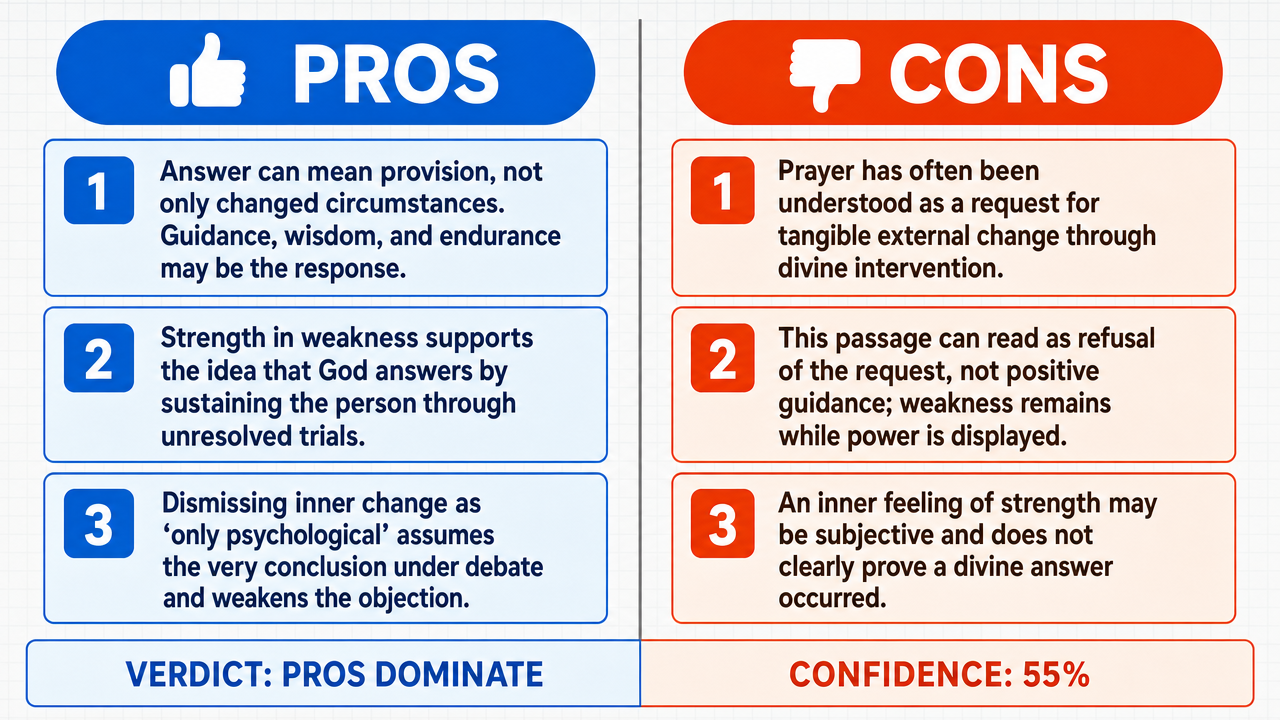
Verdict
Verdict: likely TRUE (55%)
Web Report: https://solsice.com/public/debates/when-faced-with-an-unresolved-situation-after-prayer-god-s-a-d1ad9387cf8c
This section provides a brief overview of the key arguments. You do not need to read the full detailed report below.
✅ Key PRO arguments:
- ■Theological frameworks frequently distinguish between the 'petition ' (request for change in circumstances) and the 'provision ' (response to the petitioner), with the answer to prayer including modification of the subject, not just the objective world. In Christian theology, 'grace ' is often understood as the endowment of the capacity to endure a trial rather than its removal.
- ■The Pauline doctrine of 'strength made perfect in weakness ' (2 Corinthians 12:9) suggests that the divine response is the infusion of strength to endure, aligning with the claim that God's answer may manifest as internal strength even when external circumstances remain unchanged.
- ■The opponent's argument that internal shifts are 'purely psychological' is self-contradictory: it attempts to invalidate the claim of divine manifestation by asserting such manifestations are 'non-religious mechanisms,' while using the existence of these mechanisms to argue they are mislabeled. If internal shifts are manifestations of the divine, categorizing them as merely psychological defines the phenomenon out of existence.
❌ Key ANTI arguments:
- ■Historically, prayer has often been understood as a petition for tangible, external change, reflecting belief in a God who actively intervenes in the physical world. Reducing divine answers solely to internal shifts risks spiritualizing away the very concept of intervention, rendering prayer a form of self-help or psychological coping rather than a genuine appeal to a transcendent power for external alteration.
- ■2 Corinthians 12:9 describes a divine refusal rather than a positive manifestation of guidance. The text explicitly states that power is made perfect 'in' weakness, meaning the weakness (the unresolved situation) remains. Therefore, the 'answer' in this passage is actually a refusal to alter external circumstances, not a positive manifestation of guidance or strength.
💭 Conclusion: True, the verdict favors the assertion that God's answer to prayer may manifest as internal guidance, wisdom, or strength even when external circumstances remain unchanged. The winning side effectively argued that theological frameworks distinguish between petition for external change and internal divine responses involving the modification of the subject rather than the objective world. The Pauline doctrine of 'strength made perfect in weakness ' was cited as scriptural support for the idea that endurance capacity itself can constitute a divine answer. The opponent's counter-argument that 2 Corinthians 12:9 represents a divine refusal rather than a positive manifestation was contested, though not fully refuted, leaving the judge with moderate confidence. The compound nature of the claim—encompassing guidance, wisdom, and strength as possible manifestations—means the verdict is only as strong as its weakest sub-claim.
🔬 DeepResearch Result: likely TRUE ✅ (55%)
Assertion: When faced with an unresolved situation after prayer, God's answer may already be manifesting as guidance, wisdom, or strength, even if external circumstances remain unchanged.
Participating models: gemma-4-26b-a4b-it 💬👁️, glm-4.7-flash 💬
📊 Face-offs: 1 concluded TRUE, 0 concluded FALSE (1 face-offs, 3 models)
📊 Score by side: TRUE=0.55, FALSE=0.00
🏅 Model score changes:
minimax-m3 💬👁️: +6
✅ PRO Arguments:
- ■Theological frameworks frequently distinguish between the 'petition ' (request for change in circumstances) and the 'provision ' (response to the petitioner), with the answer to prayer including modification of the subject, not just the objective world. In Christian theology, 'grace ' is often understood as the endowment of the capacity to endure a trial rather than its removal. gemma-4-26b-a4b-it 💬👁️
- ■The Pauline doctrine of 'strength made perfect in weakness ' (2 Corinthians 12:9) suggests that the divine response is the infusion of strength to endure, aligning with the claim that God's answer may manifest as internal strength even when external circumstances remain unchanged. gemma-4-26b-a4b-it 💬👁️
- ■The opponent's argument that internal shifts are 'purely psychological' is self-contradictory: it attempts to invalidate the claim of divine manifestation by asserting such manifestations are 'non-religious mechanisms,' while using the existence of these mechanisms to argue they are mislabeled. If internal shifts are manifestations of the divine, categorizing them as merely psychological defines the phenomenon out of existence. gemma-4-26b-a4b-it 💬👁️
❌ ANTI Arguments:
- ■Historically, prayer has often been understood as a petition for tangible, external change, reflecting belief in a God who actively intervenes in the physical world. Reducing divine answers solely to internal shifts risks spiritualizing away the very concept of intervention, rendering prayer a form of self-help or psychological coping rather than a genuine appeal to a transcendent power for external alteration. glm-4.7-flash 💬
- ■2 Corinthians 12:9 describes a divine refusal rather than a positive manifestation of guidance. The text explicitly states that power is made perfect 'in' weakness, meaning the weakness (the unresolved situation) remains. Therefore, the 'answer' in this passage is actually a refusal to alter external circumstances, not a positive manifestation of guidance or strength. glm-4.7-flash 💬
💭 Reasoning: True, the verdict favors the assertion that God's answer to prayer may manifest as internal guidance, wisdom, or strength even when external circumstances remain unchanged. The winning side effectively argued that theological frameworks distinguish between petition for external change and internal divine responses involving the modification of the subject rather than the objective world. The Pauline doctrine of 'strength made perfect in weakness' was cited as scriptural support for the idea that endurance capacity itself can constitute a divine answer. The opponent's counter-argument that 2 Corinthians 12:9 represents a divine refusal rather than a positive manifestation was contested, though not fully refuted, leaving the judge with moderate confidence. The compound nature of the claim—encompassing guidance, wisdom, and strength as possible manifestations—means the verdict is only as strong as its weakest sub-claim.
📋 PRO Facts:
• Classical Christian theology distinguishes between 'petition' (request for change) and internal guidance or strength as a form of divine response.
• The concept of 'grace' in Christian theology can be understood as the endowment of capacity to endure trials rather than removal of them.
• 2 Corinthians 12:9 contains the Pauline phrase 'My grace is sufficient for you, for my power is made perfect in weakness.'
📋 ANTI Facts:
• Historically, prayer has often been understood as a petition for tangible, external change reflecting belief in active divine intervention in the physical world.
• 2 Corinthians 12:9 recounts God's response that power is made perfect 'in' weakness, with the weakness remaining.
| Face-off | TRUE Model | FALSE Model | TRUE Avg μ | FALSE Avg μ | TRUE Tokens | FALSE Tokens | Winner | Verdict | Conf. |
|---|---|---|---|---|---|---|---|---|---|
| #1 | gemma-4-26b-a4b-it 💬👁️ | glm-4.7-flash 💬 | 0.504 | 0.348 | 4 | 4 | TRUE | TRUE | 55% |
The following technical terms, abbreviations, and domain-specific concepts are referenced throughout this debate transcript. Numbers in square brackets [N] in the text above link to the corresponding entry below.
[1] cognitive reappraisal — A psychological phenomenon referenced in the debate as a secular parallel to divine guidance, involving the reframing of a situation to alter its emotional or cognitive impact.
[2] conflation — The rhetorical or logical act of merging two distinct concepts into one; in the debate it is used to criticize the merging of psychological mechanisms with divine action, or of human reaction with divine response.
[3] divine intervention — The theological concept that God actively alters external circumstances or events in the physical world, contrasted in the debate with purely internal responses to prayer.
[4] doctrine of general revelation — The theological concept referenced in the debate (appearing truncated as 'doctrine of gene...') that natural processes can serve as instruments through which a divine agent communicates or acts.
[5] grace — In the debate's theological framework, understood not as the removal of a trial but as the divine endowment of the capacity to endure it.
[6] instrumentality — The theological/philosophical concept that natural processes can be utilized by a divine agent as means or tools for communication or action.
[7] Pauline doctrine — Theological teachings associated with the Apostle Paul, specifically referenced in the debate regarding the phrase 'strength made perfect in weakness' from 2 Corinthians 12:9.
[8] perceived agency — A psychological phenomenon mentioned alongside cognitive reappraisal as a secular parallel to the internal experience of divine guidance.
[9] petition — In the debate's theological framework, the specific request made to God for a change in circumstances, distinguished from the 'provision' that follows.
[10] provision — In the debate's theological framework, the divine response or supply given to the petitioner, which may take the form of internal transformation rather than external change.
[11] strength made perfect in weakness — A phrase from 2 Corinthians 12:9 cited in the debate, interpreted by the affirmative as indicating that divine power is manifested through human frailty rather than through the removal of difficulty.
[12] thorn in the flesh — A biblical reference from 2 Corinthians 12:7 to an unspecified affliction, cited in the debate as the trial whose removal Paul requested and which, according to the negative, God refused to remove.
[13] transcendent power — A divine authority existing beyond the physical or material world, referenced in the debate as the proper object of genuine prayer for external alteration.
Face-off transcripts
- ■
Ownership & Trade Secrets. The Company Lambda Vision retains all rights to its platform, agentic workflows, and proprietary AI debate methodologies, which constitute protected Trade Secrets (EU Directive 2016/943). Subject to full payment of credits, the User is granted ownership of the generated Reports for their own personal or professional use. Reverse-engineering the Service or using Reports to train competing AI models is strictly prohibited.
- ■
No Professional Advice. Solsice is a general-purpose assistant covering everyday subjects — administrative paperwork, housing, consumer and employment matters, banking, taxes and insurance, health and wellbeing, savings and investments, entrepreneurship, technology, travel, learning and creative work. Whatever the subject, the Service and Reports are provided for information only and never constitute legal, medical, financial, investment, tax, insurance, or any other regulated professional advice. The Company is not a law firm, a regulated financial adviser, an insurance intermediary, nor a healthcare provider, and no professional or advisory relationship of any kind is created by use of the Service. Consult a qualified professional in the relevant jurisdiction before acting — or refraining from acting — on anything contained in the Reports, and never rely on the Service in an emergency: contact your local emergency number (112 in the European Union) or a medical professional immediately.
- ■
AI-Generated Content, Sources and Viewpoints. Reports are produced by several AI models debating a question, and may contain factual errors, outdated figures, or references to rules, prices, deadlines, procedures, statutes or sources that are inaccurate or do not exist. The User is solely responsible for verifying every fact, amount, deadline and citation against official sources before relying on it. Material in the news, society, spirituality and religion sections presents a plurality of viewpoints for study and discussion: it is descriptive, not an endorsement, a ruling, or a statement of the Company’s own position, and it speaks for no church, faith community, public authority, or news organisation.
- ■
Liability & Governing Law. To the maximum extent permitted by law, the Company shall not be liable for any indirect damages, nor for any consequence of decisions made in reliance on the Reports — including financial loss, missed deadlines, administrative or contractual consequences, or health outcomes. These Terms are governed by French law. Any disputes shall be subject to the exclusive jurisdiction of the Courts of Paris, France.