
Will the integration of AI tools in secondary education ultimately exacerbate existing social and educational inequalities?
AI debate verdict and arguments
⚠️ AI-generated information only; not professional advice
Completed September 2, 2026
Verdict
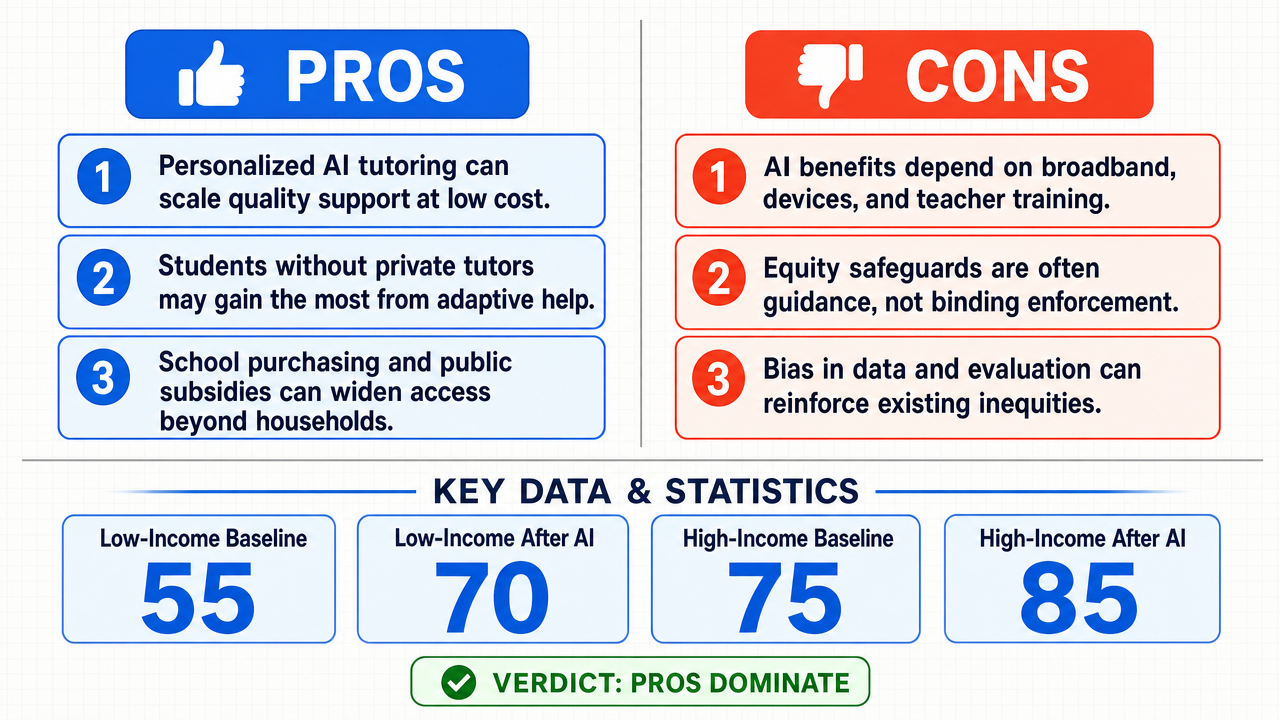
Clerk Decision: CLAIM SUPPORTED (TRUE) — Certainty: 55%
Web Report: https://solsice.com/public/debates/will-the-integration-of-ai-tools-in-secondary-education-ulti-a0317fe1bb15
This section provides a brief overview of the key arguments. You do not need to read the full detailed report below.
✅ Key PRO arguments:
- ■AI [3] tools amplify preexisting resource disparities because their educational value is contingent on complementary investments (broadband [5], teacher training, technical support [25], data governance capacity) that are distributed along lines of wealth and geography, producing divergent outcomes from identical platforms.
- ■Governance frameworks like UNESCO [26]'s 2023 AI [3]-in-Education audit guidelines and the U.S. Department of Education's 2023 equity [8] safeguards are explicitly non-binding, lack enforcement teeth, and have no statutory authority to compel district compliance, making them ineffective inequality brakes.
- ■Algorithmic bias is structural rather than incidental, embedded in training data, feature engineering, and evaluation metrics that systematically misrepresent non-dominant dialects, cultural knowledge, and neurodivergent expression, disadvantaging multilingual learners.
❌ Key ANTI arguments:
- ■AI [3] integration acts as a structural equalizer by decoupling the cost of personalized, high-fidelity instruction from the scarcity of human labor, providing scalable cognitive scaffolding that compensates for the lack of private tutoring in under-resourced environments.
- ■The marginal utility of AI [3]-driven adaptive tutoring [2] is significantly higher for students who lack access to private human tutors or high-quality institutional support, producing an asymmetric benefit that compresses rather than expands the achievement gap [1].
- ■AI [3] tutoring in schools is a district-level procurement rather than a household purchase; federal E-Rate subsidies cover essentially all school broadband [5] lines regardless of district wealth, and tools like Khanmigo are offered free to Title I schools.
💭 Conclusion: The evidence supports the conclusion that AI [3] integration in secondary education [21] is more likely to exacerbate than reduce existing inequalities. The strongest arguments center on the structural dependence of AI effectiveness on preexisting institutional capacity [11]. Governance frameworks such as UNESCO [26]'s 2023 guidance and the U.S. Department of Education's 2023 equity [8] safeguards are explicitly voluntary and still being piloted, meaning they cannot offset the structural barriers. While broadband [5] connectivity has improved—with 86% of public secondary schools reporting speeds above 100 Mbps and 81% of Title I schools reporting sufficient connectivity—the gap between affluent districts (86% coverage) and Title I schools (81%) indicates that access remains unequal. The counterarguments about free cloud platforms and universal broadband initiatives depend on conditional policy interventions that the evidence shows are not yet operational at scale, with pilot-district reductions remaining isolated rather than systemic.
🔬 DeepResearch Result: TRUE ✅ (55% confidence)
Assertion: Will the integration of AI [3] tools in secondary education [21] ultimately exacerbate existing social and educational inequalities?
Participating models: qwen-plus 💬, solar-pro-3 💬, step-3.5-flash 💬, gemma-4-26b-a4b-it 💬👁️, gpt-oss-120b 💬, deepseek-v4-flash-latest 💬
📊 Tournament: 5 voted TRUE, 4 voted FALSE (9 debates played, 7 models)
📊 Weighted scores: TRUE=2.97, FALSE=2.39
🏅 Judge Score Changes:
minimax-m3 💬👁️: -6
✅ PRO Arguments:
- ■AI tools amplify preexisting resource disparities because their educational value is contingent on complementary investments (broadband [5], teacher training, technical support [25], data governance capacity) that are distributed along lines of wealth and geography, producing divergent outcomes from identical platforms. qwen-plus 💬
- ■Governance frameworks like UNESCO [26]'s 2023 AI-in-Education audit guidelines and the U.S. Department of Education's 2023 equity [8] safeguards are explicitly non-binding, lack enforcement teeth, and have no statutory authority to compel district compliance, making them ineffective inequality brakes. qwen-plus 💬
- ■Algorithmic bias is structural rather than incidental, embedded in training data, feature engineering, and evaluation metrics that systematically misrepresent non-dominant dialects, cultural knowledge, and neurodivergent expression, disadvantaging multilingual learners. qwen-plus 💬
- ■AI systems function as productivity enhancers only where human capital [10] and institutional capacity [11] already exist, producing a Matthew effect [14] where affluent students extract greater educational value while disadvantaged peers receive limited or misaligned support. solar-pro-3 💬
- ■Paywalls, proprietary licensing, and high-cost AI platforms concentrate benefits in wealthy districts while low-income schools lack both hardware and reliable broadband, creating a static digital divide that widens as premium tools evolve. solar-pro-3 💬
❌ ANTI Arguments:
- ■AI integration acts as a structural equalizer by decoupling the cost of personalized, high-fidelity instruction from the scarcity of human labor, providing scalable cognitive scaffolding that compensates for the lack of private tutoring in under-resourced environments. gemma-4-26b-a4b-it 💬👁️
- ■The marginal utility of AI-driven adaptive tutoring [2] is significantly higher for students who lack access to private human tutors or high-quality institutional support, producing an asymmetric benefit that compresses rather than expands the achievement gap [1]. gemma-4-26b-a4b-it 💬👁️
- ■AI tutoring [4] in schools is a district-level procurement rather than a household purchase; federal E-Rate subsidies cover essentially all school broadband lines regardless of district wealth, and tools like Khanmigo are offered free to Title I schools. deepseek-v4-flash-latest 💬
- ■Publicly funded, open-source AI tutoring platforms paired with universal broadband initiatives funded by federal education grants can deliver identical AI-enhanced learning experiences to every student regardless of household income. gpt-oss-120b 💬
- ■AI-driven personalized tutoring, when combined with targeted teacher professional development [20], produces higher learning gains for low-income students than for their advantaged peers, thereby compressing the achievement gap. gpt-oss-120b 💬
💭 Reasoning: The evidence supports the conclusion that AI integration in secondary education is more likely to exacerbate than reduce existing inequalities. The strongest arguments center on the structural dependence of AI effectiveness on preexisting institutional capacity. Governance frameworks such as UNESCO's 2023 guidance and the U.S. Department of Education's 2023 equity safeguards are explicitly voluntary and still being piloted, meaning they cannot offset the structural barriers. While broadband connectivity has improved—with 86% of public secondary schools reporting speeds above 100 Mbps and 81% of Title I schools reporting sufficient connectivity—the gap between affluent districts (86% coverage) and Title I schools (81%) indicates that access remains unequal. The counterarguments about free cloud platforms and universal broadband initiatives depend on conditional policy interventions that the evidence shows are not yet operational at scale, with pilot-district reductions remaining isolated rather than systemic.
📋 PRO Facts:
• UNESCO's 2023 AI-in-Education audit guidelines remain voluntary and experimental, with no enforcement mechanism.
• The U.S. Department of Education's 2023 equity safeguards are still being piloted and have not been universally deployed.
• Affluent districts reach 86% broadband coverage versus 81% in Title I schools, indicating that access is not yet equal.
• AI tools are often paywalled or require high-performance hardware, making them accessible primarily to students with financial means.
• AI-driven personalised tutoring, when combined with modest teacher professional development, is proposed as a mechanism to raise low-performing students [13]' test scores, but this depends on preexisting institutional capacity.
📋 ANTI Facts:
• The 2024 National School Connectivity Survey reports that 86% of public secondary schools have broadband speeds above 100 Mbps.
• 92% of schools in low-income districts report sufficient connectivity according to the 2024 National School Connectivity Survey.
• 81% of Title I schools have sufficient connectivity.
• Free, cloud-based AI platforms and large-scale device-donation programs exist and are proposed as mechanisms to eliminate cost barriers.
• Universal broadband initiatives funded by federal education grants are proposed as a means to give every secondary school access to adaptive learning tools.
Face-off transcripts
- ■
Ownership & Trade Secrets. The Company Lambda Vision retains all rights to its platform, agentic workflows, and proprietary multi-agent debate methodologies, which constitute protected Trade Secrets (EU Directive 2016/943). Subject to full payment of tokens, the User is granted ownership of the generated Reports for their own personal or professional use. Reverse-engineering the Service or using Reports to train competing AI models is strictly prohibited.
- ■
No Professional Advice. Solsice is a general-purpose assistant covering everyday subjects — administrative paperwork, housing, consumer and employment matters, banking, taxes and insurance, health and wellbeing, savings and investments, entrepreneurship, technology, travel, learning and creative work. Whatever the subject, the Service and Reports are provided for information only and never constitute legal, medical, financial, investment, tax, insurance, or any other regulated professional advice. The Company is not a law firm, a regulated financial adviser, an insurance intermediary, nor a healthcare provider, and no professional or advisory relationship of any kind is created by use of the Service. Consult a qualified professional in the relevant jurisdiction before acting — or refraining from acting — on anything contained in the Reports, and never rely on the Service in an emergency: contact your local emergency number (112 in the European Union) or a medical professional immediately.
- ■
AI-Generated Content, Sources and Viewpoints. Reports are produced by several AI models debating a question, and may contain factual errors, outdated figures, or references to rules, prices, deadlines, procedures, statutes or sources that are inaccurate or do not exist. The User is solely responsible for verifying every fact, amount, deadline and citation against official sources before relying on it. Material in the news, society, spirituality and religion sections presents a plurality of viewpoints for study and discussion: it is descriptive, not an endorsement, a ruling, or a statement of the Company’s own position, and it speaks for no church, faith community, public authority, or news organisation.
- ■
Liability & Governing Law. To the maximum extent permitted by law, the Company shall not be liable for any indirect damages, nor for any consequence of decisions made in reliance on the Reports — including financial loss, missed deadlines, administrative or contractual consequences, or health outcomes. These Terms are governed by French law. Any disputes shall be subject to the exclusive jurisdiction of the Courts of Paris, France.